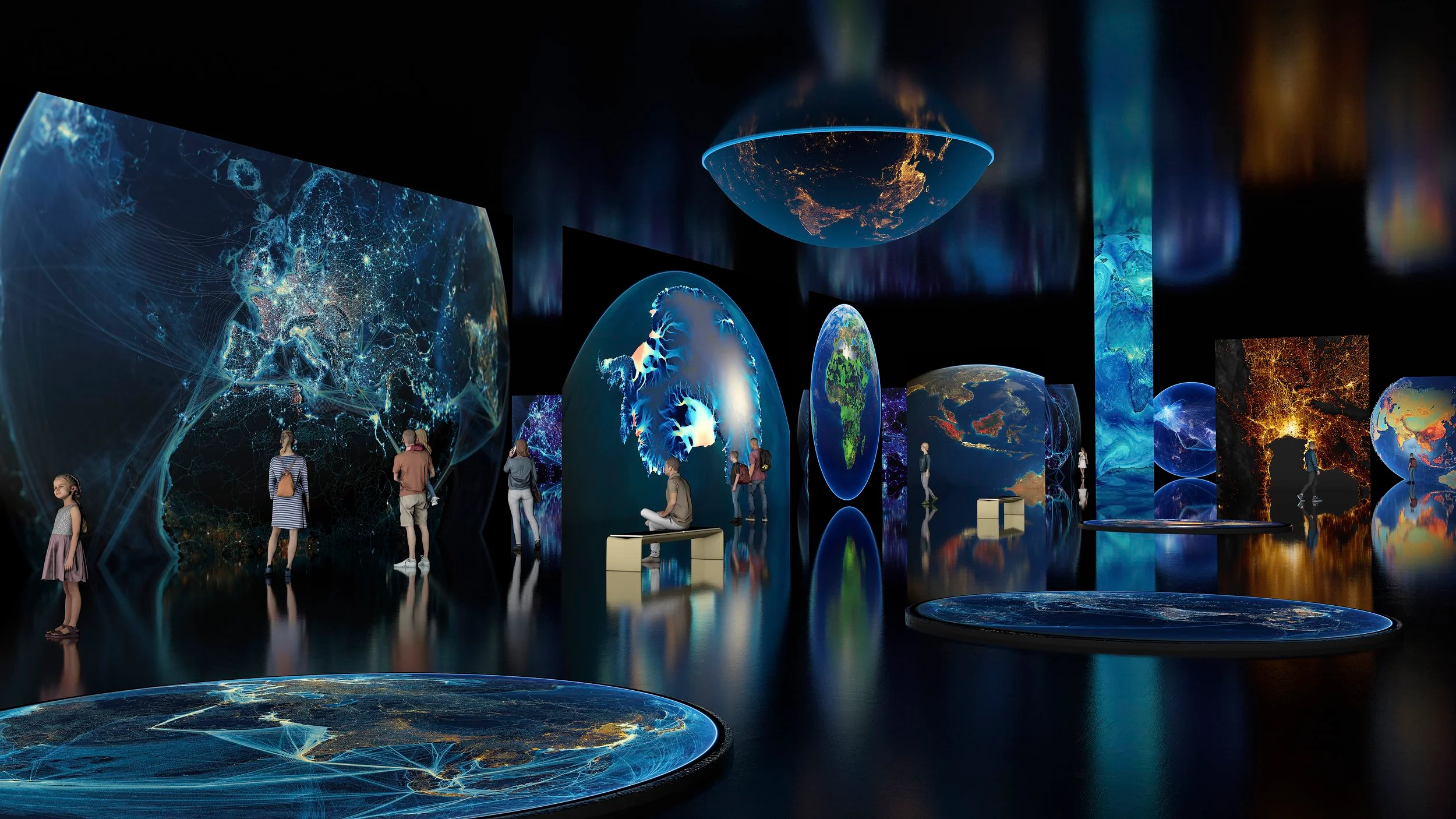
Navigating Universal Representation
The Minimum Information Representation Algorithm (MIRA) is a principle we formulated for our own work, and a procedure that follows from it.
The principle. Every visual representation of a universal concept, whether the planet, humanity, the climate or life, loses information and introduces bias. Something similar holds for all learning, as the physicist Murray Gell-Mann described it in The Quark and the Jaguar (1994). Anything that learns from the world, whether a bacterium becoming resistant to a drug, a child learning to speak or science itself, notices certain patterns in what reaches it, condenses them into a short working summary, and treats the rest as noise. That summary is how it makes sense of the world, and which patterns stand out depends on who is looking. A picture of the planet is such a summary: the question is never whether something was left out, but what, and by whom. The wider the scope of what is represented, the more must be left out, and the harder it becomes to include every perspective, place and group it concerns. No image of the whole Earth is complete, and none is seen from nowhere.
The procedure. Loss being unavoidable, it should at least be legible. Unavoidable selectivity does not make all representations equally biased or equally defensible: what separates them is whether the reader can see what was chosen. So each of our planetary representations owes its reader a minimum of information about itself:
- What it shows: the phenomenon, the period, the data and their sources.
- What it leaves out: what was simplified, aggregated, or not measured at all.
- How it was made: the choices of scale, projection, classification, colour and emphasis.
- Whose world it is: whether an aggregate “we” hides unequal causes and unequal burdens.
- Where else to look: another scale, another centre, another way of seeing the same thing.
We do not always meet this standard yet; it is the one we hold ourselves to, and we invite readers to hold us to it. Why we keep drawing the planet anyway, and how we think about the questions planetary images raise, is the subject of the essay On Seeing the Planet.
Reimagining Earth
We acknowledge the Eurocentric biases in standard cartographic conventions, such as Greenwich-centered projections and North-up orientations. These norms subtly influence global power perceptions and distort geographical relationships. Our work explores alternative representations, including South-up maps and centering traditionally marginalized regions like New Zealand. By challenging cartographic assumptions, we aim to foster a more inclusive and nuanced understanding of global geography, encouraging viewers to reconsider their perceptions of Earth’s spatial relationships and geopolitical dynamics.
Our Use of AI
Most of the writing on this site is drafted with the help of large language models, as is much of the code behind its interactive visualisations and much of the work of reshaping the datasets they draw on.
What the tools do not supply is substance. Every figure, curve and date traces to a named source — peer-reviewed literature where it exists, published institutional datasets otherwise. Where a source is silent we say so rather than fill the gap. Nothing is estimated or invented to make a visualisation look finished, nothing is published that a person has not checked, and no claim on this site originates with a machine.
That being said, we are not comfortable with this. The energy and water the datacentre industry draws are a planetary matter: we map that infrastructure on Existential Risks, trace it from quartz seam to seabed cable in Machine Intelligence Infrastructure, and follow the field’s own dangers in the AI Risks Observatory. The models were trained on work whose authors were neither asked nor credited. We give our own images away for educational use and ask two things in return — attribution, and no reworking without consent — which are exactly the conditions that kind of training sets aside. The question is not an abstract one for us. And several prominent voices in the field hold views about humanity’s future that we set our distance from.
We have decided to embrace them anyway. They let a very small organisation work at a scale, and with an inventiveness, it never thought it could reach alone — and declining them would reduce none of those harms, only the number of attempts to make planetary science legible. That judgement is provisional. If it changes, we will say so here. Anyone who wants no part of these tools has our respect.
Privacy & Data
GLOBAÏA is committed to respecting your privacy. This website does not use cookies, does not run third-party ad trackers, and does not build visitor profiles.
Analytics — We use Vercel Web Analytics and Speed Insights to understand aggregate site traffic (page views, countries, device types). These tools are cookieless and collect no personal identifiers. Visitor data is derived from an anonymized hash discarded within 24 hours.
Contact form — When you submit the contact form, your name, email address, and message are sent to our team via Resend. We use this information solely to respond to your inquiry. We do not add you to any mailing list.
Store — Product purchases are processed by Shopify. Shopify may set its own cookies during checkout. We do not access or store your payment information.
Local storage — We use your browser’s local storage for minor interface preferences (e.g., dismissing announcements, remembering access-gate status). No personal data is stored this way.
Your rights — If you have questions or wish to request deletion of any data you have shared with us, contact info@globaia.org.