GLOBAÏA is named for two ideas held together: the global and Gaïa — the planetary whole, and the living Earth. Our motto expresses the means by which we try to make that whole more intelligible and more felt: through science and art. Our logo, built around the image of Earth seen from space, reflects a simple conviction: that to understand our condition, we must learn to see our world as one.
Our Name
The name GLOBAÏA brings together two words: global and Gaïa.
It expresses a double awareness. The first is modern: Earth is a planet, a world among worlds, suspended in a vast cosmos. The second is older: Earth is not merely a stage on which life unfolds, but the living ground from which all life emerges and upon which all depends.
In ancient Greek cosmology, Gaïa (Γαῖα) names the Earth as primordial origin — not an inert object, but the generative world itself. In the oldest poetry the word carries a double sense: gaia is the substance Pandora is moulded from and the ground a tree shoots up out of, but it is also what closes over the dead. What conceals and what brings forth are one thing. Where the word itself comes from, no one has established; the proposals still contradict each other. This name for the ground beneath us reaches back past the point where language can follow it — which seems fitting.
That bond between Earth and the human condition is woven into language at its deepest layers. Greek had another word for earth, χθών (khthōn, as in “chthonic”), whose ancestry is traceable: it descends from the Proto-Indo-European word for the earth, *dʰéǵʰōm, found from Hittite to Sanskrit to Old Irish. From that same word, through a derivative meaning something like “the earthly one,” comes Latin homo, “human” — a being of the soil rather than the sky. The intuition is not confined to one language family: in Hebrew, ʾādām, “human,” stands beside ʾădāmāh, “ground.” Across many traditions, language suggests the same thing: that we are beings of this world before we are anything else. Not above it, not outside it, but of it.
By joining Gaïa to global, the name also reflects a more contemporary consciousness: that our planet must now be understood at once as a living world, a physical system, and a shared human home. GLOBAÏA thus names both an inheritance and a task: to cultivate a planetary awareness commensurate with the world we inhabit.
Our Motto
Cultivating planetary awareness through science and art
This sentence is GLOBAÏA’s verbal signature. Each of its words was chosen against alternatives, and each carries a meaning worth unfolding.
We say cultivate rather than promote: the work is patient and generational, closer to tending than to messaging. To cultivate is to tend rather than to broadcast. The verb shares its root with culture — Latin colere, to till, care for, inhabit. It implies patience and soil. Planetary awareness, on this reading, is not a message we deliver but a condition we grow, generation by generation, within the cultural ground from which any society draws its sense of the real.
We say planetary awareness rather than environmental advocacy: the scope is the whole Earth system, and the aim is a way of seeing as much as a call to act. Awareness is more than information. Facts about Earth circulate widely; the felt apprehension of living on one is rarer. Awareness is the meeting of the two — perception inflected by understanding, understanding inflected by perception.
We pair science and art rather than choose between them: rigour and imagination as joined modes, not rival ones. Science and art are paired because awareness, to become more than private, requires both. Science is how a claim about the world becomes shareable across persons — checkable, refinable, joined to a wider body of knowledge. Art is how an experience of the world becomes shareable across persons — carryable, memorable, joined to a wider body of imagination. Together they form a culture of attention. Art is the most visible of these mediums, which is why the motto names it, but the cultural project is wider: architecture, literature, music, public ritual, civic imagination — all the forms through which an awareness of Earth can take root in shared life, or fail to.
Our Logo
The “O” in GLOBAÏA is rendered as a blue marble Earth.
It echoes the iconic Apollo 17 photograph taken in December 1972 — the image that came to be known as “The Blue Marble.” Few images have done more to shape the modern planetary imagination. Earth appears in it not as territory, but as a whole: luminous, finite, without visible borders, suspended in darkness. That image remains foundational to our logo because it crystallizes a shift in consciousness. It made newly legible the fragility, beauty, and singularity of the world we inhabit.
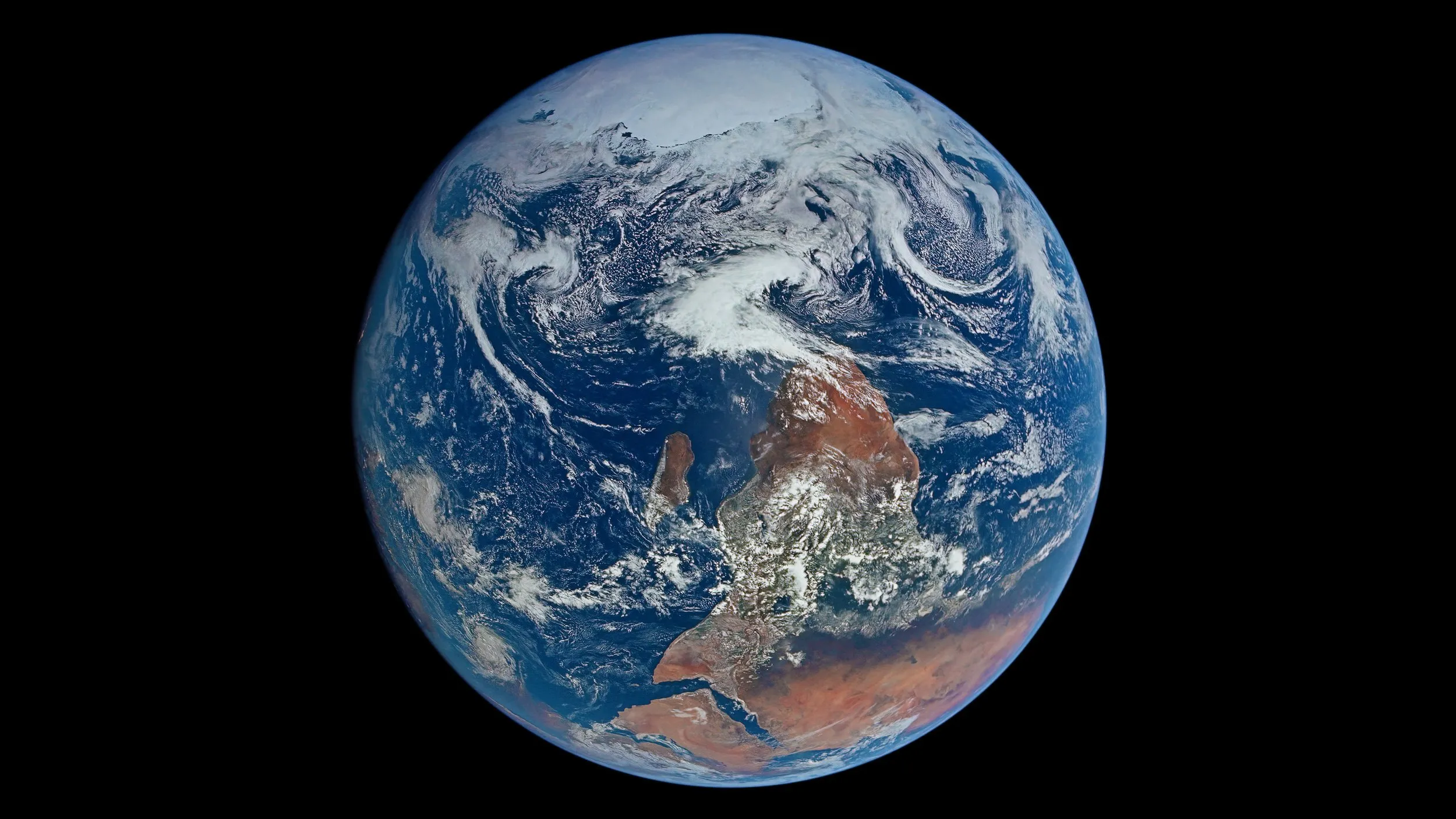
The Blue Marble — NASA’s iconic Apollo 17 photograph (AS17-148-22727), the inspiration for GLOBAÏA’s logo. Taken by the Apollo 17 crew on December 7, 1972, the original photograph showed Antarctica at the top and Africa below — because in space there is no up or down, and the crew simply happened to be oriented with the south pole overhead. NASA flipped the image before releasing it, because “south up” felt disorienting to a Northern Hemisphere-dominated audience — a quiet irony, given that the most iconic photograph of Earth as a borderless whole was immediately reframed to match our parochial cartographic convention.
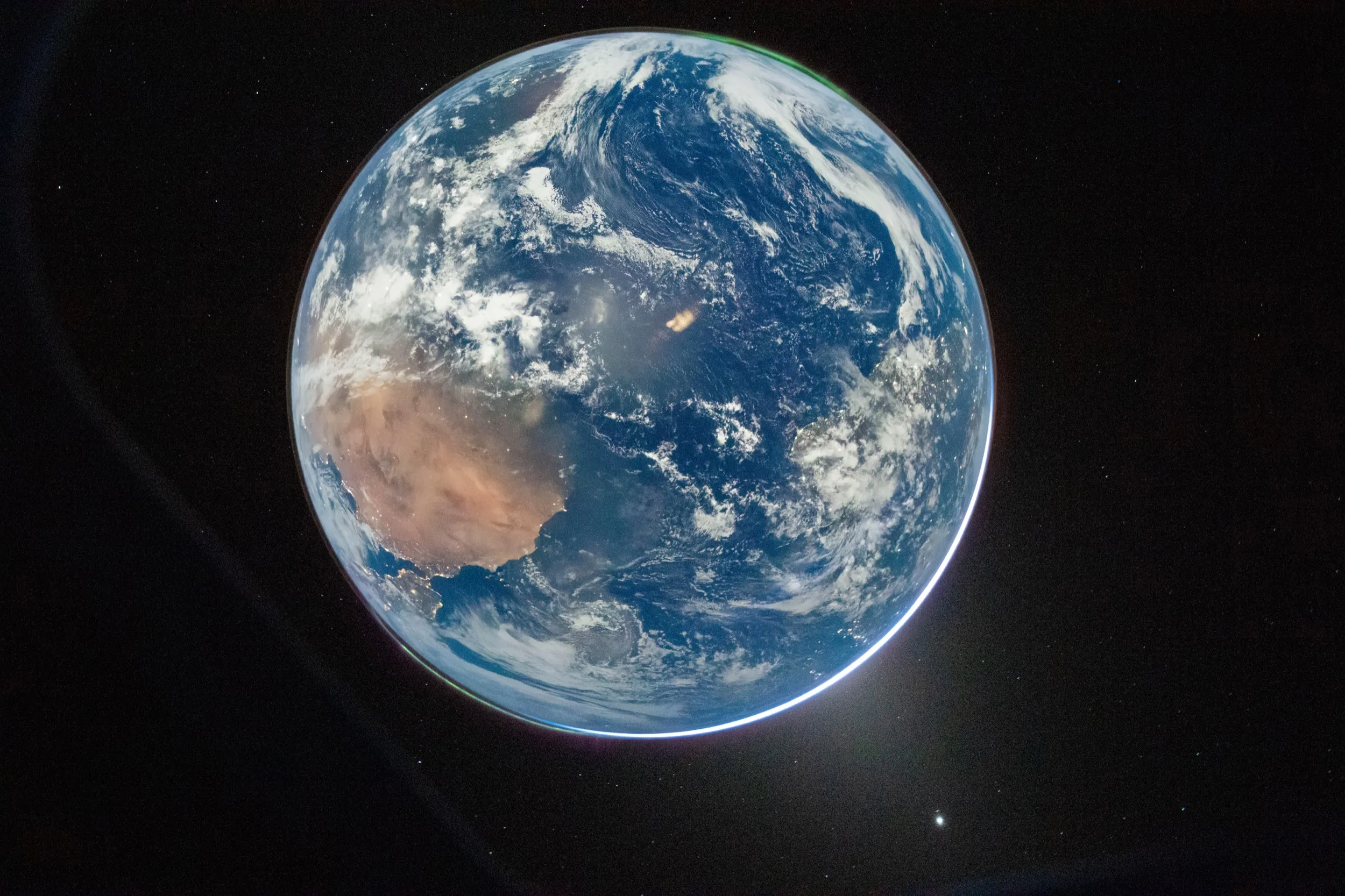
Hello, World — NASA Artemis II photograph (art002e000192), taken by mission commander Reid Wiseman on April 3, 2026 UTC. Fifty-three years after the Apollo 17 crew captured The Blue Marble in sunlight, humans once again photographed their planet whole — this time by moonlight, with Africa and the Atlantic visible through cloud bands, twin auroras glowing at opposite limbs, and Venus as a bright point below. The title borrows from programming’s universal first exercise, the line of code every beginner writes to prove their system is alive and listening — a fitting name, given that half a century had passed since anyone was far enough away to see the whole thing at once.
Our logo also includes two simple lines, evoking the Equator and the Polar Circle. These are not decorative additions. They point to one of the most basic truths of the Earth system: solar energy is unevenly distributed across the planet’s surface. From that asymmetry follow gradients of temperature, seasonality, circulation, climate, and biosphere.
In this sense, the logo is both symbolic and scientific. It suggests wholeness, but not uniformity; unity, but not sameness. It is an image of one planet shaped by difference — one world, shared yet uneven, held together by the conditions that make life possible.
One World or None
The Blue Marble was taken in 1972, the year of the first United Nations Conference on the Human Environment in Stockholm, the birth of the modern environmental movement. Hello, World arrives fifty-three years later, in an age of heightened geopolitical tensions, accelerating ecological crisis (global heating, biodiversity erosion, multiple transgressed planetary boundaries) and rapid, ungoverned technological advances, from artificial intelligence to synthetic biology. An age, in short, of polycrisis and existential stakes.
And yet — consider the sheer improbability of the world these photographs depict. A planet where liquid water has persisted for four billion years. Oceans vast enough to regulate the climate of entire continents. Tropical rainforests so dense with life that a single hectare can harbour more tree species than all of northern Europe. Coral reefs, mangrove coasts, alpine meadows, abyssal plains — each an experiment in survival, each irreplaceable. Roughly eight million species sharing a thin, luminous shell of atmosphere, locked in a web of reciprocity so intricate that the pollination of a flower and the migration of a whale are part of the same planetary metabolism. And within this living world, tens of thousands of human cultures, languages, cosmologies, musical traditions, ways of grieving, ways of celebrating, ways of making sense of the astonishing fact of being here at all. That any of this exists — that matter organised itself into birdsong, into ocean currents, into a species capable of photographing its own home from the void — is not a backdrop to the crisis. It is the reason the crisis matters.
The two photographs are separated by more than time. The Blue Marble shows the day side: oceans, clouds, continents in sunlight, a world of geology and weather with no visible trace of the species that sent the camera. Hello, World shows the night side, and with it something new. City lights are visible across the darkened surface, making human presence legible from space for the first time in an Apollo-lineage photograph. Where the 1972 image depicted a planet, the 2026 image depicts a civilization on a planet, and all the contradictions that follow.
The photograph repays close reading. The Iberian Peninsula is visible beneath the clouds, a landmass that was, for tens of thousands of years, the last refuge of the Neanderthals, our closest evolutionary cousins, whom Homo sapiens drove to extinction through competition, displacement, and the inability of a sister species to adapt fast enough to a changing world in the late Pleistocene. Below it, the Sahara, the largest hot desert on Earth, a region where mean annual temperatures are projected to exceed 29°C by the end of this century, rendering it virtually uninhabitable. The Atlantic occupies much of the frame, its waters carrying the Atlantic Meridional Overturning Circulation, a planetary heat conveyor already showing signs of weakening, with consequences for every continent. Beyond it, the Amazon basin, another tipping system under mounting thermal stress, part of an emerging cascade linking tropical forests, ocean circulation, and Antarctic ice sheets.
At the planet’s edges, twin aurorae mark the poles, produced when the solar wind interacts with Earth’s magnetosphere and excites atmospheric gases. They are a visible trace of the magnetic shield that deflects high-energy particles from the sun. Surrounding the entire globe, the thin band of airglow traces the outermost limit of the atmosphere, the last shared frontier between habitability and vacuum. On the horizon, the brightening rim of dawn announces a new day. And in the zodiacal light, Venus is visible, a world that may once have harboured oceans but was consumed by a runaway greenhouse effect, its surface now hot enough to melt lead. It sits in the same frame as a planet that is, at present, moving along a similar thermodynamic trajectory.
The image is oriented with the south up, subverting the cartographic convention that places the Northern Hemisphere at the top. In space, as the Apollo 17 crew already knew, there is no up or down. To see the world this way is to begin to see it without the filter of convention.
There is an irony in the fact that seeing our planet whole requires leaving it, escaping the ecosphere aboard machines whose exhaust scars the very atmosphere they photograph. Yet these views, captured from a place hostile to all life, remain the most direct expression of the choice that Einstein, Oppenheimer, Bohr and others laid before humanity in their 1946 book One World or None: either we learn to see Earth as a single, shared home and govern it accordingly, or we don’t. There is no second option. May these images, old and new, continue to unsettle our parochialism and invite us to reconsider our place in the cosmos and our trajectory on planet Earth — and to remember that what we stand to lose is not an abstraction but the most extraordinary thing we know of in the universe: a living world, and the wonder of being alive within it. What remains to be seen is whether we can learn to inhabit it as though what we know had become what we see and feel.