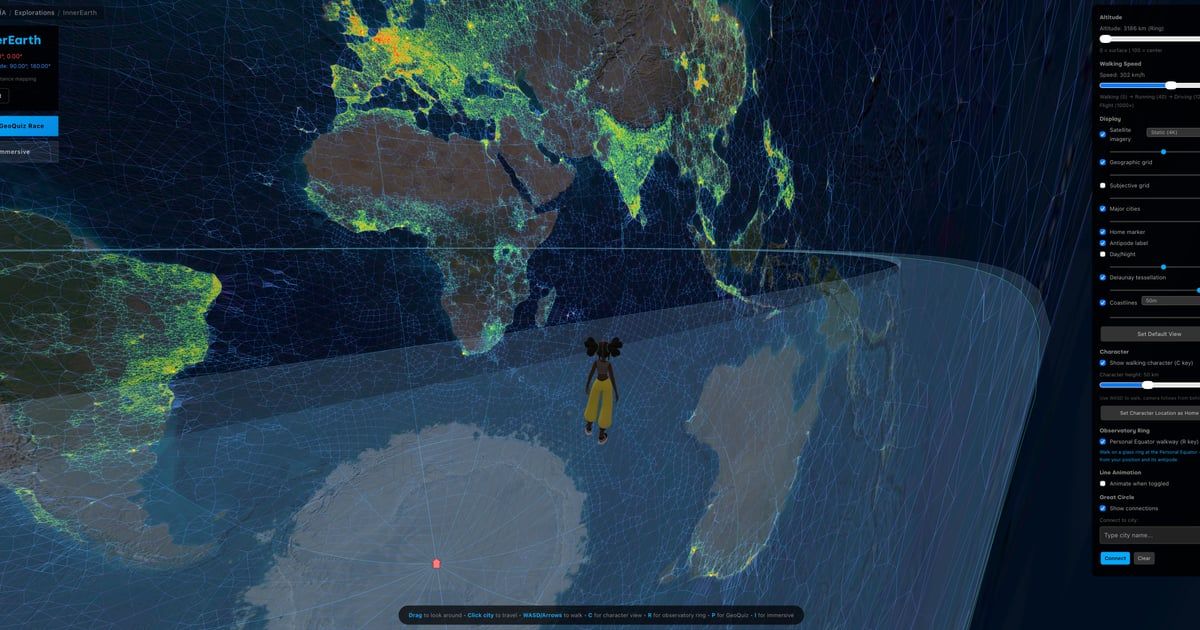
Step inside a hollow Earth and walk its curved interior — a real-scale 3D world with satellite imagery, cities, and a geo-quiz race.
Loads the 3D world
InnerEarth
For the first time in human history, we can see our entire planet without losing sight of where we stand.
This is not a metaphor. It is the central epistemological breakthrough of InnerEarth: the simultaneous visibility of the local and the global as a single, continuous perceptual field.
The Problem of the Horizon
Every representation of Earth has faced the same constraint: you cannot see everything at once.
Stand on the ground, and the horizon limits you to 5 kilometers. Climb Everest, and you reach 336 kilometers — still a fraction of Earth's surface. Even astronauts in low orbit see only a curved slice.
Maps flatten the sphere, creating edges where continuity exists. Globes preserve the curve but present an exterior surface — you see around the Earth, never within it. Zoom in and context vanishes; zoom out and detail disappears.
The horizon is not merely a visual limit. It is an epistemological boundary — a dividing circle between the known and the unknown, between here and elsewhere.
InnerEarth eliminates it.
The Inversion
InnerEarth projects Earth's surface onto the interior of a sphere, with you at the center. Your location becomes the nadir beneath your feet. Your antipode rises to the zenith above your head. Every point on Earth occupies a position in your field of view.
There is no edge. No boundary. No "off-screen." The world does not end where your sight fails; it curves upward, surrounding you completely.
The Perceptually-Scaled Planetary View
InnerEarth employs a Perceptually-Scaled Planetary View: locations near you appear in high detail — street-level, architectural, intimate — while distant regions compress gradually into continental and hemispheric patterns.
The result: you can see your neighborhood AND your continent AND your hemisphere AND your antipode simultaneously, each at a resolution appropriate to human perception.
This is not zoom. Zoom chooses between scales. InnerEarth bridges them — a continuous gradient from the intimate to the planetary, visible all at once.
What Becomes Visible
When the horizon dissolves and scales merge, phenomena that were previously abstract become perceptible:
Teleconnections — Atmospheric links between distant events traced as visible arcs across your interior sky.
Flows — Migration routes, trade networks, ocean currents — patterns that span continents become legible as the continuous paths they actually are.
Cycles — The terminator line of day and night, the seasonal pulse of vegetation across hemispheres — temporal patterns rendered spatial.
Relationships — The distance to a loved one, measured not in hours but in visible arc.
An Ancient Intuition, Finally Realized
InnerEarth was imagined in 2011 by GLOBAÏA — yet when people experience it, they often feel something strangely familiar. This is not coincidence.
InnerEarth taps into deep cultural archetypes that humans have explored for millennia. It is a seemingly timeless experience because it resonates with forms and ideas that have always been with us:
The unfamiliar feels familiar because InnerEarth fulfills what humanity has been imagining for millennia.
The horizon was never a feature of Earth. It was a limitation of our perception — a boundary we mistook for a property of the world. Now we see through it.