"The construction of the atom bomb has brought about the effect that all the people living in cities are threatened, everywhere and constantly, with sudden destruction. There is no doubt that this condition has to be abolished if [humanity] is to prove [itself] worthy, at least to some extent, of the self-chosen name of Homo sapiens."
Homo sapiens
Homo does not mean wise or thinker or maker. It means earthling — a being of the soil. The species epithet, sapiens, is another matter entirely.
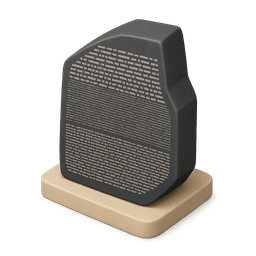
The Word Across Languages
Earthlings,
Everywhere
The PIE root *dʰéǵʰōm (earth) gave rise to the Latin humus (soil), homō (human being), and humilis (humble — literally "close to the ground"). The same root appears in Sanskrit kṣám, Greek χθών (khthōn, as in autochthonous), Lithuanian žemė, and Old English guma (man, surviving in "bridegroom").
To be human is, at root, to be of the earth. Not above it, not apart from it. Every culture has named this strange animal. Most names circle back to earth, breath, or awareness — the same intuitions, independently arrived at, across millennia and continents.
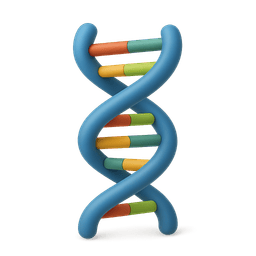
Binomial Nomenclature
Our Place in the
Tree of Life
In 1758, Carl Linnaeus published the 10th edition of Systema Naturae and gave every known species a two-part name: Genus species. The genus groups related organisms; the species epithet distinguishes one kind from its kin. It is usually a Latin or Latinized adjective describing a trait, a place, or a person.
For our species, Linnaeus chose Homo sapiens — literally "wise human." It was an act of breathtaking self-flattery. No other species names itself, and no other species would have the audacity to call itself wise. But is it accurate?
Here is the lineage that connects us to every living thing on Earth — a chain of 4 billion years of ancestry, from the Last Universal Common Ancestor to you. Tap or hover over each node to learn what changed at that branching point.
The genus Homo is settled. We are earthlings — beings of the soil. Four billion years of ancestry, from LUCA to you, place us firmly in the tree of life. But the species epithet is another matter.
Sapiens — from the Latin sapere, to taste, to have sense, to be wise. Unlike every other epithet Linnaeus assigned, this one is not a description but a claim. No other species names itself, and no other species would have the audacity to call itself wise. Where he gave the common frog temporaria (of the season) and the wolf lupus (wolf), he gave us a moral aspiration.
And that is the problem. Are we wise? The evidence is contradictory. We split the atom and dropped it on a city. We decoded the genome and are editing it before we understand it. We mapped the climate system and kept burning. If we are honest, we are not only wise. We are also foolish, destructive, magnificent, cruel, creative, short-sighted, and sometimes breathtakingly far-seeing.
So what if we could fill in the blank — Homo _______ — with something more honest? Not one epithet, but many. A rotating taxonomy of what we actually are:
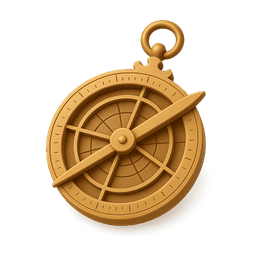
A taxonomy of what we are
Homo _______
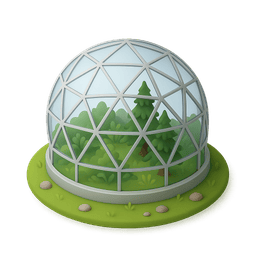
Beyond Homo
Terra sapiens
Wise Earth
All the names above belong to Homo — to us, to our species, to our self-portrait. But there may be a name beyond the species. Not Homo anything, but Terra sapiens — a Wise Earth. A planetary intelligence in which humanity and biosphere become indistinguishable.
On the Kardashev Scale, we are not yet a Type I civilization — we do not command even the full energy budget of our own planet. The Drake Equation asks whether technological civilizations survive their own adolescence, or whether they self-destruct before reaching maturity. The answer depends on whether Homo stultus or Homo sapientior prevails.
Terra sapiens is not a prophecy. It is a possibility — the idea that a planet's biosphere and its conscious species could co-evolve into a single, self-aware, self-regulating system. A Planetary Change of the Fourth Kind. We are all of the names on the wheel. The question is which ones we choose to grow into.
The road to a Wise Earth
References & Inspirations
- Cribb, Julian. Surviving the 21st Century: Humanity's Ten Great Challenges and How We Can Overcome Them. Springer, 2017.
- Frank, Adam, David Grinspoon & Sara Walker. "Intelligence as a planetary scale process." International Journal of Astrobiology 21(2), 76–81 (2022).
- Grinspoon, David. Earth in Human Hands: Shaping Our Planet's Future. Grand Central Publishing, 2016.
- Harari, Yuval Noah. Homo Deus: A Brief History of Tomorrow. Harvill Secker, 2016.
- Huizinga, Johan. Homo Ludens: A Study of the Play-Element in Culture. 1938.
- Arendt, Hannah. The Human Condition. University of Chicago Press, 1958.
- Morin, Edgar. La Méthode. Seuil, 1977–2004.
- Ord, Toby. The Precipice: Existential Risk and the Future of Humanity. Hachette Books, 2020.
- Rockström, J. et al. "A safe operating space for humanity." Nature 461, 472–475 (2009).
- The Earth Charter. earthcharter.org, 2000.
- Linnaeus, Carl. Systema Naturae. 10th ed., 1758.