01
Big History
The long unfolding of the cosmos, Earth, life, and humanity: 13.8 billion years of emergence, complexity, and contingency, from the first atoms to the first cities, told as a single coherent narrative.

The human mind evolved to meet a certain kind of danger: sudden, deliberate, and close — a predator in the grass, a rival’s raised hand, a fire already at the door. Our alarm is tuned to threats that are intentional, immoral, imminent, and instantaneous. Global change is none of these. It arrives without an enemy, so we do not mobilize against it. It rarely presents as a moral violation, appearing instead as a systemic or biophysical drift, so it stirs no outrage. It seems always distant — someone else’s problem, some later decade — so it never feels urgent now. And it unfolds by increments across many systems at once, slow enough that each new normal quietly replaces the last. A threat that is faceless, blameless, distant, and gradual slips beneath the very faculties evolution gave us to detect danger.
To this blind spot, add a mismatch of scale. The forces remaking the planet move in registers no sense was built to read: the deep time of climate, the exponential curves of the Great Acceleration, the planetary circulation of carbon and nitrogen, the quiet unravelling of the living systems that hold civilization aloft. We are transforming a world we cannot directly perceive. And so beneath today’s converging crises lies a failure that is not only political or technical but perceptual — a gap between the planetary reach of what we do and the narrow compass of what we see and feel. No society can steward what it cannot perceive, or hold dear what it has never been shown.
Here is GLOBAÏA’s wager. Each of us apprehends the world through a worldview — cosmovisión in Spanish, Weltanschauung in German — inherited, largely unconscious, rarely examined, yet decisive in what we notice, value, and choose. Alongside institutions and technologies, these frames of perception are among the most powerful levers through which societies change. This is not only an intuition. Across the experimental record, the messages that move people toward planetary action are not the ones that supply more facts, but the ones that reach them morally and aesthetically: a sense of what is owed, and the beauty of the living world. Images outperform words. Wonder outperforms evidence. To render the Earth system legible and felt is not ornament added to the real work of transformation; it is part of that work. Every image we make is an attempt to close the distance between how we live and what we know — so that a civilization might, at last, see the planet it inhabits, and inhabit it as it is: finite, dynamic, interconnected, and shared.
GLOBAÏA gives form to planetary reality. As kosmographers at the intersection of science and art, we create the intricate planetary visualizations, animated films, maps, timelines, interactive experiences, and conceptual frameworks that render the Earth system legible and felt — in service of scientists, educators, civil-society networks, and a wider public learning to inhabit the Anthropocene.
GLOBAÏA was born from urgency — the urgency to understand, and the urgency to act.
We live at a moment when human activity alters the Earth system at planetary scale: crossing critical thresholds, reshaping the very conditions under which civilization emerged, and outpacing the institutions meant to govern change. Across the world, vast international teams of scientists now work in concert to map these trends, and an unprecedented portrait of the biosphere has come into focus — measured, modelled, and cross-checked as never before in human history.
And yet history is unkind to societies that hold such knowledge and fail to act on it. A civilization meets a problem of this magnitude in four movements, and can falter at each. It must anticipate what has not yet arrived — hardest where there is no memory of a like event, where the past has been forgotten, or where a false analogy dresses the unfamiliar in familiar clothes. It must perceive the problem already underway — yet its origins may lie beyond the reach of available instruments, its stewards too far from the source, its signal a slow trend buried in loud fluctuation. This is creeping normalcy, and its companion, landscape amnesia: each degraded baseline mistaken for the natural order, the horizon forgotten even as it shifts. It must then find a remedy — against the grain of interests that reward the individual for what impoverishes the whole: the tragedy of the commons, the prisoner’s dilemma, the cold arithmetic of collective action in which what is rational for each is ruinous for all. And at last it must apply that remedy, in time and at scale, before the window closes.
Each is a distinct competence, and each can fail on its own. GLOBAÏA works, humbly, near the front of that chain — on foresight and perception: giving the planetary sciences form, atmosphere, and reach, and carrying what they disclose into the places where meaning is actually made. We do not imagine that seeing is enough — the effect of any single image is small, and we would mistrust anyone who claimed otherwise. But it is real, it compounds with repetition, and it does not stop at private conduct: what moves a person to change how they live moves them just as much to demand that their society change. Nothing else begins without it.
At the intersection of science, art, and philosophy, we act as an incubator for new representations of the world — maps, timelines, interactive visualizations, and conceptual frameworks adapted to contemporary socio-ecological realities. As kosmographers*, we give form to the invisible: the deep-time rhythms of climate, the acceleration of human enterprise, the fragile boundaries that sustain life. We translate complexity into imagery that crosses language and culture — because a shared planet demands a shared way of seeing.
Science reveals structures, relationships, limits, and trajectories that would otherwise remain obscure. Art gives form, atmosphere, and emotional resonance to what science discloses. This is not a division between the serious half and the decorative half. What science discloses, people receive through feeling — and awe, more than argument, is what has been shown to move them.† Together, they foster a more lucid, embodied, and widely shared understanding of Earth and our place within it.
Through these means we create visual narratives for scientists, educators, filmmakers, and institutions — including as part of the ‘Third UN,’ the informal networks of researchers and civil-society organizations that shape global policy. Our work has reached audiences through Netflix, BBC, TED, and the scientific community, always in service of the same goal: making the state of the planet legible, felt, and impossible to ignore.
This is the emerging discipline of planetary communications — translating Earth-system science into forms that land and lead to action. It is the work GLOBAÏA has pursued for over a decade, and the through-line of everything on this site.
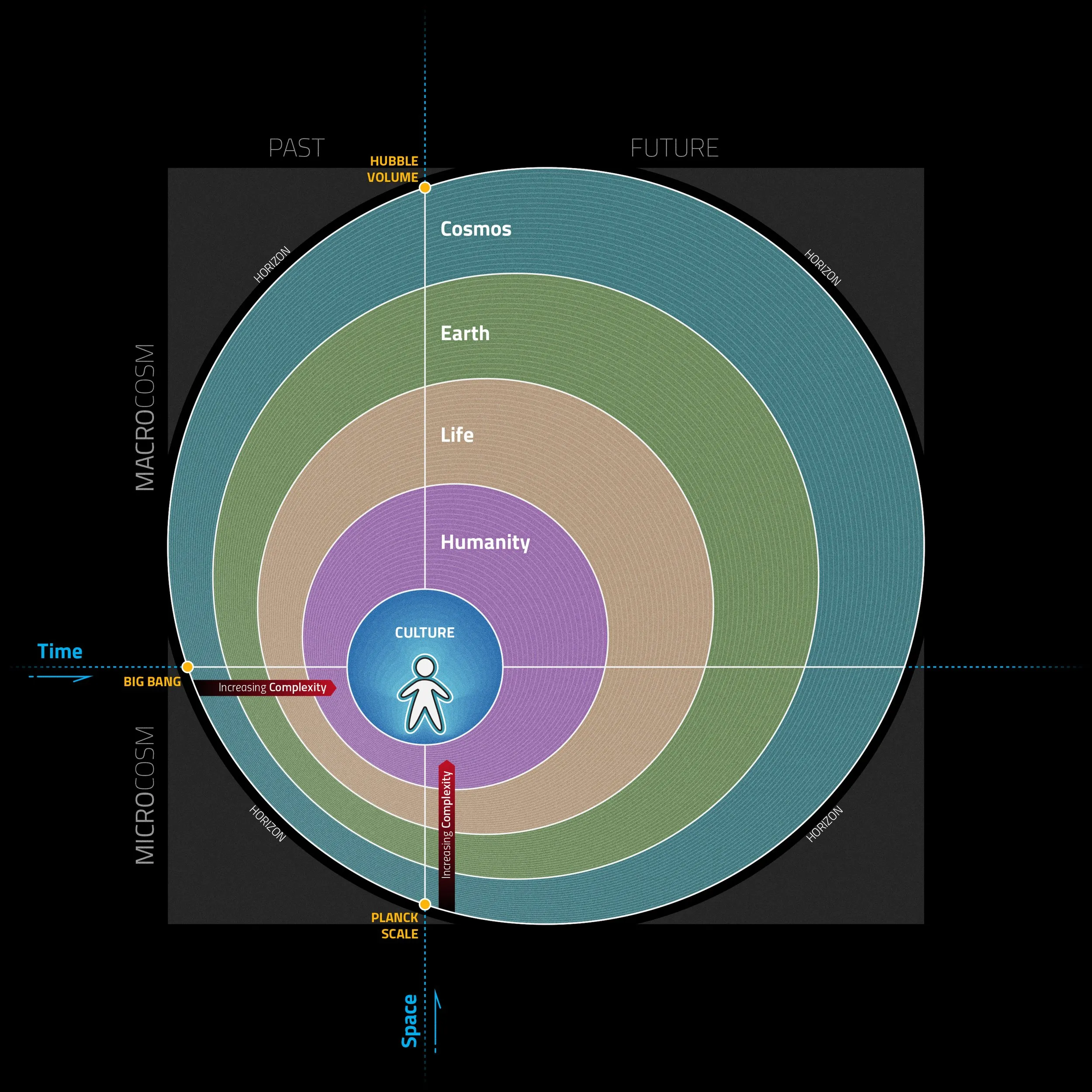
Our work explores four interwoven themes — windows onto a single coherent question: how do we learn to inhabit Earth as it is?
The long unfolding of the cosmos, Earth, life, and humanity: 13.8 billion years of emergence, complexity, and contingency, from the first atoms to the first cities, told as a single coherent narrative.
The conditions, processes, and interdependencies that sustain Earth system habitability: the climate patterns, biogeochemical cycles, and ecological relationships within which all societies are embedded and on which all economies depend.
The era in which human activity has become a geological force, reshaping planetary systems at rates unprecedented in Earth's history: the Great Acceleration, biodiversity loss, and the convergence of socio-ecological crises that define the present moment.
The search for pathways toward a just, regenerative, and enduring future: the governance frameworks, ethical commitments, and civilizational reorientations needed to sustain both human flourishing and a thriving biosphere.
These themes converge in the idea of cosmophany: the view that the formation of societies and the development of civilizations should remain grounded in an attentive understanding of observable reality — its structures, processes, patterns, cycles, and phenomena. Durable civilizational progress cannot be built on illusion, denial, or estrangement from the world, but must remain answerable to the widest and most rigorous understanding we can attain of Earth, life, and the cosmos.
To render the planet legible is also to take a position on the future it points toward. GLOBAÏA’s is not the techno-utopian dream of transcending Earth or leaving it behind, but the older, humbler aspiration of belonging to it well. A liveable future must be ecologically and socially just at once — attentive to those least responsible for the planetary crises and most exposed to them, and answerable to the many cultures, cosmovisions, and ecological wisdoms through which humanity has long known its world. And we count the more-than-human within that world: the other lives, systems, and kinships with which our own is inseparably bound. A planet seen whole is a planet shared — not a resource to escape, but a home to inhabit.
The Anthropocene has begun. To navigate it as enlightened beings demands an exceptional vision.
Wo aber Gefahr ist, wächst das Rettende auch.
Where danger grows, so too grows what saves.
— Friedrich Hölderlin, Patmos (1803)
*A kosmographer, from the Greek kosmos (order, world) and graphia (writing, drawing), goes beyond traditional cosmography. It is an interdisciplinary practice that merges science, philosophy, and the arts to portray the known world as an interconnected, evolving, and aesthetically coherent whole.

GLOBAÏA is guided by the principles of the Earth Charter, a declaration of fundamental ethical principles for building a just, sustainable, and peaceful global society.
An immersive, soothing voyage to abstract infinity awaits. Best with long, slow space-ambient music — whatever lets you drift — your screen full, and nothing asked of you for a while.