
A vision
Centre for Planetary Stewardship
A civic organ for thinking planetarily. One design among many, and the first of many.
Published · GLOBAÏA
There is no house for the planetary.
We have institutes that study the Earth system and museums that tell its past. We have planetariums that show the sky and science centres that explain it. There is still no public place devoted to the planetary itself: to Earth as one living system that we belong to, depend on, and are now changing.
The science has never been clearer, or easier to find. What is missing is somewhere to meet it, and one another. A place in the city where anyone can walk in, sit down, and come to feel what it means to live on one living, finite world, and to work out, with others, what to do about it.
Each of us is now a planetary steward, whether we chose to be or not.
Together, eight billion people have become a force that moves the climate, the oceans and the web of life. Ours is the first generation to understand this, and the last with a real chance to steer it.
An organ, not a monument.
Societies grow organs for what they must do together. Libraries hold memory. Courts weigh conflict. Parliaments deliberate. Hospitals care. Observatories watch the sky. Each is a building, and each is also a habit a society keeps. For the one condition that now shapes all the others, the state of the Earth system, the city has no such organ.
The Centre for Planetary Stewardship is proposed as that organ. Like a living one, it does a few things continuously:
-
Perceive
Make the Earth system perceptible at human scale: from orbit under the dome, underfoot in the court, all at once in the Situation Room below it, overhead on a dark night.
-
Digest
Turn the flood of science into meaning people can hold: books, images, exhibitions and stories, made with care and in public.
-
Deliberate
Give citizens a room to argue about what to do, with the evidence present and the stakes shared.
-
Tend
Practise care where it can be touched: soil, water, food, a forest in the middle of a city.
It is neither a museum of the planet nor a campaign. It is social infrastructure: the kind of shared place that decides, more than any message, whether people meet, trust one another and act together.1 Its purpose is to make planetary thinking ordinary, part of a city’s daily life.
Why knowing is not enough.
For decades, much environmental communication assumed that people act once they know. The evidence says otherwise.
Information alone changes little.
- What they see others doing
- What they feel
- What they practise
- Whether their efforts join with others’
Most adults learn science not at school but by choice: in museums, libraries, conversations and the media.4 And distance matters. The further away climate change feels, in space, in time and in social circle, the less people engage with it.5
The answers to climate change and biodiversity loss are largely known. What remains is harder: changing hearts, minds and the rules of the game, the norms, prices, laws and technologies that decide how eight billion people eat, move, build and consume.
So the Centre does not bet on another report. It bets on proximity: making the planetary near, shared and practised, in a place people come back to, the way they come back to a library or a café. No single exhibition or show changes much on its own, and the measured effects of communication are modest. A place works through repetition, over years, across a whole city.
The majority that cannot see itself.
69% of people, across 125 countries, would give 1% of their income to act on climate change.
43% is how many they believe their fellow citizens would.
Nine in ten want their governments to do more. Yet in every country surveyed, people underestimate how much the people around them care.6 In the United States, supporters of major climate policies outnumber opponents two to one, and Americans believe the reverse.7
The concern is shared; the sharing is invisible.
That gap matters because norms move in jumps. In controlled experiments, a committed minority of about a quarter of a group was enough to overturn an established convention.8 In whole societies, such tipping runs through norms, education and institutions, the slow infrastructure of shared life.9 A place where people gather around the planet every day, in plain sight, is one of the simplest ways to let the majority see itself.
Why now.
- +1.5 °C the first full year beyond 1.5 °C of warming, 2024
- 7 of 9 planetary boundaries crossed, of nine, in 2025
- −73% average fall in monitored wildlife populations since 1970
- 59% of 16-to-25-year-olds in ten countries very or extremely worried about climate change
In 2024 the world was, for the first time over a whole year, more than 1.5 °C warmer than before industrialisation.10 Six of the nine planetary boundaries were found crossed in 2023; with ocean acidification, the count in 2025 was seven.11,12 Monitored wildlife populations have fallen by almost three quarters since 1970.13 Wars, pandemics and record inequality have fused with these into a polycrisis, while artificial intelligence reorganises how knowledge is made and shared. Modern medicine, abundant food and instant communication are real achievements, and they rest on the same Earth system; they will last only if the ideas and rules built into our institutions and technologies change with them.
Across ten countries, 59% of people aged 16 to 25 say they are very or extremely worried about climate change, and many feel their governments are failing them.14 Reports are not what is lacking.
What is lacking is a culture able to hold all of this without despair.
A planetary culture, rooted in places, where awareness can become care and care can become stewardship. Contact with living places, especially in childhood, is associated with constructive hope rather than paralysis.15
Planetary, not global.
The global is what we built: markets, networks, institutions spanning the world. The planetary is what all of it stands on. It is Earth as a living, integrated metabolic system, running through atmosphere, oceans, rock, life and now the technosphere, across deep time and at every scale, from the microbial to the whole Earth. It exists independently of us, and it is increasingly shaped by us. Humanity lives inside the biosphere, not beside it.16
A Centre for Planetary Stewardship is a place to learn to see the planetary through the global, and to act accordingly. The full definition is in the Planetary Lexicon.
What stewardship asks.
Planetary stewardship is the conscious, active care of the Earth’s life-support systems, for the people alive now and for those not yet born: learning, together, to be a wiser and kinder presence on the only living world we know.
It is less a new idea than a scattered one. Indigenous nations have practised it for millennia. Youth movements demand it, social justice movements insist that it be fair, and the United Nations, in Our Common Agenda, asks governments to act for future generations. But these threads rarely meet, and they are unevenly spread. The Centre is where they can meet, and where a worldview can become a way of life. It serves that worldview in three modes at once:
-
Observatory
Watches how planetary thinking spreads, and where it stalls.
-
Laboratory
Tries new ways to make the planet felt, understood and cared for.
-
Accelerator
Carries what works into schools, media, institutions and the rooms where decisions are made.
What we believe.
The Centre for Planetary Stewardship began as a short manifesto. Its mission has not changed: to create and curate new narratives that help humanity choose to enhance its life-support system rather than wear it down.
- We believe the twenty-first century is a critical century for humanity.
- We believe humanity’s future on Earth will be more peaceful, more prosperous and more stable if we become planetary stewards sooner rather than later.
- We believe people need new narratives of hope, inspiration and optimism to build that future.
- We believe planetary stewardship is already here, in places, but unevenly distributed: in youth movements, in the scientific community, in Indigenous wisdom, in the United Nations.
- We believe planetary stewardship is possible, on the best available evidence.
- We believe the task is to change the narrative, to change hearts and minds, and to change the rules of the game: the civilisational codex.
- We believe it can be done through science and storytelling.
Our choice is to become better Earthlings, or not to be at all.
A day at the Centre.
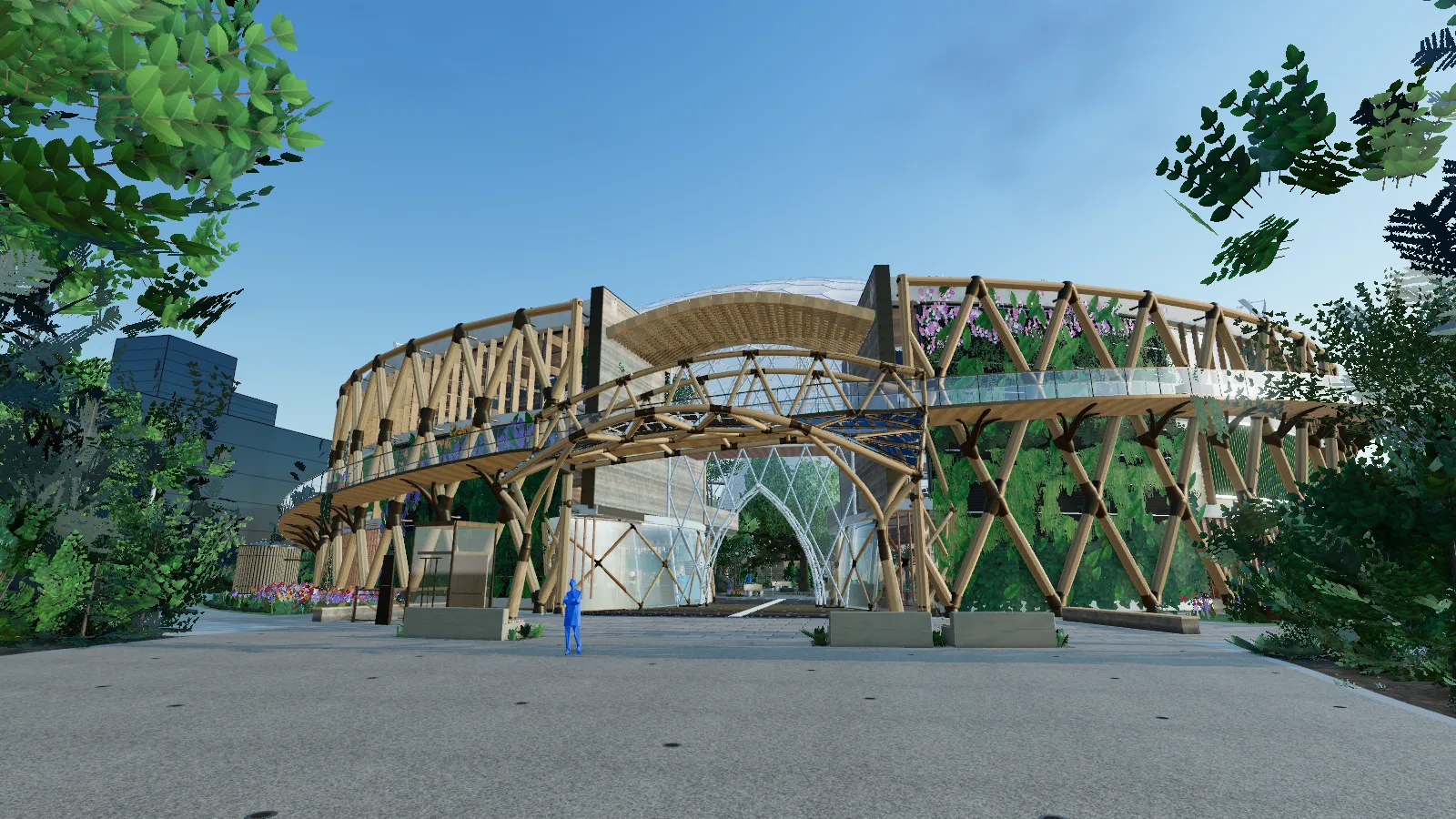
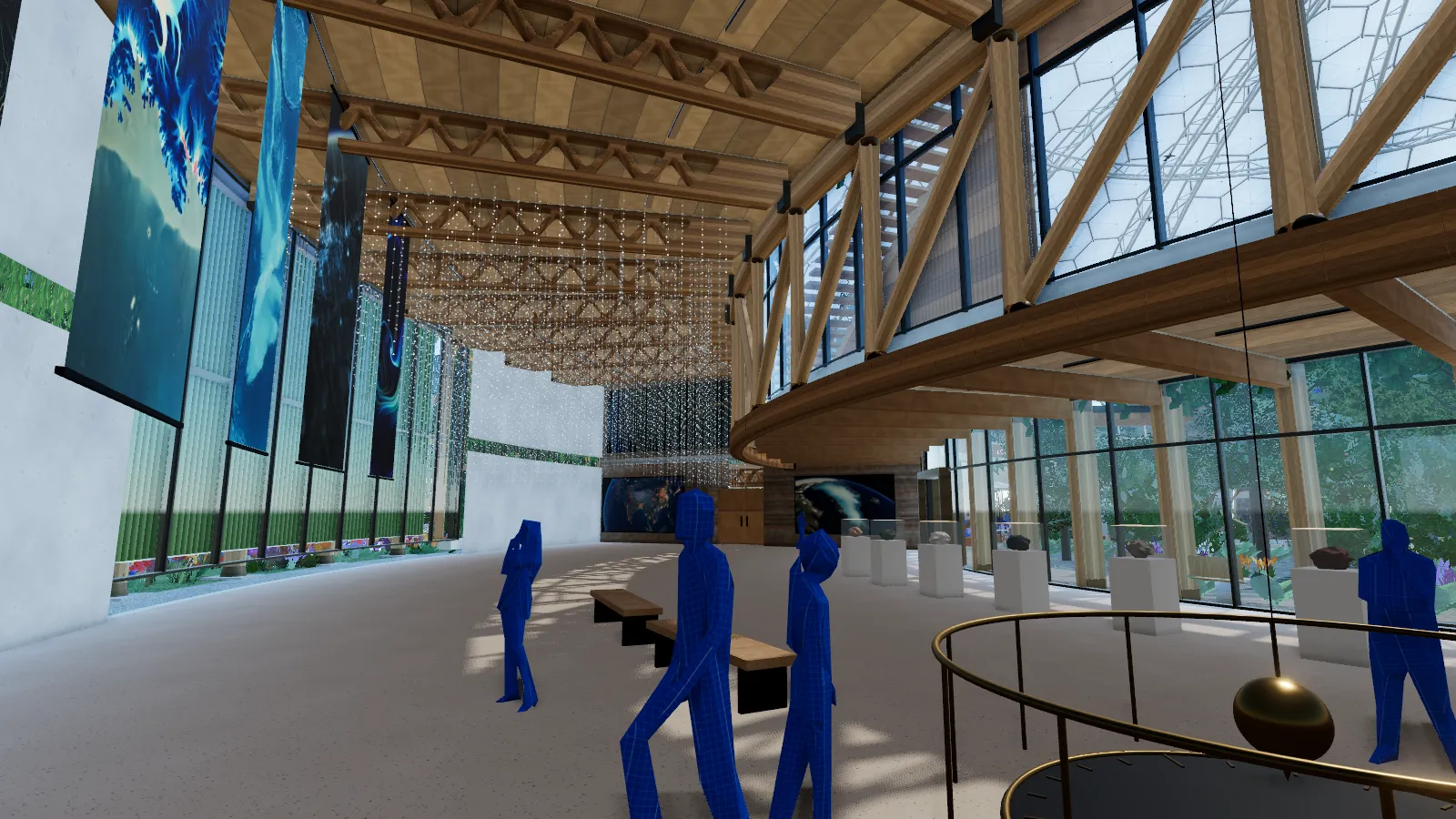
One proposal, drawn for a northern city: a ring of terraced timber floors, held from outside by a timber exoskeleton, around a forest court, with a geodesic dome across its northern side. In winter a roof of air-filled cushions of light plastic film (ETFE) keeps the court alive as a winter garden. Every floor steps back to leave a planted terrace facing the court, and a young forest surrounds the whole building. Under the court and the ring, a level cut into the rock, the Undercroft, gathers the Centre’s ways of seeing the whole planet at once. Walk it from dawn to midnight here, or freely in 3D.
Welcome
The approach
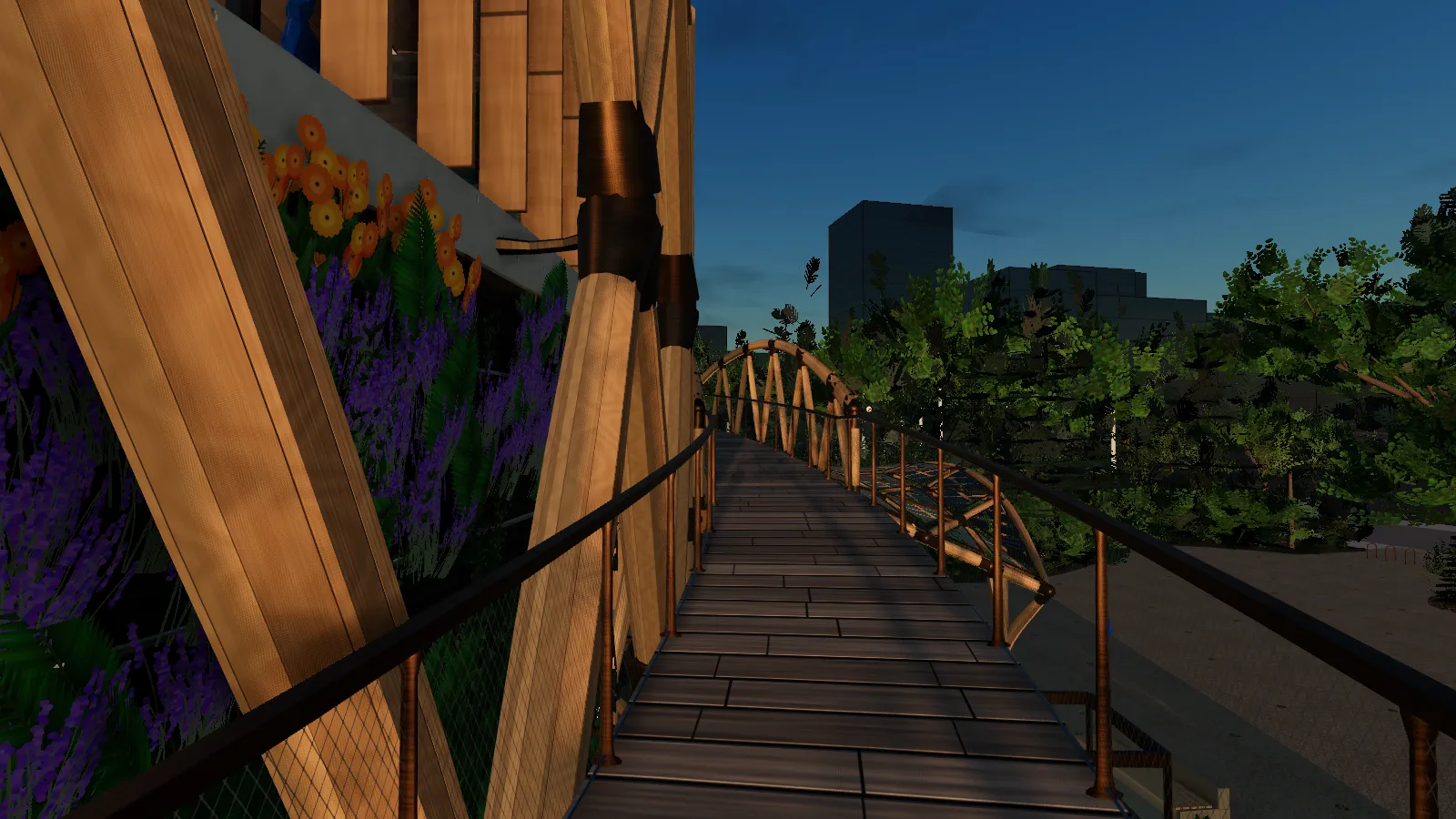
The Centre stands in a city, inside a young forest planted the Miyawaki way: native species, dense and mixed, in four layers from the canopy down to the ferns. Spruce, fir, birch and aspen here. An avenue curves through it, hiding the entrance, then showing it: a ring of terraced floors held by a timber exoskeleton, living walls between its diagonals. Over the entrance, a timber truss bridge carries the outdoor ramp across, and from it hangs a canopy of triangular solar glass, held at the front by two bronze tree forks. Halfway, an old oak stands in a clearing with benches round it.
Perceive
The threshold
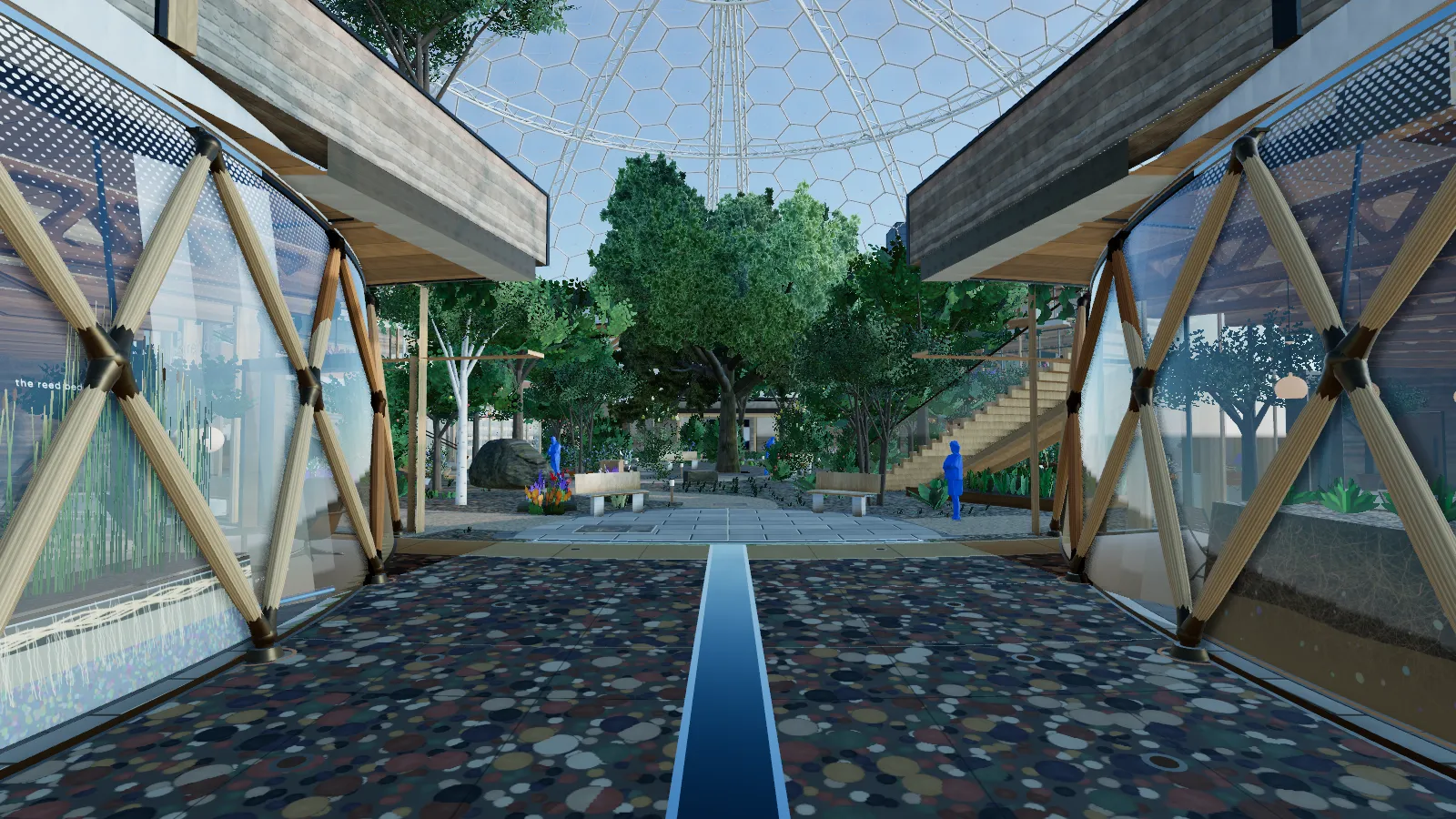
The way in is an open passage through the ring, with no doors and no turnstile. Two leaning glass walls narrow toward the middle and open again onto the court, like a lens. Underfoot, the Deep-Time Floor: 4.54 billion years to now on a logarithmic scale, in nine bands of real rock, from the Earth’s formation to the ice ages. The Holocene, the ten thousand years of farming and cities, takes the last metre and a bit; the last 250 years are a strip of brass four centimetres wide, and a brass line marked now runs on into the court. Between the two skins of glass the building shows how it works: rain from the roof in a cistern and a reed bed on one side, living soil with roots, mycelium and worms on the other. Over the mouth of the passage, the canopy of solar glass shows what it is producing as a bead of light running along a brass rail.
Tend
The forest court
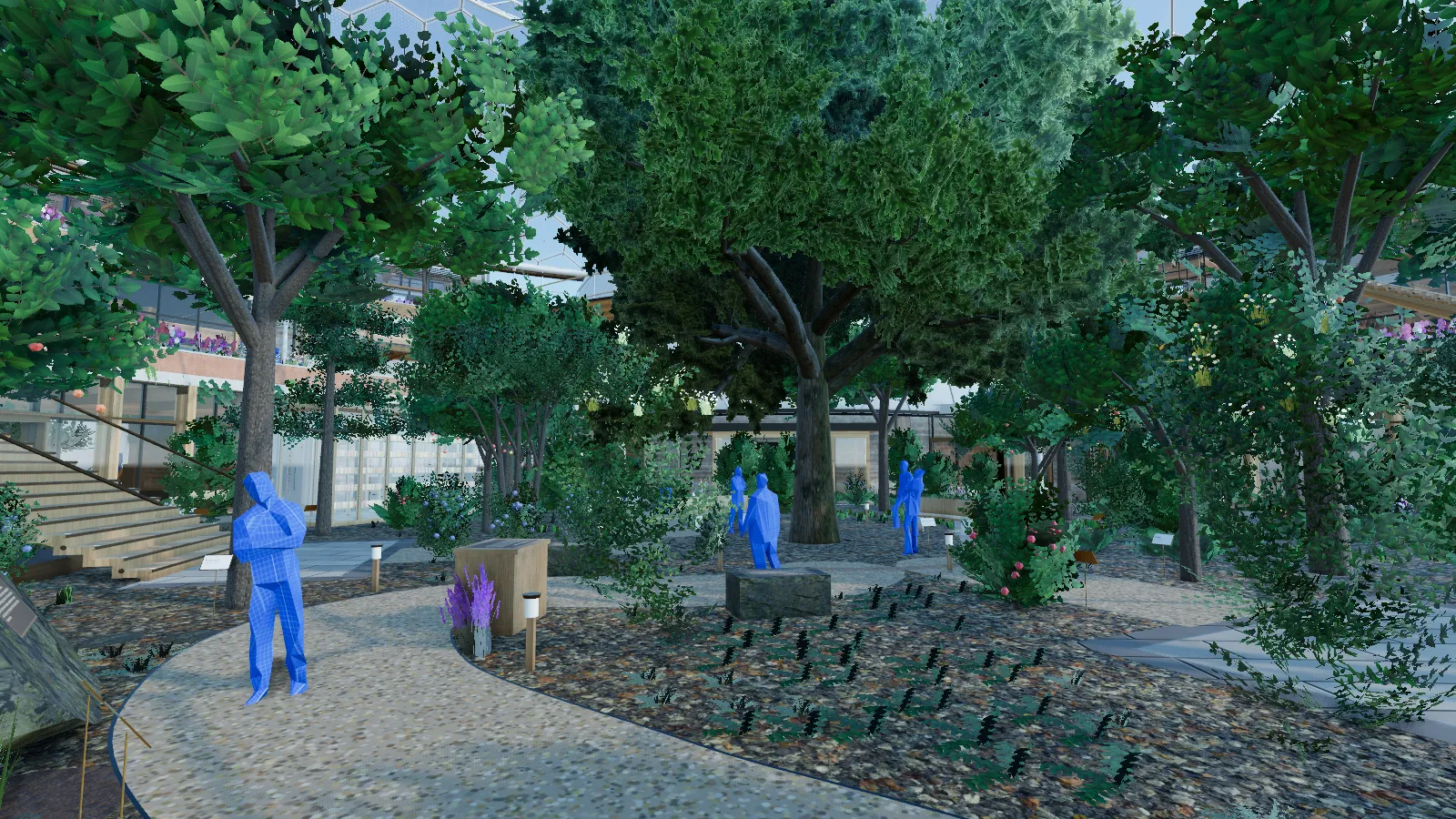
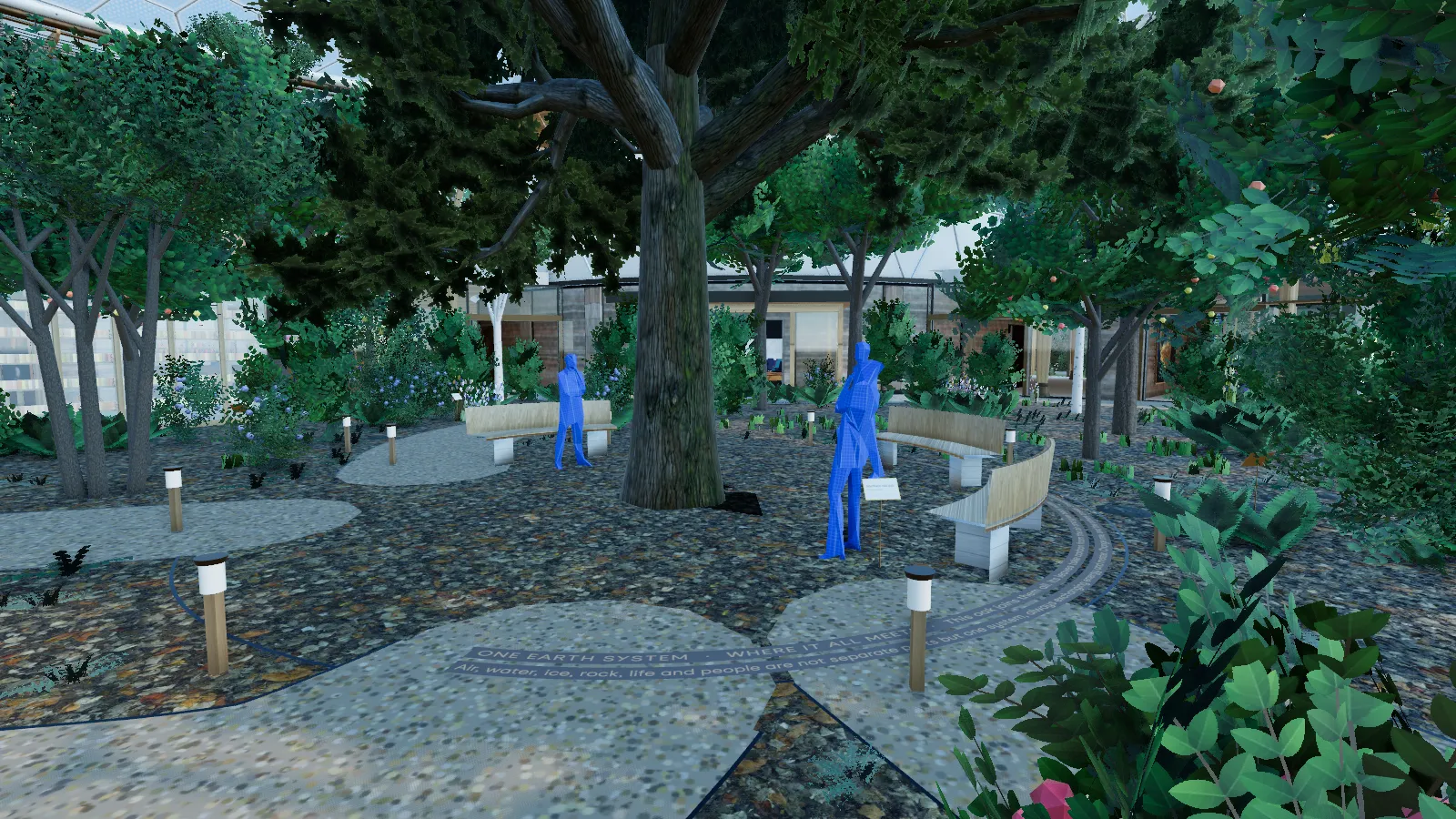
Inside the ring, a forest garden instead of a plaza: tall trees, fruit trees, berry shrubs, herbs and groundcover in layers, winding paths, a swale that keeps the rain on the land. Bronze plates set low along the trail, in the path, the stones and the ground, read the court as the Earth’s spheres: the air, water, ice, rock, life, and us.
Perceive
The mother oak
At the centre, an old red oak in a clearing, ringed by bronze letters that join all the plates together: the leaves trade carbon and water with the air, the roots break rock and hold soil, the acorns feed jays. Change one sphere and the others answer. It is the argument of the whole building, told by a tree.
Digest
Planetareads
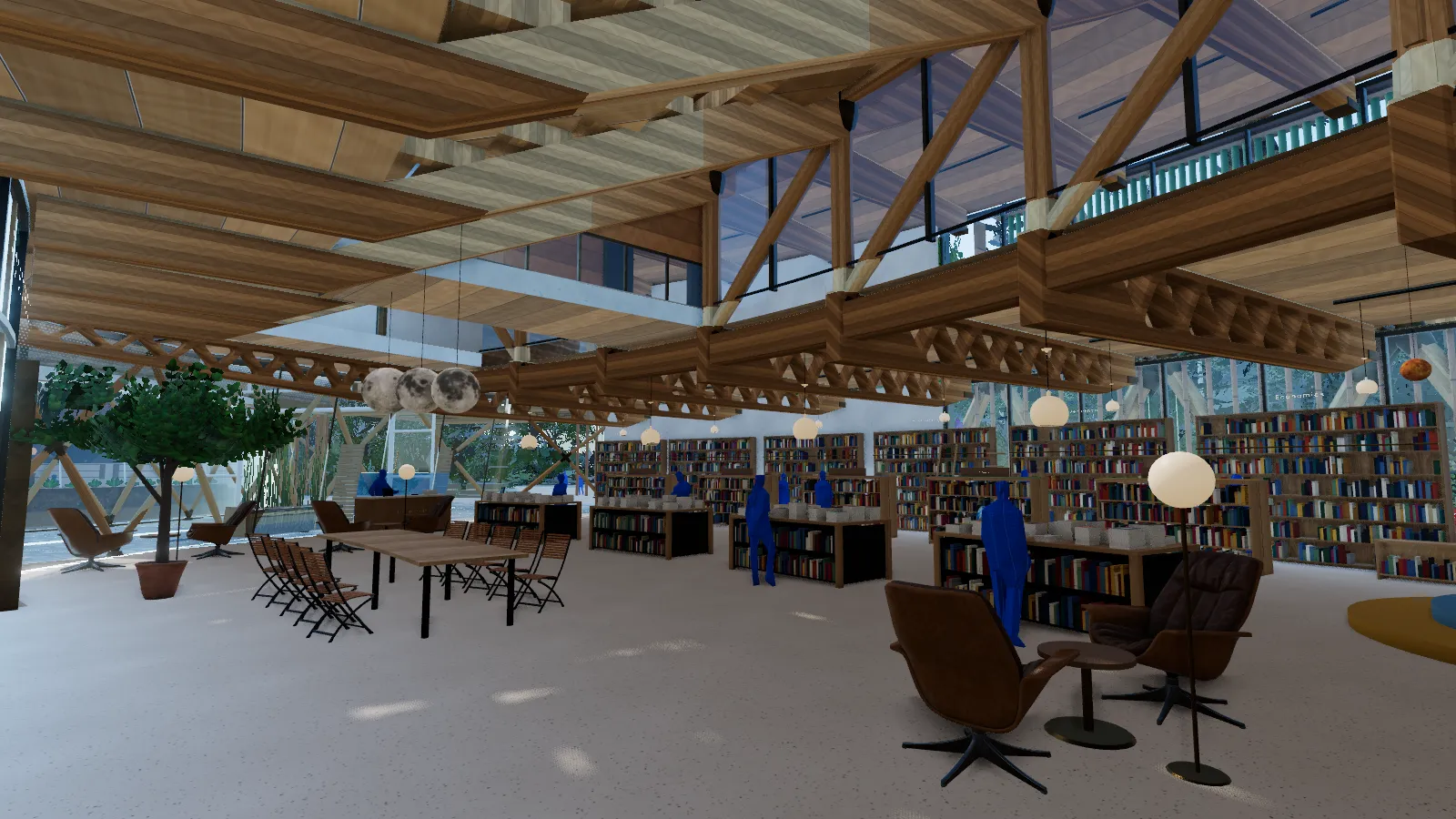
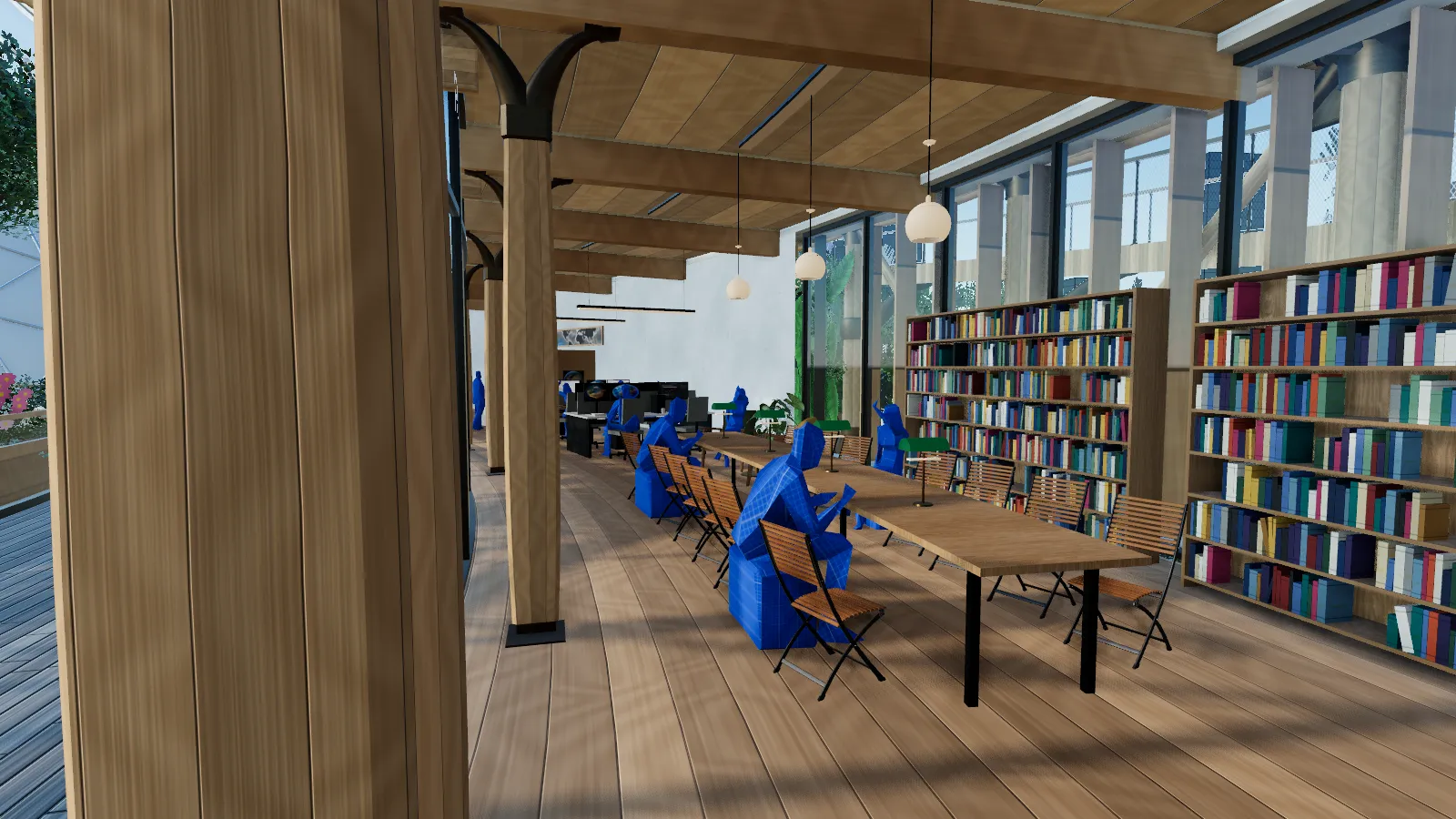
The bookstore is laid out in eighteen sections: Earth Science, Climate, Oceans, Biodiversity, Deep Time, Cosmos, Indigenous Knowledge, Philosophy, Governance, Economics, Risks, AI, Futures, Speculative Fiction, Atlases, and a low shelf for children, among others. Planetary thinking is a library before it is a slogan. Its ceiling is the underside of the Great Steps above, stepping up toward the court, lit by daylight through glass set in the risers.
Welcome
The Great Steps
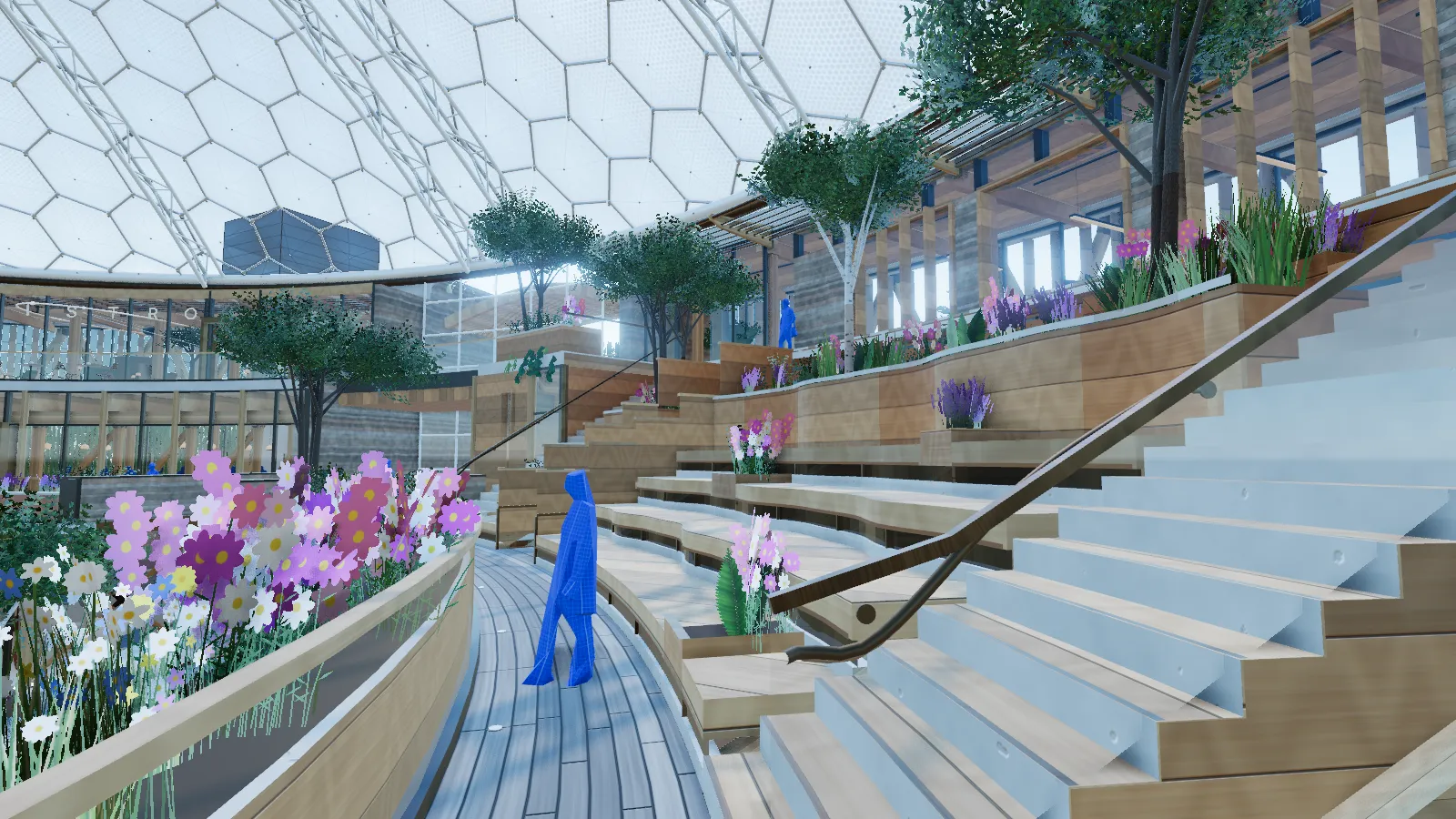
Above the bookstore, the terraces become one wide stair: nine rows of timber seats between planted bands and three trees, climbing from the first terrace to the second. People read here, eat lunch, wait for a talk, watch the court. It is the building’s most public room, and it has no walls.
Tend
The Food lab
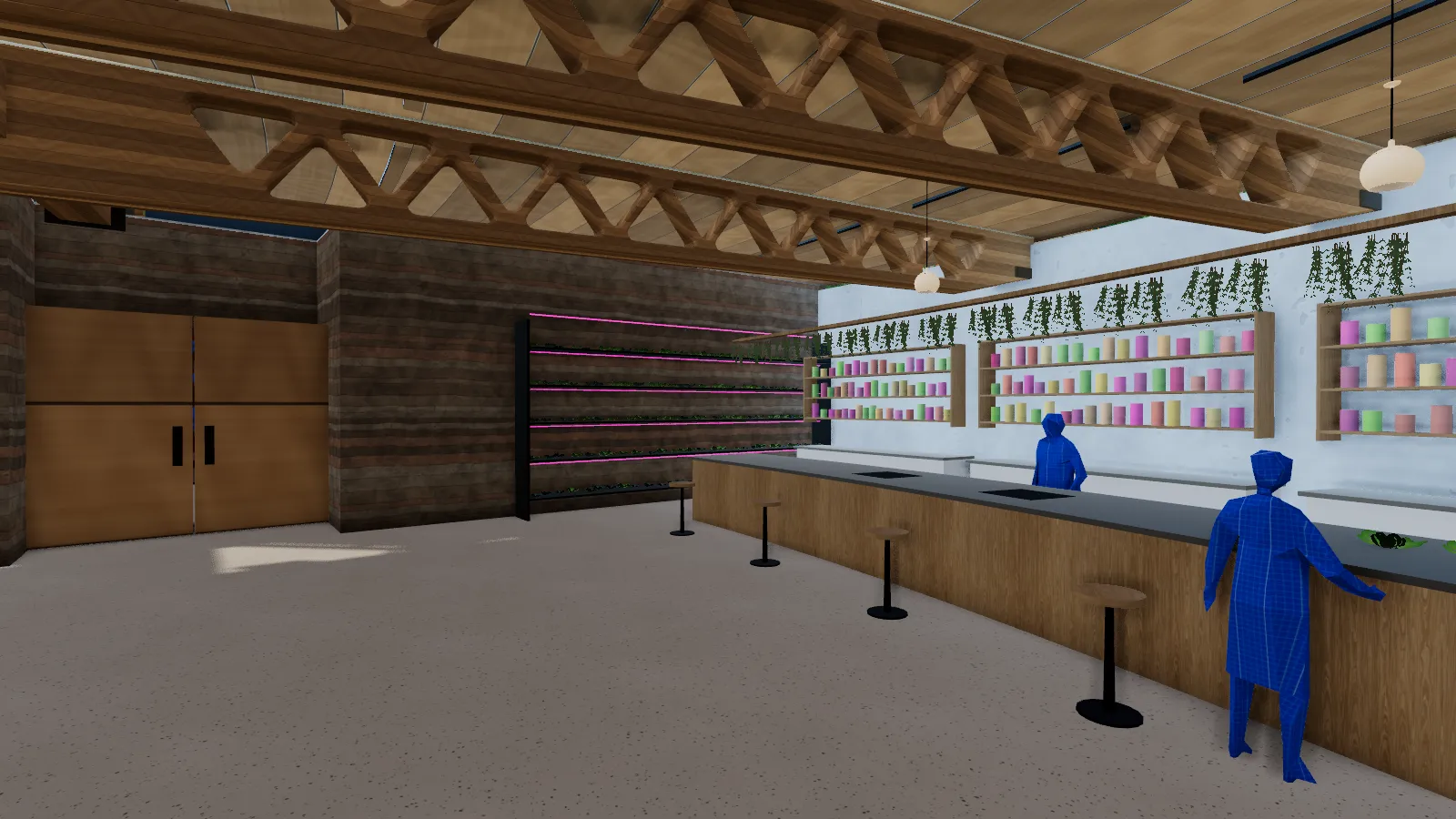
What grows in the court and on the terraces meets a kitchen. Seedlings grow under light, jars ferment on the shelves, and a class learns to cook the planetary health diet. Food systems produce about a third of humanity’s greenhouse gas emissions; here that fact arrives as lunch.17,18
Welcome
Laïkafé
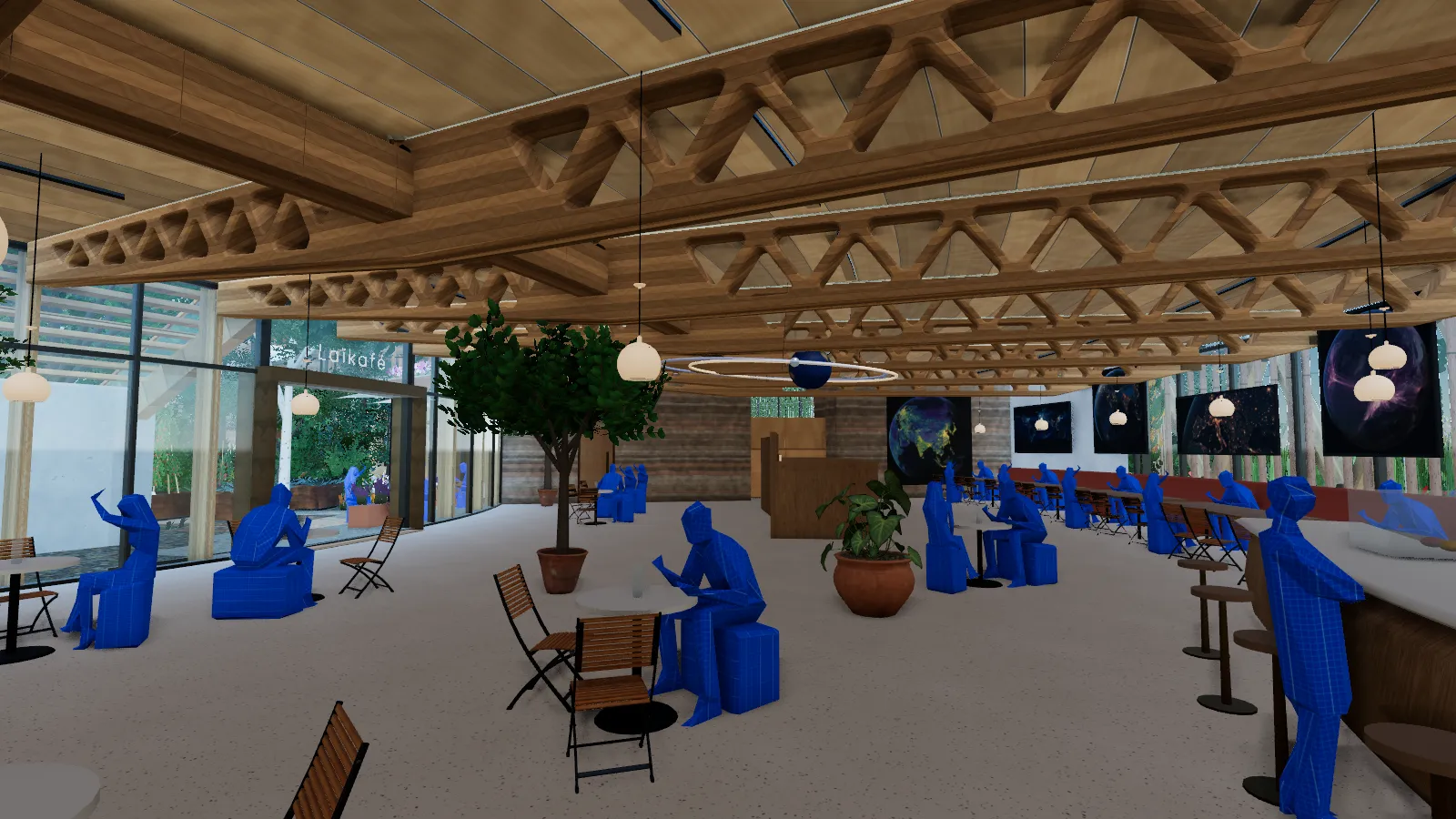
The city’s living room: a third place between home and work, laid out as a run of places rather than a canteen. Alcoves under slatted canopies for long conversations, a long table for working together, armchairs by the garden glass, a wall of books on the planet, and a cabinet of old instruments that once measured the sea, the rain and the sky. Plants hang from the girders; a small Earth turns in a ring of light overhead. People read, work, argue and linger. No one needs a ticket to belong here.19
Digest
The halls
Double height, flat floors, rigging overhead, walls that move. An exhibition one month, a hackathon the next, a gathering of elders or a school fair after that. Large works are commissioned for the building itself. Timber trusses carry the floors above, so the rooms are almost free of columns. In the visit they hold one of three shows, chosen in its settings.
Deliberate
The Agora
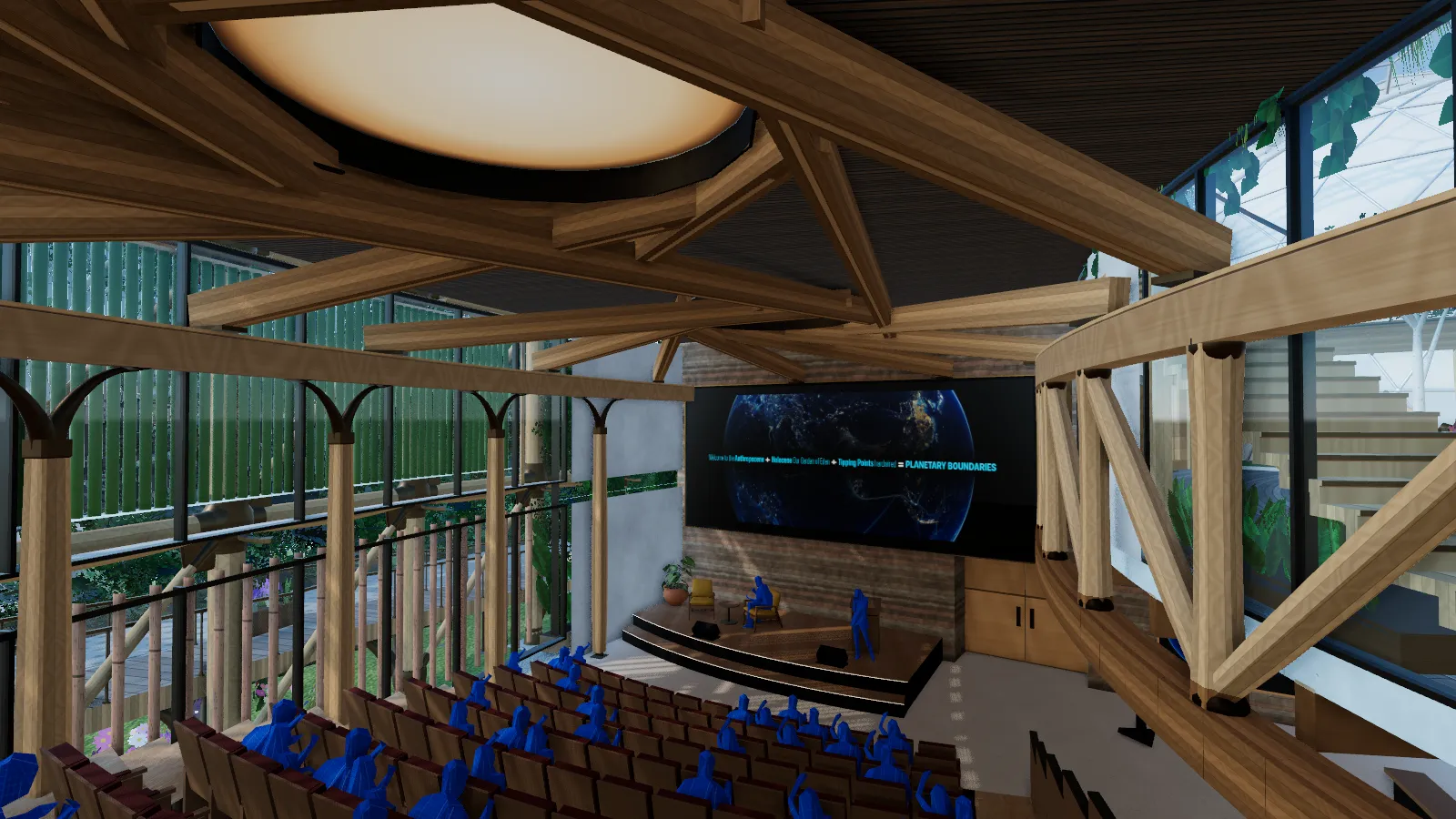
A two-storey hall of 199 raked seats under a roof of timber beams that rest on one another, with no column inside. A wall of light ten metres wide shows the evidence; cameras carry every session beyond the walls. It holds lectures, debates and hearings, and citizens’ assemblies, where residents drawn by lot learn from experts, deliberate and make recommendations. Upstairs, the Workshop gives people tables and whiteboards to work things out together. At the back of the rake the seats rest on open timber trusses; under them a small agora of seven tiers sinks into the ground, and a grand stair goes on down to a hall in the rock and the level below. The room where citizens argue is a stair away from the evidence.20,21
Perceive
The Situation Room
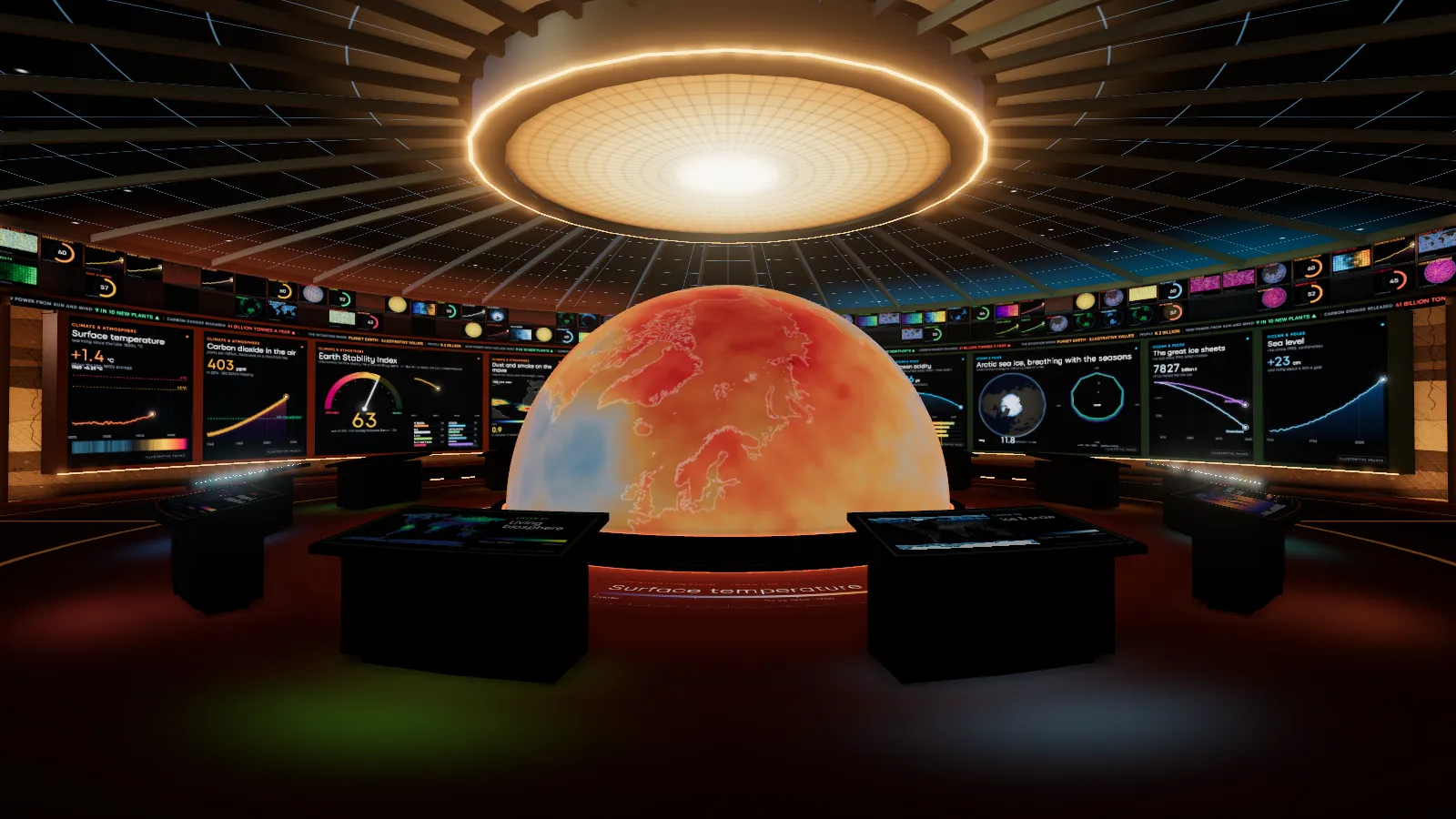
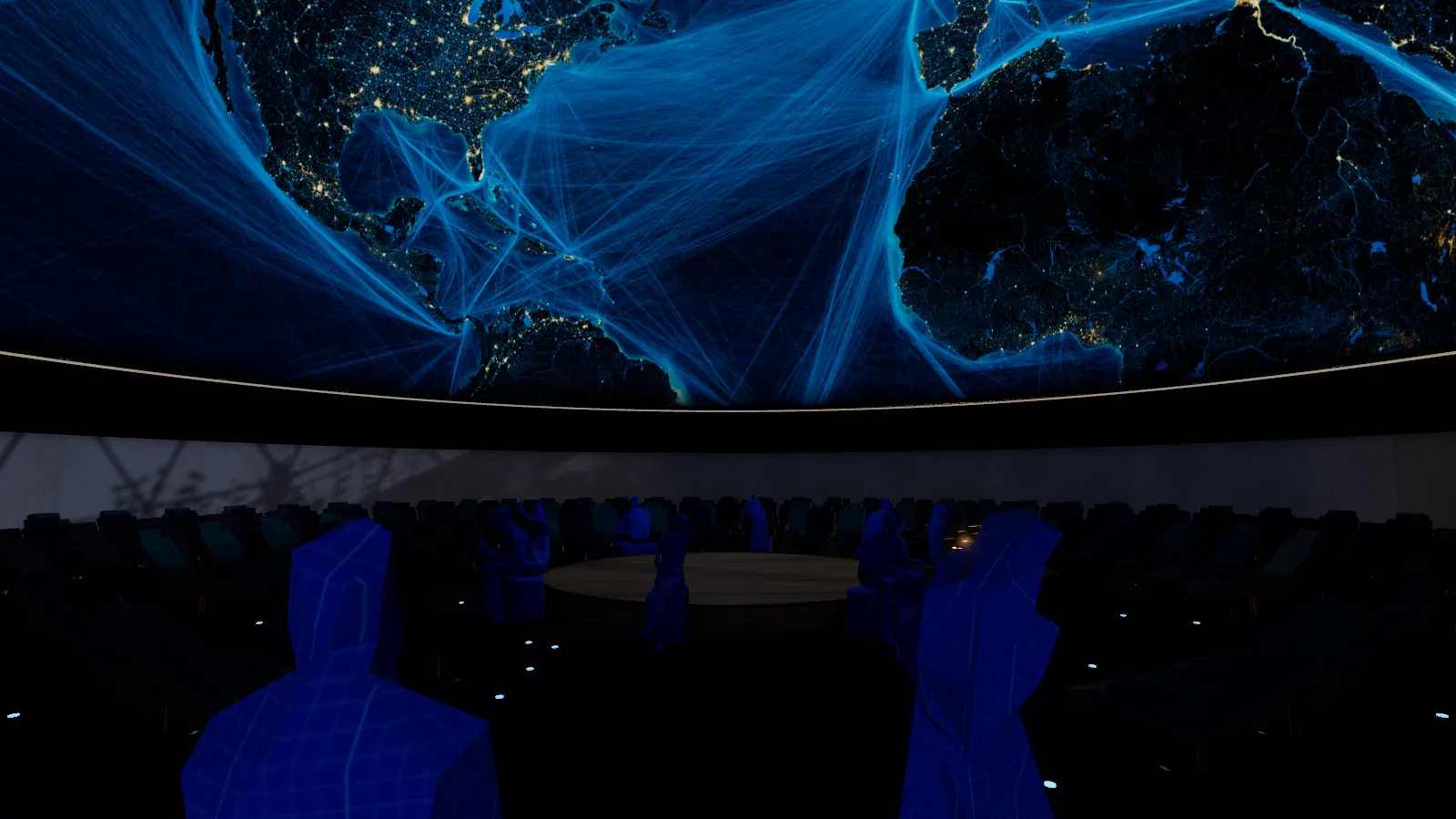
Under the centre of the court, a round room cut into the rock, ringed with screens: the Situation Room for planet Earth. They show the planet’s vital signs side by side, the nine planetary boundaries among them: heat, carbon dioxide, the ocean, the ice, forests, wildlife, fresh water, the flows of nitrogen and phosphorus, and the ozone layer, healing since the world agreed to stop the chemicals that thinned it. On the floor, a hemisphere of the Earth answers touch: choose a layer and the globe and the screens change together. Each screen opens a short card in plain words: what it shows, why it matters, what helps. In the visit the values are illustrative; in a built Centre they would be the live record. Passages lead on to a hall of mirrors and fields of light, the Infinite Commons, and to the deep ocean, the Abyss.
Digest
The Ice Archive
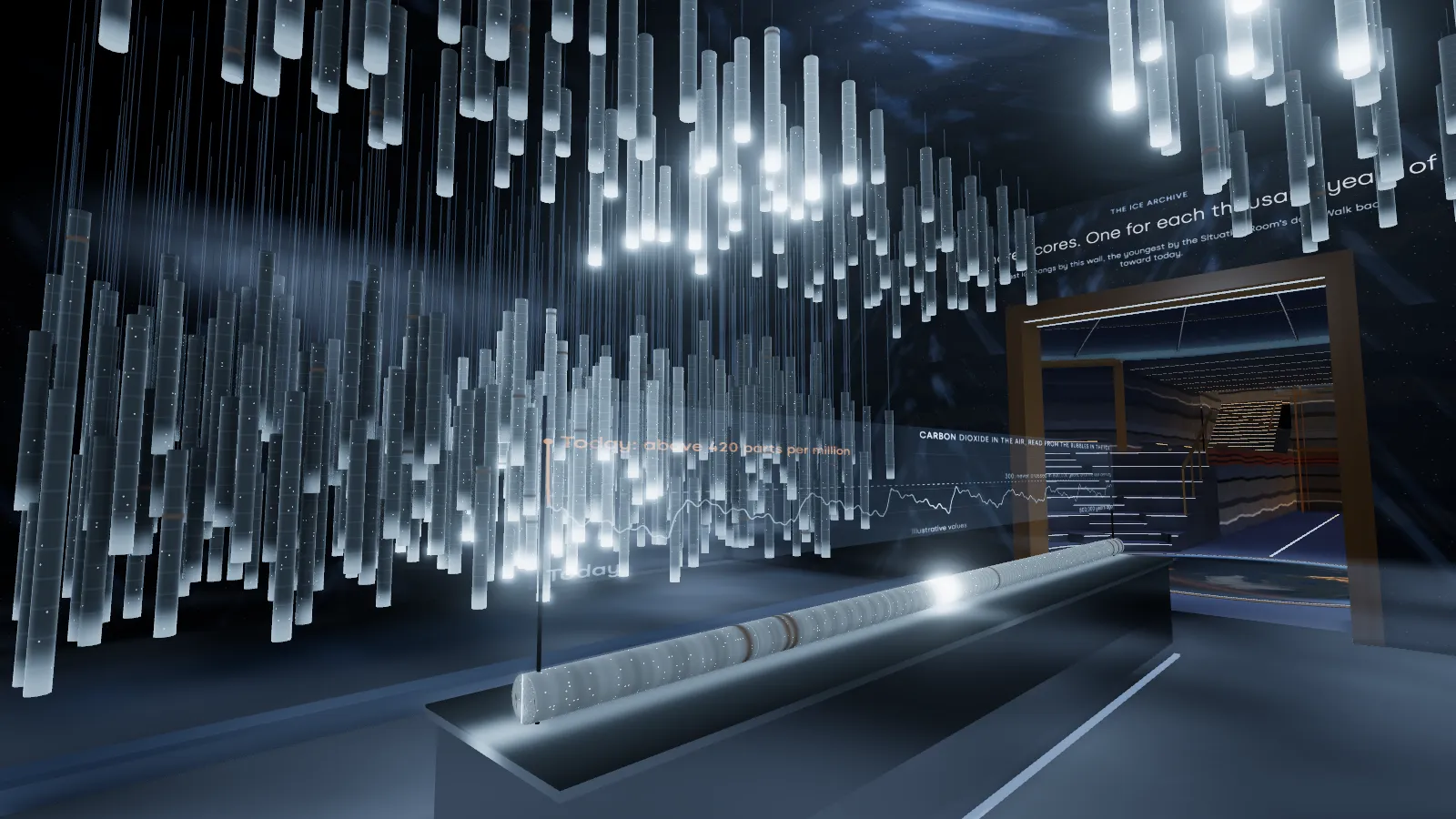
North of the room, in cold light, eight hundred ice cores hang in rows, each standing for a thousand years of air trapped in polar ice, the oldest at the far wall. On a long table of lit glass lies one core, read like a book: its years, its layers of volcanic ash, its bubbles of ancient air. Every half minute a pulse of light runs through all of them, from the deep past to today. Above the table, the carbon dioxide of eight ice ages rises and falls, then climbs past anything the ice has held.
Perceive
The Whole Sphere
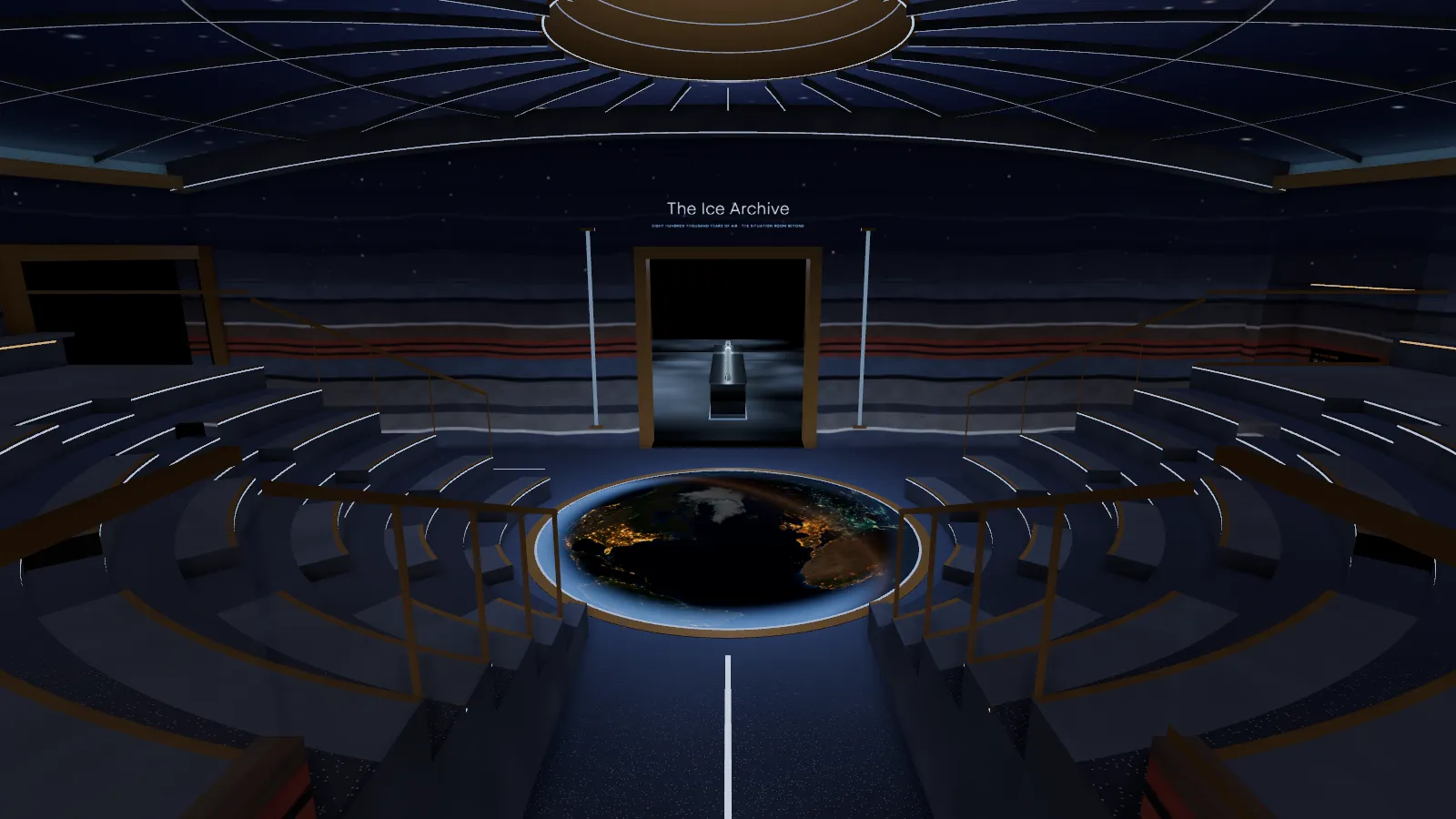
Through the Archive’s far wall, past its oldest ice, the Whole Sphere. The sky projected in the dome is the upper half of a sphere; under the dome’s floor, the rock is cut into the lower half: a theatre of tiers converging on a round floor where the Earth glows under walkable glass. A glass lens in the dome’s stage joins the two halves. The vault is a night of slowly turning stars, ringed at its foot by a thin pale line, the planet’s shell of air as it looks edge on from orbit: a cosmic womb, with the sky above, the Earth below and people in between. It has its own way down from the surface, a glazed bay behind the dome, so no one needs to cross the dome during a show.
Digest
The Descent
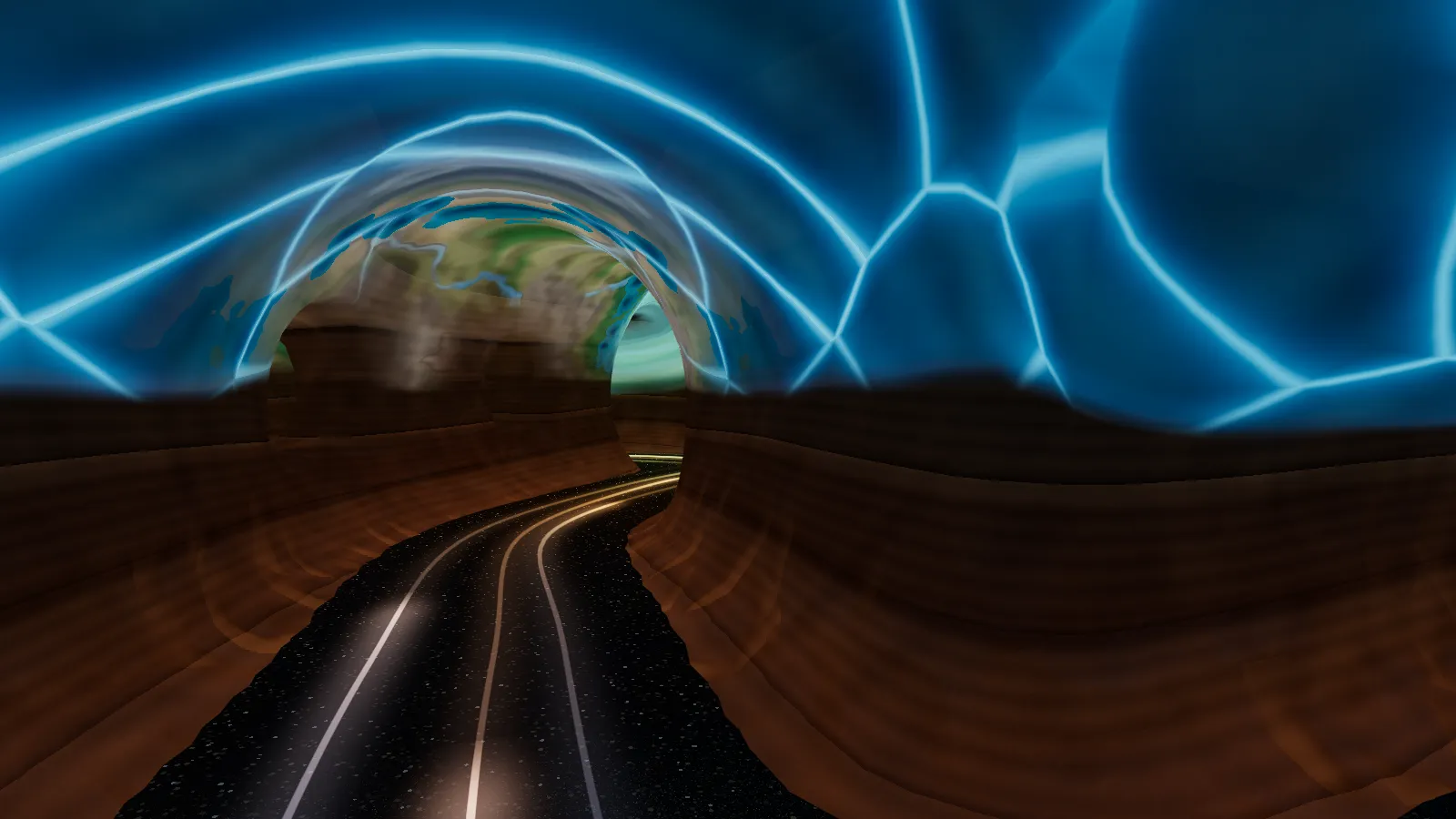
From the Sphere, the way back to the Situation Room is the Descent: a braided river of water-worn cave, level all the way, whose strands part round islands of rock and meet again. On its walls and vaults the six realms of the Earth system flow as moving light, the air, the ocean, the ice, the land, life and people, one after another, then woven together. Windows open between the strands; clearings give room to pause. At the room’s east door every strand joins one confluence. The realms are one system, and they meet where it is watched.
Digest
The Atelier
The Centre’s memory and workshop: an archive on rolling stacks, a reading library, and a creative studio with a large-format printer, a light table and a book scanner. Datasets come in; maps, prints, books and stories go out.
Perceive
The research wing
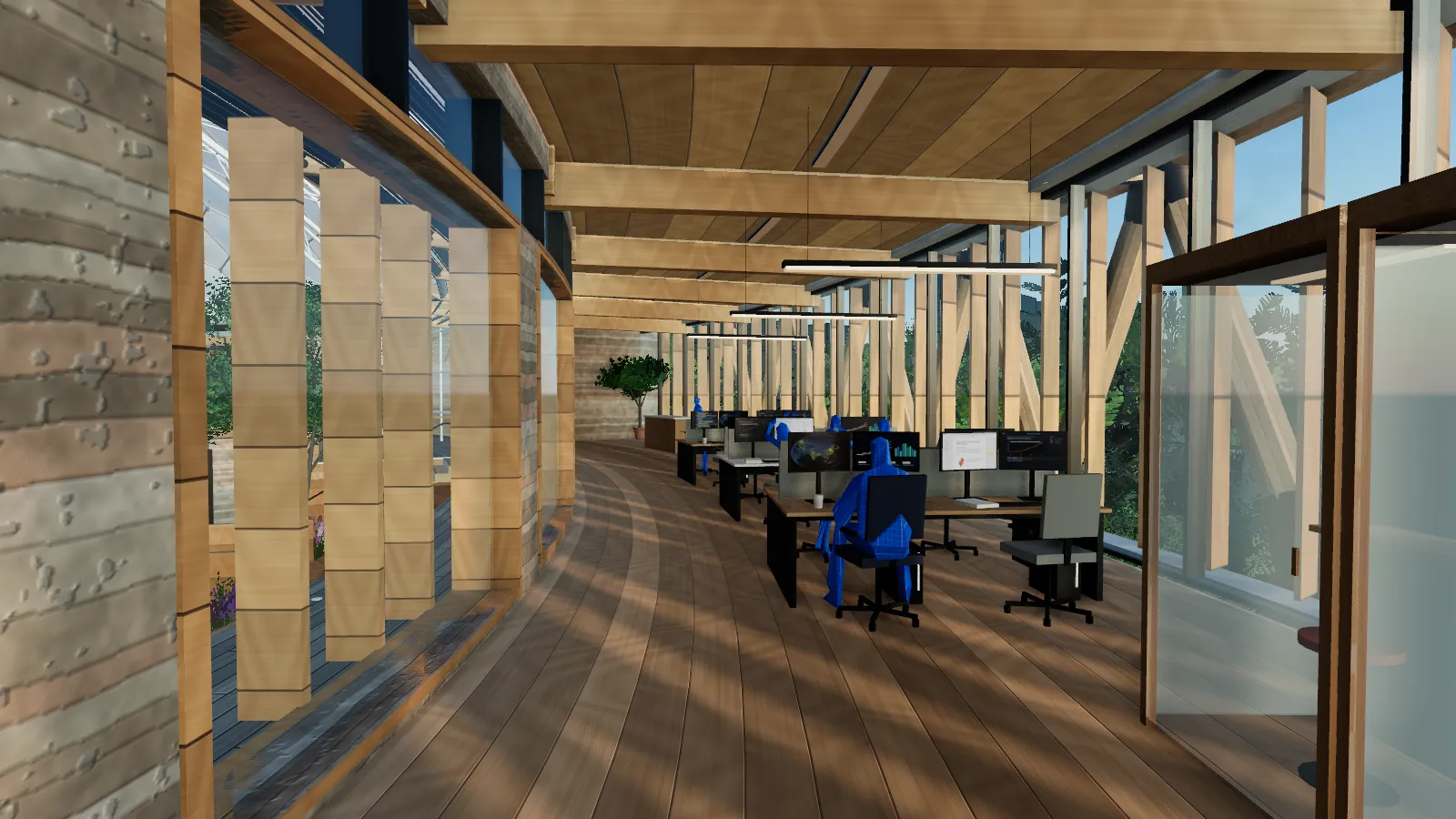
Open studios for residents: scientists, artists, scholars and knowledge holders who live the Centre’s daily life for a season. Their screens show work in progress. What they make ends up under the dome, in the halls, on the shelves.
Tend
The promenade
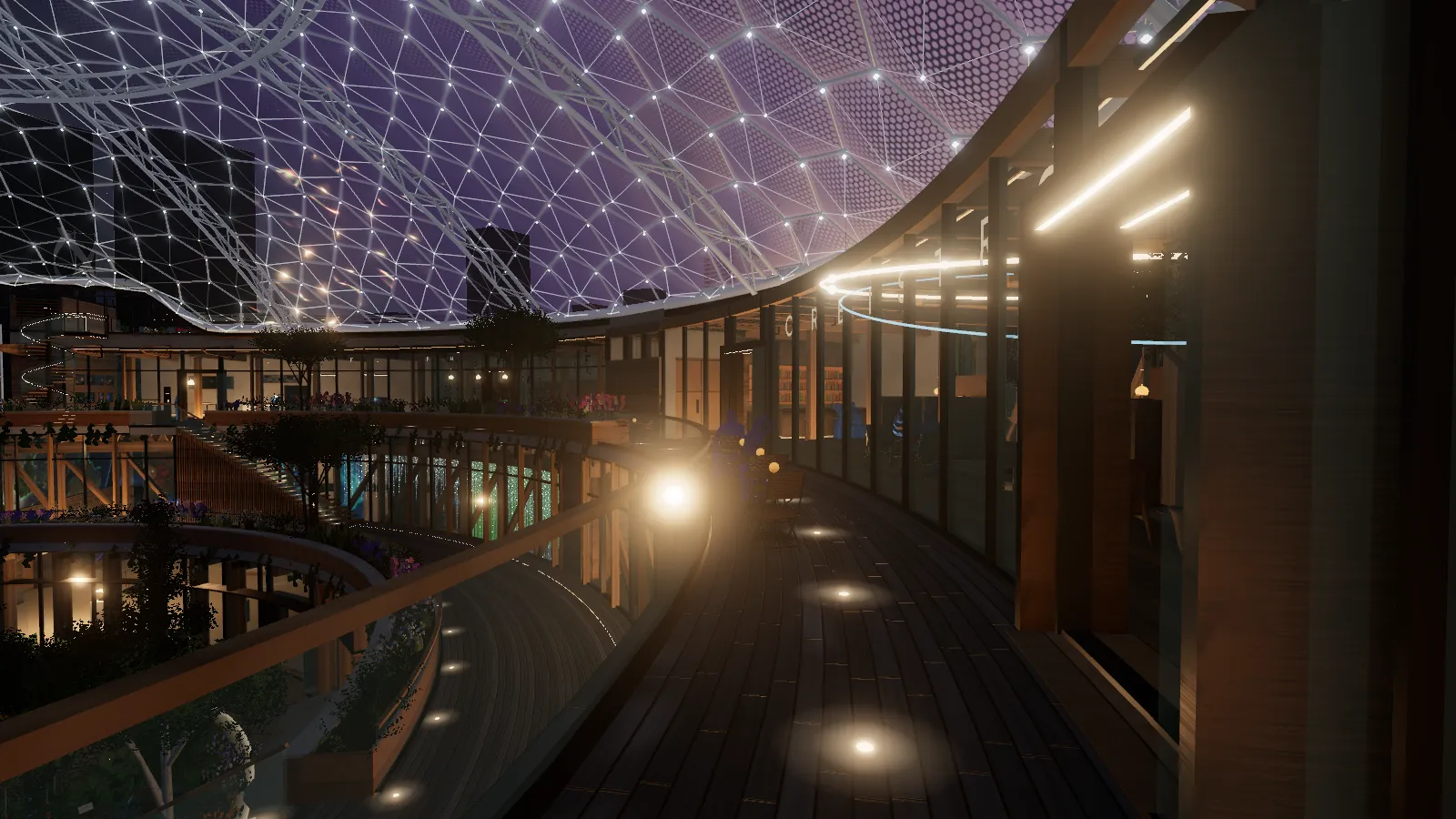
Every floor steps back as it rises, so each has a planted terrace facing the court: an amphitheatre of gardens. Outside, a gentle ramp with level landings climbs round the building on its exoskeleton, from the forest floor to the roof. At the top is the belvedere, a roof garden open to everyone, shaded by a pergola of solar panels. At golden hour it fills with people looking in at the court and out over the city. Beside the vestibule, a second way up, the Deep-Time Stair, winds round a column that draws the Earth’s 4.6 billion years to true scale, and ends on a terrace at its crown.
Perceive
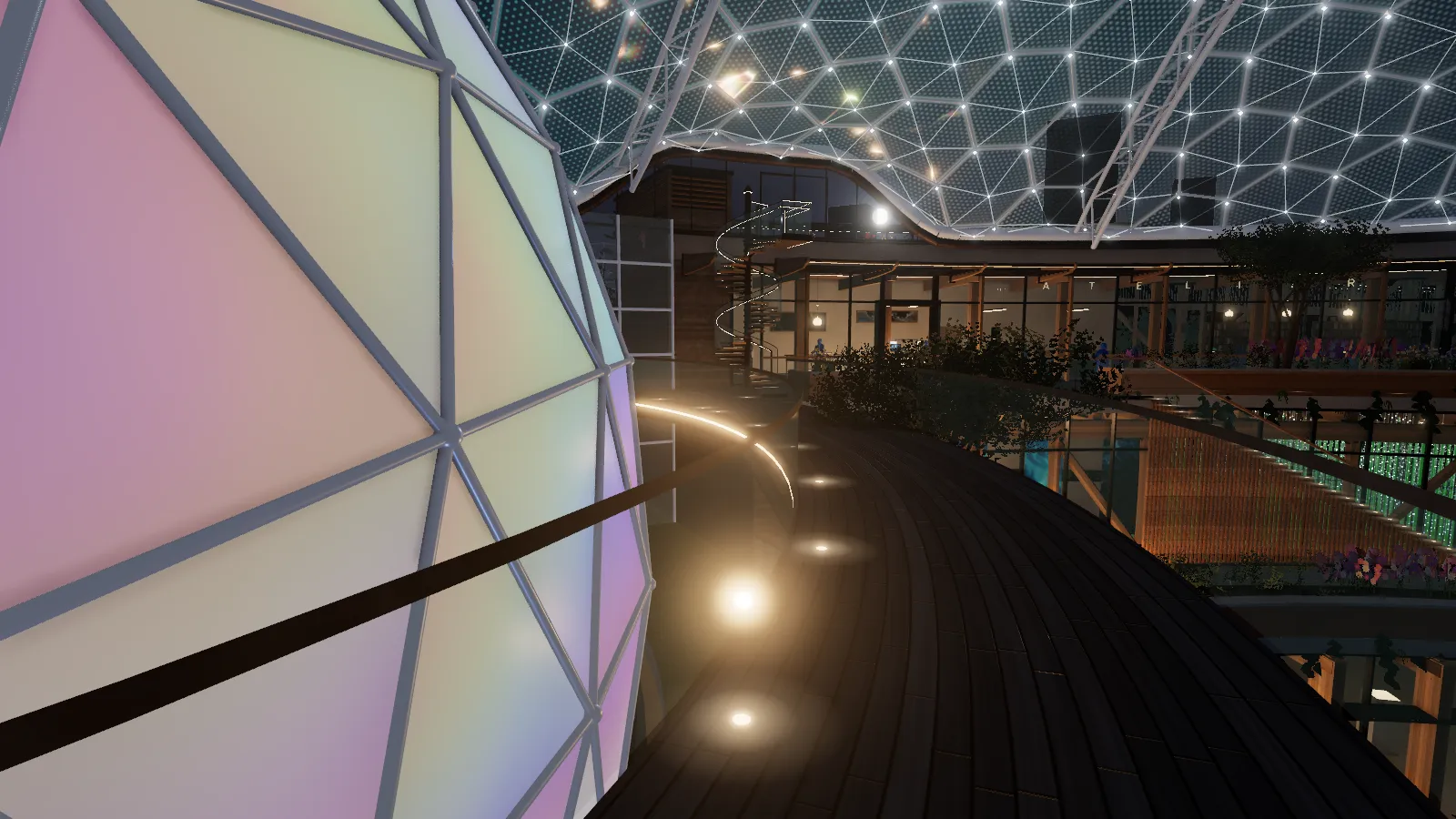
The halo
A ring walk nine metres up, circling the dome, held on six timber tree columns. At dusk the shell begins to glow, each panel a slowly drifting colour: a signal to the neighbourhood that the evening programme has begun.
Perceive
The dome
About 180 seats under a 28-metre shell. The Earth from orbit, its day side and night side; the planet’s winds and coastlines; shipping routes over the Arctic. Astronauts describe the sight of the whole Earth as awe, and in experiments awe makes people more generous. The dome offers a distant echo of that view. Then the lights come up and the conversation begins.22,23
Deliberate
Orbistro
On the top floor the ‘Orbistro’ stays open late, a room of smaller rooms: woven nests round small tables, a long table by a kitchen fed by the garden, a library wall, a lounge round a fire bowl, and a vitrine of the sea with shells, a Secchi disk and a Nansen bottle, the tools oceanographers used to read the water. By day the court’s light comes in over low planters; at night lamps and candles take over. People coming out of the dome stay a little longer, and the evening’s questions keep going.
Perceive
Dark sky
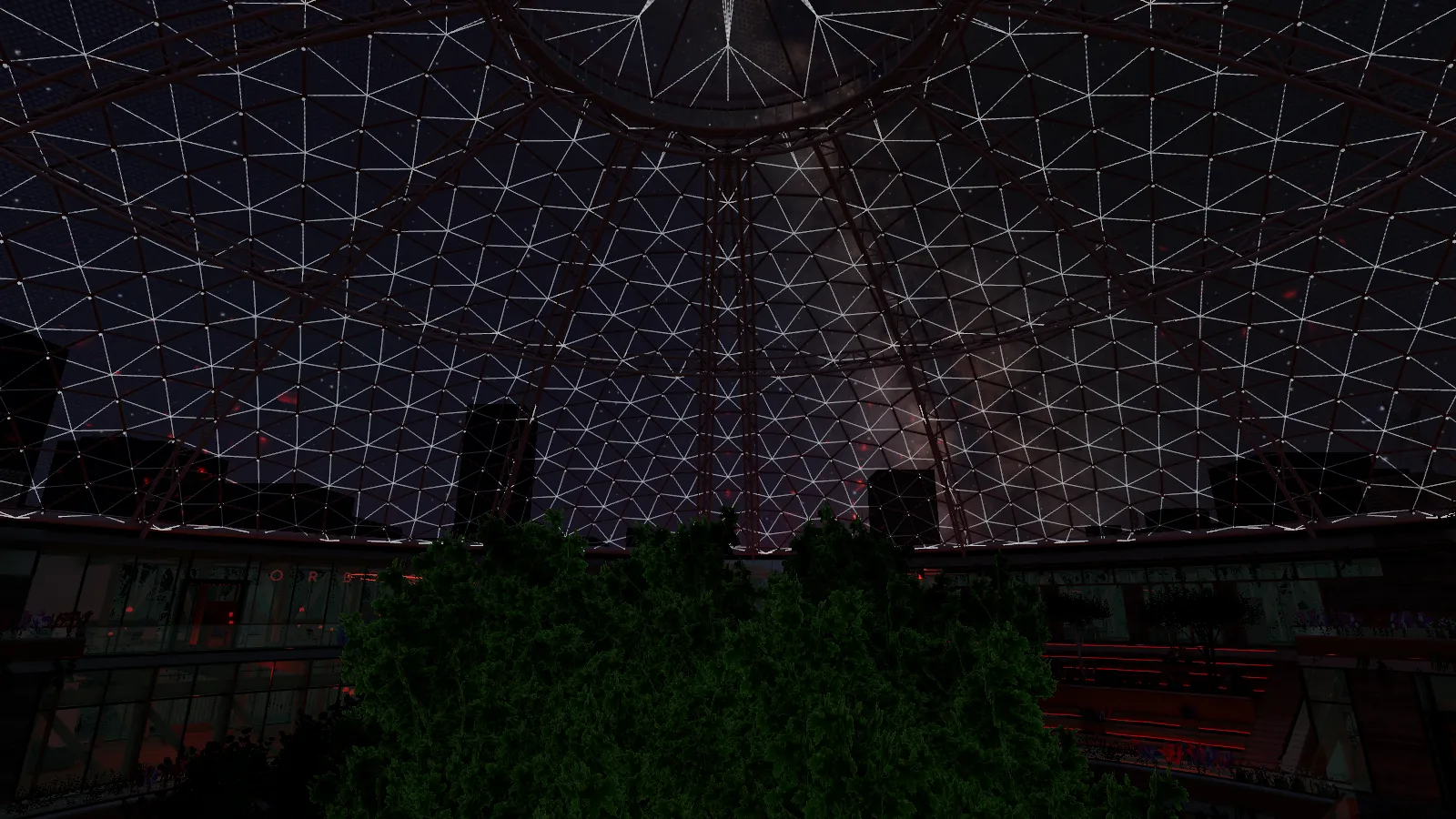
Near midnight the Centre can go dark: every outdoor light turns a low red, which keeps eyes adapted to the night; the lights set in the forest paths still wake round each walker and fade behind them, so the building shows its visitors, not itself. The stars come out over the court, the Milky Way among them. Most city dwellers have lost that sky, and it is still brightening by nearly a tenth each year. For an hour, the building gives it back.24
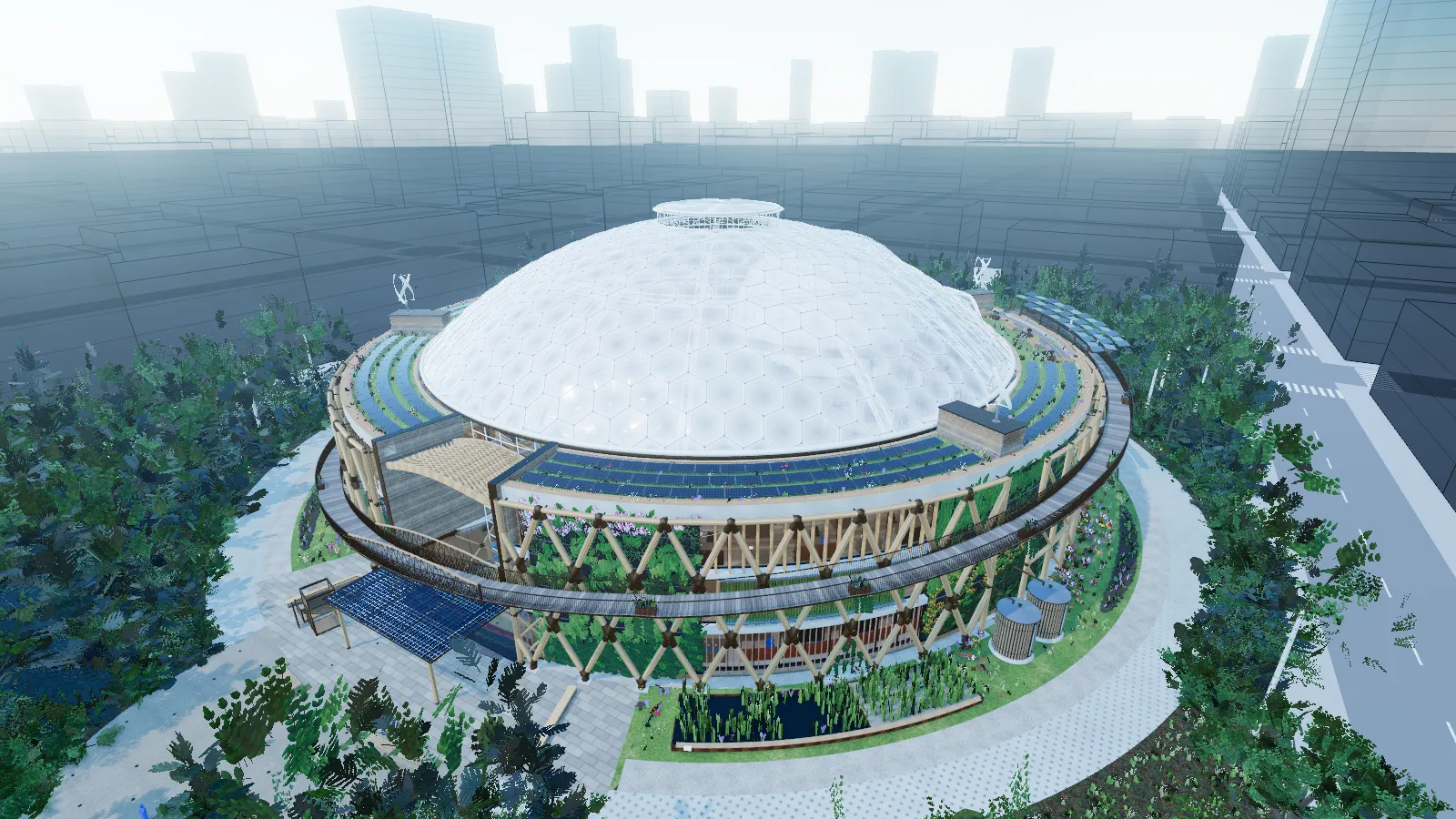 Virtual visit Walk through the Centre Every room, above ground and below, from dawn to midnight. Change the hour, the climate and the night lights, or fly over the whole plan. Best on a computer with a recent browser. Enter the visit
 Research, creation, communication.
The Centre does three things, and reads each of them through the three questions of our time: how to see where we stand (awareness), how to face what is happening (emergency), and how to take care of it (stewardship). Each lens is also a grand challenge, carried by major campaigns and long-form works: books, feature films and series, data visualisations, animations and reports. To make things happen, you first have to make things.
AwarenessWhat should every citizen know about the Earth system? How can a changing information system widen what people see?
EmergencyHow can the state of the planet be tracked and told so that people sit up and listen, and what guidance helps them face it?
StewardshipWhich routines steer human behaviour at scale? How can science and Indigenous knowledge meet? What are the signs that stewardship is taking hold?
AwarenessA yearly barometer of planetary awareness and of the civic imagination: what the city knows of the Earth system, and which futures it can picture.
EmergencyResidents in the research wing synthesise the latest Earth system science with partner institutes, in the open.
StewardshipRecommendations for policymakers, drawn from research and citizens’ assemblies; foresight, economics and governance studied in view of the public.
AwarenessDome shows built from real data: the Earth from orbit, its winds, its routes, its night lights.
EmergencyThe Atelier and narrative workshops turn datasets into images, films, books and stories people can hold.
StewardshipResidencies for artists and scholars; the forest court and the Food lab as living experiments.
AwarenessExhibitions in the halls, ‘Planetareads’, and school programmes from age eight.
EmergencyPublic talks, hearings and citizens’ assemblies in the Agora; open data and publications.
StewardshipEvery talk streamed, every toolkit free; shows shared with domes and museums; a network of Centres.
Research that answers to the city.
The Centre studies the people it serves as closely as the planet it explains. Three kinds of research come out of the building every year, free to all:
-
The civic imagination
Every year, a study of public sentiment about societal transformation: which futures people can picture, which ones they want, what they believe stands in the way, and whom they trust to get there. Imagination is where change begins, and it can be measured.
-
The state of planetary awareness
How well the city understands the Earth system it lives in, from the carbon cycle to the planetary boundaries, measured year on year and published in the open. The Centre is accountable to its own purpose.
-
Recommendations for policymakers
What the research, the residents and the citizens’ assemblies conclude, written as concrete recommendations for local, regional and national government, and carried to the people who decide.
It does this in partnership with Chief Planetary Scientists: advisers who give the stability of the Earth system a dedicated voice in government. They translate planetary boundaries and Earth system risks into national priorities, bring those risks into budgets, investment, security, health and economic planning, anticipate tipping points and cascading threats, and share an evolving picture of the planet’s health across a global network. The Centre gives them what a government adviser rarely has: a public. Their questions reach the people of the city, and the city’s answers reach them.
A building that broadcasts.
Most people will never walk through the door, so the Centre is built to radiate. Every talk, debate and workshop is streamed live and kept in an open archive. Dome shows, exhibitions, data and images are published for others to reuse. Its conference hall is equipped like a broadcast studio, so a hearing in the city can be followed across the country, and a scientist on another continent can take questions from a room full of residents. For the people who carry knowledge onward, it makes toolkits:
A building that practises what it says.
Buildings and their construction account for more than a third of the world’s energy and process-related carbon dioxide emissions.25 A Centre for Planetary Stewardship that ignored its own footprint would teach the opposite of what it says. So the building is part of the programme: its systems are visible, explained, and open to visitors who want to see how they work.
The food makes the case best. ‘Laïkafé’, the Food lab and the ‘Orbistro’ cook the planetary health diet: mostly plants, generous with whole grains, legumes, nuts, fruit and vegetables, with meat and dairy as occasional guests. It is the diet the EAT–Lancet Commission found could feed some ten billion people within planetary boundaries while preventing around eleven million premature deaths a year.17 Here it is simply lunch, seasonal and fed in part by the court and the terraces, and it proves the point the way good food does: people come back for it.
A pattern language, not a blueprint.
The building in these pages is one answer, not the answer. What should travel from city to city is not a form but a set of patterns, in the sense the architect Christopher Alexander gave the word: relationships between people and places that can be built in many ways.26 Every Centre keeps these fifteen.
What each place decides.
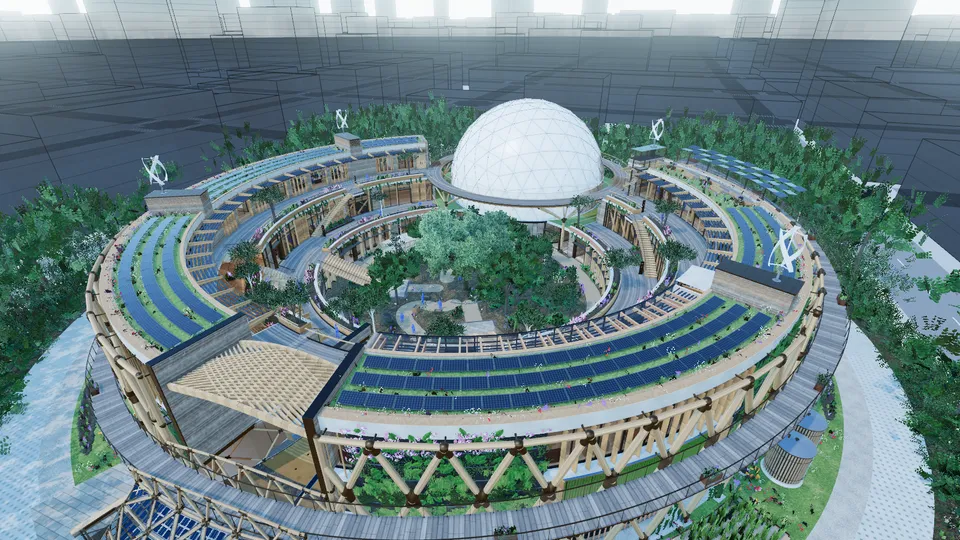
Temperate: the court open to the sky.
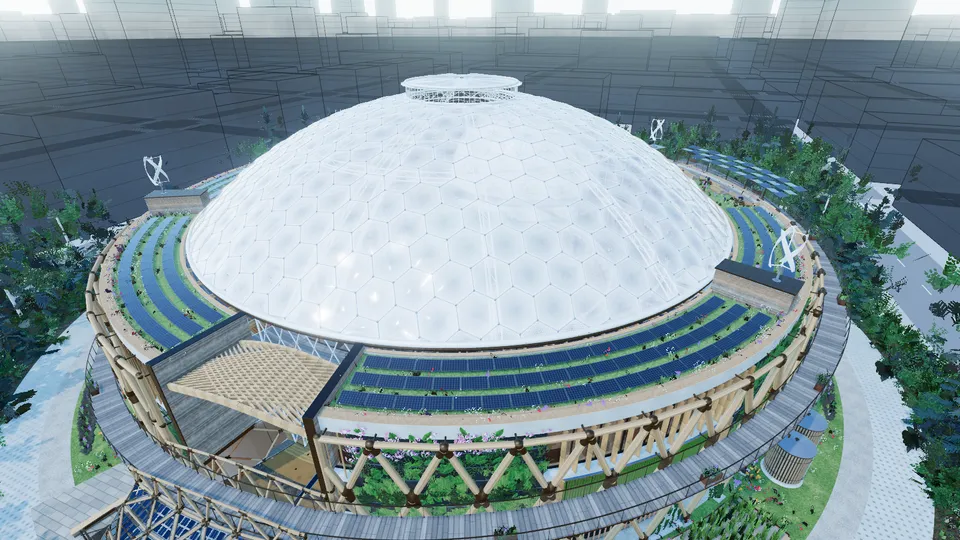
Boreal: a canopy turns the court into a winter garden.
The visit leaves other choices open too, in its settings: two ways to plant the court, and three things the halls can hold.
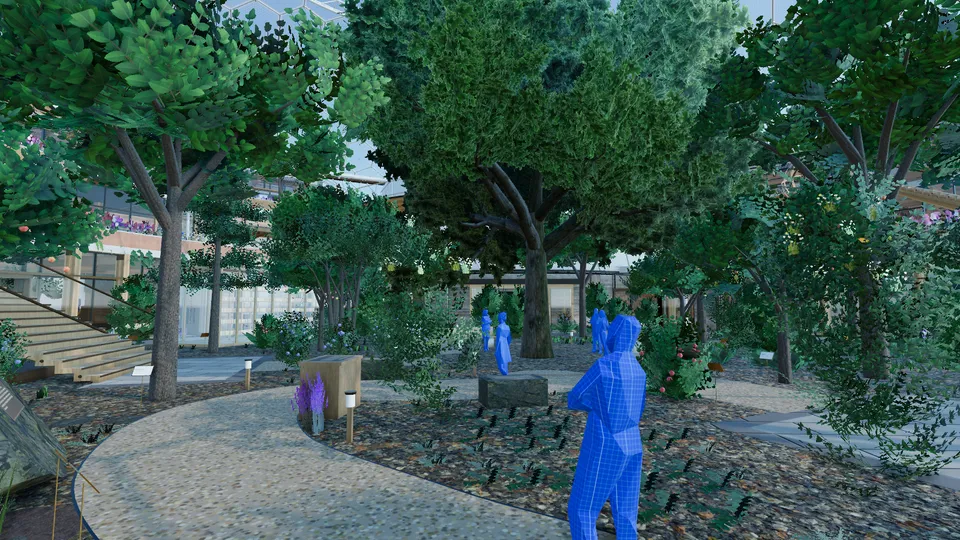
Forest: a forest garden round a great red oak.
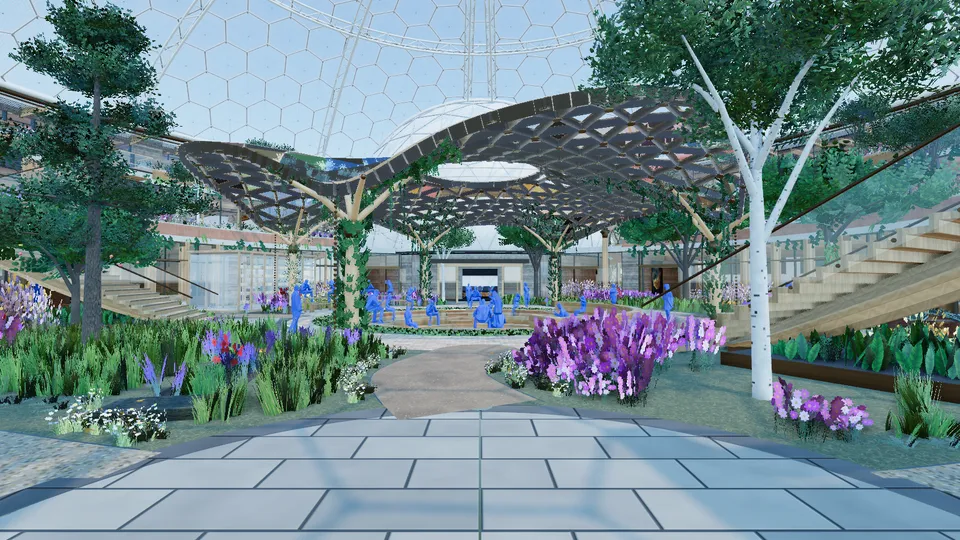
Hearth canopy: a ring round a fire under woven coloured glass, climbers on its columns, fed by rain pools.
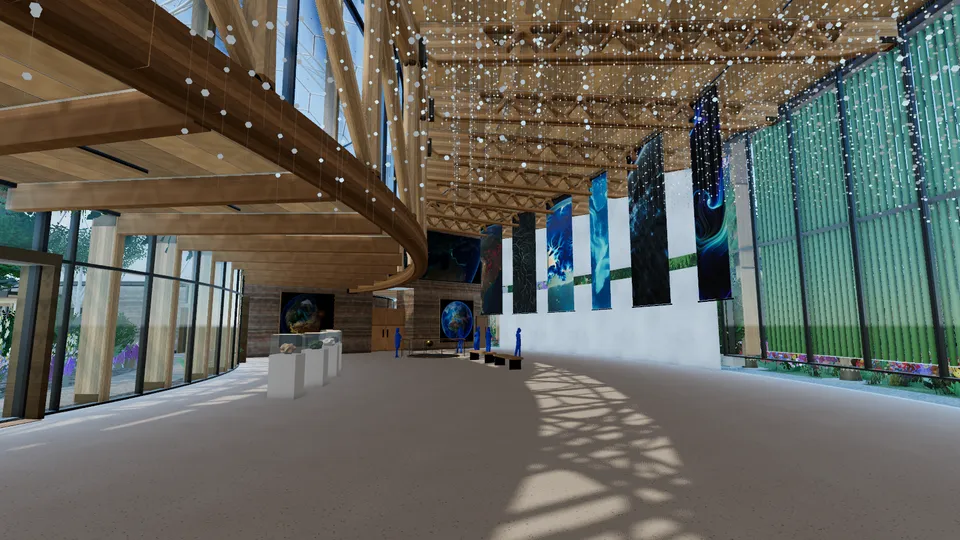
Works: GLOBAÏA’s large prints and banners, a Foucault pendulum, a field of light strands.
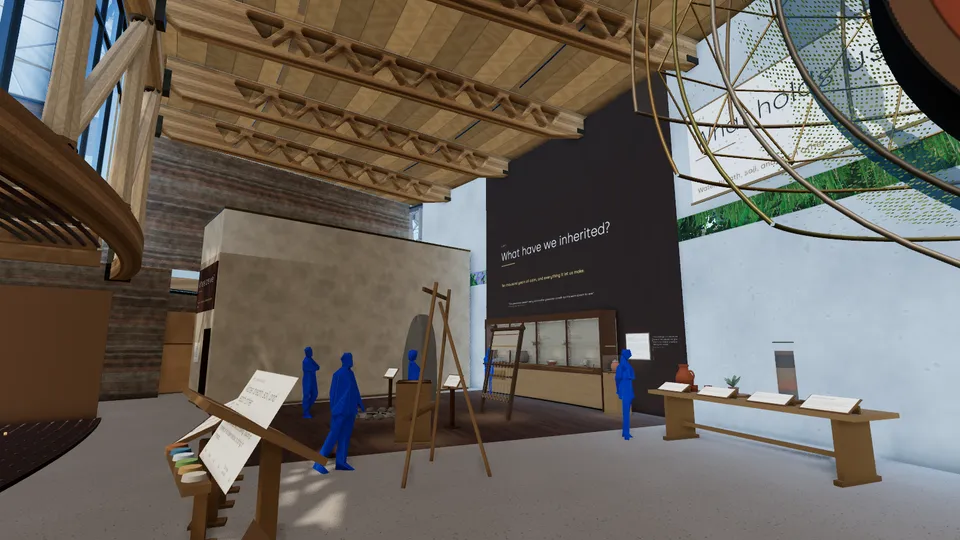
Exhibition: The Planetary, seven questions told through objects, voices and the science beneath them.
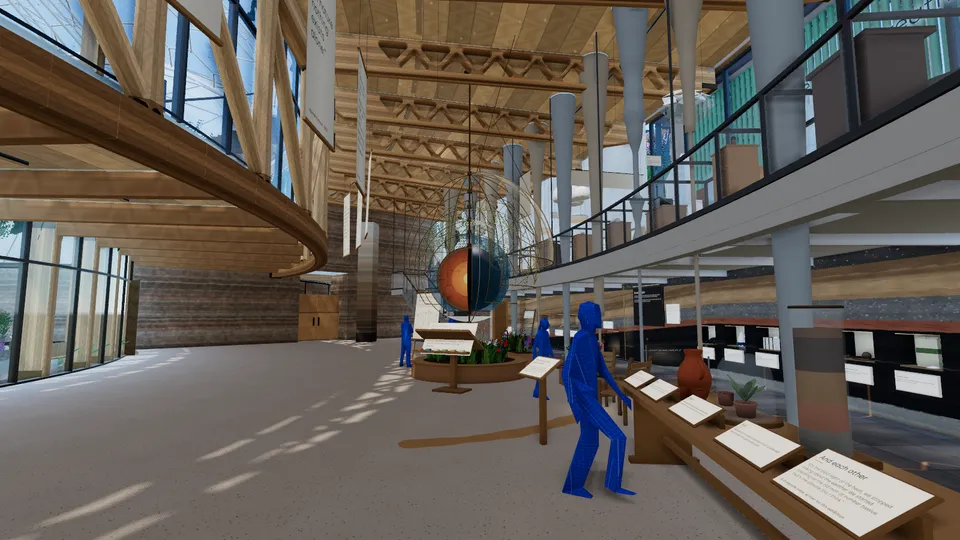
Stone and Sky: the Earth’s strata in a gallery under a deck, the Earth in the open nave, breath and weather on the deck above.
Almost done before.
A building can change a city’s culture. These houses proved it, each in its own way.
-
Société des arts technologiques
Montréal · 1996
Its Satosphère made a dome in the middle of a city a public stage for immersive art, not only a planetarium.
-
Arvo Pärt Centre
Laulasmaa, Estonia · 2018
A building in a pine forest, dedicated to one body of work and to silence. Architecture can carry a state of mind.
-
ZKM | Center for Art and Media
Karlsruhe · 1989
Research, collection, production and exhibition under one roof, in a converted munitions factory.
-
Ars Electronica Center + Futurelab
Linz · 1996
A museum of the future joined to a working lab, linking art, technology and society for three decades.
-
Waag Futurelab
Amsterdam · 1994
A public research lab in a medieval weigh house, turning technology back toward the commons.
-
Pioneer Works
Brooklyn · 2012
A former ironworks where artists and scientists share studios, residencies, talks and free public programmes.
None of them is devoted to the planetary. The Centre for Planetary Stewardship gathers what they have shown, the dome, the lab, the residency, the open programme, the building as a state of mind, and turns it toward the Earth.
Why every city needs one.
Public libraries, museums and hospitals were once proposals too. Each became ordinary when a society recognised a need it could only meet together. The Centre for Planetary Stewardship answers such a need.
The first of many.
The first Centre is a model, not a monument: one building, one programme, one way of being together around the planetary, designed to be adapted. Each new Centre takes root in its own city, with its own gardens, languages, knowledges and partners, and shares its shows, exhibitions, research and people with the others. The first Centres will publish everything needed to start another, the patterns, programmes, research methods and ways of governing, so the network can grow the way a forest does: from many seeds, with no headquarters.
None of it exists yet. It is offered as a vision, in the hope that real places, and real roles in our societies, will one day grow from it, in forms this page cannot foresee.
One day, every city should have one.
Support the idea.
If you would like a place like this in your city, say so. Every heart and every thumb is counted, anonymously, and tells us the idea is worth carrying further.
Partners and endorsers Experimental
Organisations that support the idea of a Centre for Planetary Stewardship: universities, museums, cities, schools, foundations, community groups. Supporting the idea commits no one to anything; it says that a place like this should exist. Each offer is read by a person at GLOBAÏA before it appears here.
No organisation is listed yet. Yours could be the first.
Notes
- Klinenberg, E. (2018). Palaces for the People: How Social Infrastructure Can Help Fight Inequality, Polarization, and the Decline of Civic Life. New York: Crown.
- Moser, S. C. (2016). Reflections on climate change communication research and practice in the second decade of the 21st century. WIREs Climate Change 7, 345–369. 10.1002/wcc.403
- Sparkman, G. & Walton, G. M. (2017). Dynamic norms promote sustainable behavior, even if it is counternormative. Psychological Science 28, 1663–1674. 10.1177/0956797617719950
- Falk, J. H. & Dierking, L. D. (2010). The 95 percent solution: school is not where most Americans learn most of their science. American Scientist 98, 486–493. 10.1511/2010.87.486
- Spence, A., Poortinga, W. & Pidgeon, N. (2012). The psychological distance of climate change. Risk Analysis 32, 957–972. 10.1111/j.1539-6924.2011.01695.x
- Andre, P., Boneva, T., Chopra, F. & Falk, A. (2024). Globally representative evidence on the actual and perceived support for climate action. Nature Climate Change 14, 253–259. 10.1038/s41558-024-01925-3
- Sparkman, G., Geiger, N. & Weber, E. U. (2022). Americans experience a false social reality by underestimating popular climate policy support by nearly half. Nature Communications 13, 4779. 10.1038/s41467-022-32412-y
- Centola, D., Becker, J., Brackbill, D. & Baronchelli, A. (2018). Experimental evidence for tipping points in social convention. Science 360, 1116–1119. 10.1126/science.aas8827
- Otto, I. M. et al. (2020). Social tipping dynamics for stabilizing Earth’s climate by 2050. PNAS 117, 2354–2365. 10.1073/pnas.1900577117
- World Meteorological Organization (2025). State of the Global Climate 2024. WMO-No. 1368. wmo.int/publication-series/state-of-global-climate-2024
- Richardson, K. et al. (2023). Earth beyond six of nine planetary boundaries. Science Advances 9, eadh2458. 10.1126/sciadv.adh2458
- Sakschewski, B., Caesar, L., Rockström, J. et al. (2025). Planetary Health Check 2025: A Scientific Assessment of the State of the Planet. Potsdam Institute for Climate Impact Research. www.planetaryhealthcheck.org
- WWF (2024). Living Planet Report 2024: A System in Peril. Gland, Switzerland. livingplanet.panda.org
- Hickman, C. et al. (2021). Climate anxiety in children and young people and their beliefs about government responses to climate change: a global survey. The Lancet Planetary Health 5, e863–e873. 10.1016/S2542-5196(21)00278-3
- Chawla, L. (2020). Childhood nature connection and constructive hope: a review of research on connecting with nature and coping with environmental loss. People and Nature 2, 619–642. 10.1002/pan3.10128
- Folke, C. et al. (2021). Our future in the Anthropocene biosphere. Ambio 50, 834–869. 10.1007/s13280-021-01544-8
- Willett, W. et al. (2019). Food in the Anthropocene: the EAT–Lancet Commission on healthy diets from sustainable food systems. The Lancet 393, 447–492. 10.1016/S0140-6736(18)31788-4
- Crippa, M. et al. (2021). Food systems are responsible for a third of global anthropogenic GHG emissions. Nature Food 2, 198–209. 10.1038/s43016-021-00225-9
- Oldenburg, R. (1989). The Great Good Place. New York: Paragon House.
- OECD (2020). Innovative Citizen Participation and New Democratic Institutions: Catching the Deliberative Wave. Paris: OECD Publishing. 10.1787/339306da-en
- Dryzek, J. S. et al. (2019). The crisis of democracy and the science of deliberation. Science 363, 1144–1146. 10.1126/science.aaw2694
- Yaden, D. B. et al. (2016). The overview effect: awe and self-transcendent experience in space flight. Psychology of Consciousness 3, 1–11. 10.1037/cns0000086
- Piff, P. K. et al. (2015). Awe, the small self, and prosocial behavior. Journal of Personality and Social Psychology 108, 883–899. 10.1037/pspi0000018
- Kyba, C. C. M. et al. (2023). Citizen scientists report global rapid reductions in the visibility of stars from 2011 to 2022. Science 379, 265–268. 10.1126/science.abq7781
- United Nations Environment Programme (2022). 2022 Global Status Report for Buildings and Construction: Towards a Zero-emission, Efficient and Resilient Buildings and Construction Sector. Nairobi: UNEP. globalabc.org/resources/publications/2022-global-status-report-buildings-and-construction
- Alexander, C., Ishikawa, S. & Silverstein, M. (1977). A Pattern Language: Towns, Buildings, Construction. New York: Oxford University Press.
- Pascual, U. et al. (2023). Diverse values of nature for sustainability. Nature 620, 813–823. 10.1038/s41586-023-06406-9
- Ostrom, E. (1990). Governing the Commons: The Evolution of Institutions for Collective Action. Cambridge University Press.
- United Nations, Department of Economic and Social Affairs, Population Division (2019). World Urbanization Prospects: The 2018 Revision. New York: United Nations. population.un.org/wup
Images of the Centre are stills from the virtual visit from GLOBAÏA. Visitors: “Freebie – Lowpoly People” by Studio Ochi, CC BY-NC-ND 4.0, unmodified. Night sky: NASA/Goddard Space Flight Center Scientific Visualization Studio; Gaia DR2: ESA/Gaia/DPAC.
Contents
- There is no house for the planetary
- An organ, not a monument
- Why knowing is not enough
- The majority that cannot see itself
- Why now
- Planetary, not global
- What stewardship asks
- What we believe
- A day at the Centre
- Walk through the Centre in 3D
- Research, creation, communication
- Research that answers to the city
- A building that broadcasts
- A building that practises what it says
- A pattern language, not a blueprint
- Almost done before
- Why every city needs one
- The first of many
- Support the idea
- Notes