GLOBAÏA · Explorations
AI Mathematics
In 2026 machines began producing mathematics that mathematicians judged important. Here are four of the problems involved, one result still unchecked and one problem still open, turned into objects you can play with: finite, honest companions that run in your browser, not proofs.
-
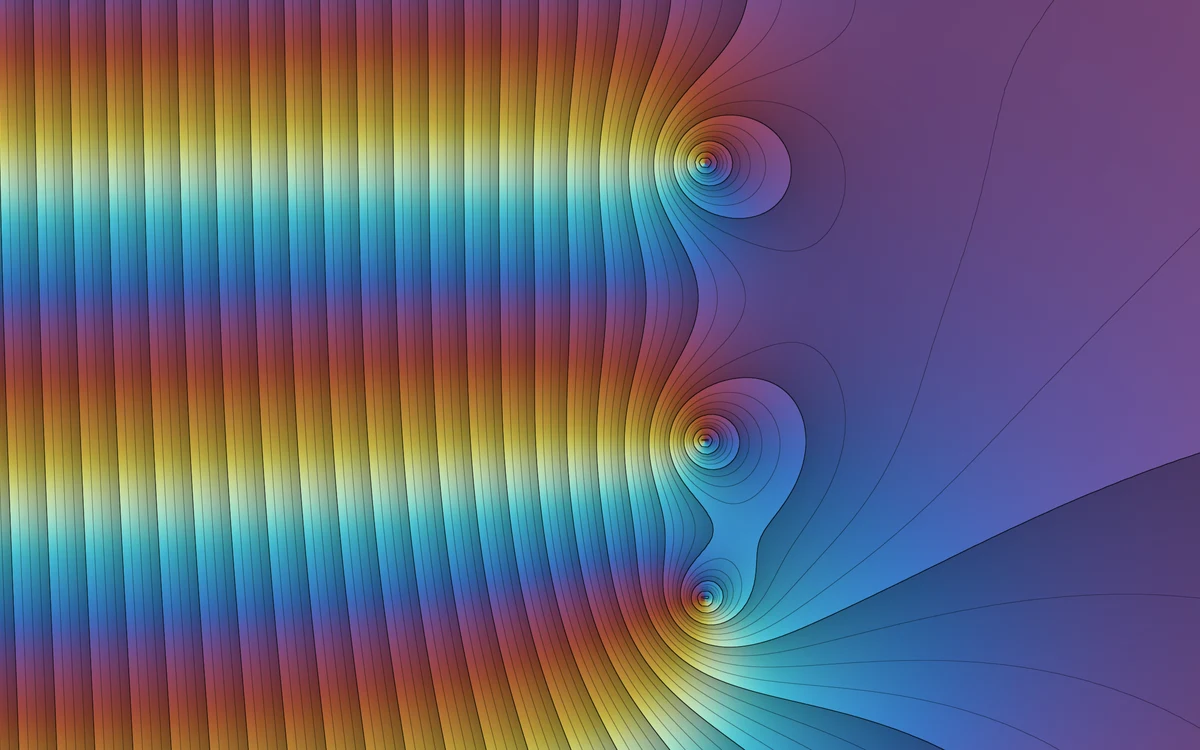 Number theory · live 2D and 3D Riemann’s Line, 1859 → 2026 The zeta function in three views: a live phase portrait, a landscape of wells, and ten thousand zeros in one image, every one of them on a single line. After Levent Alpöge’s proof of the Riemann Hypothesis, made with Claude and certified in Lean on 21 November 2026.
-
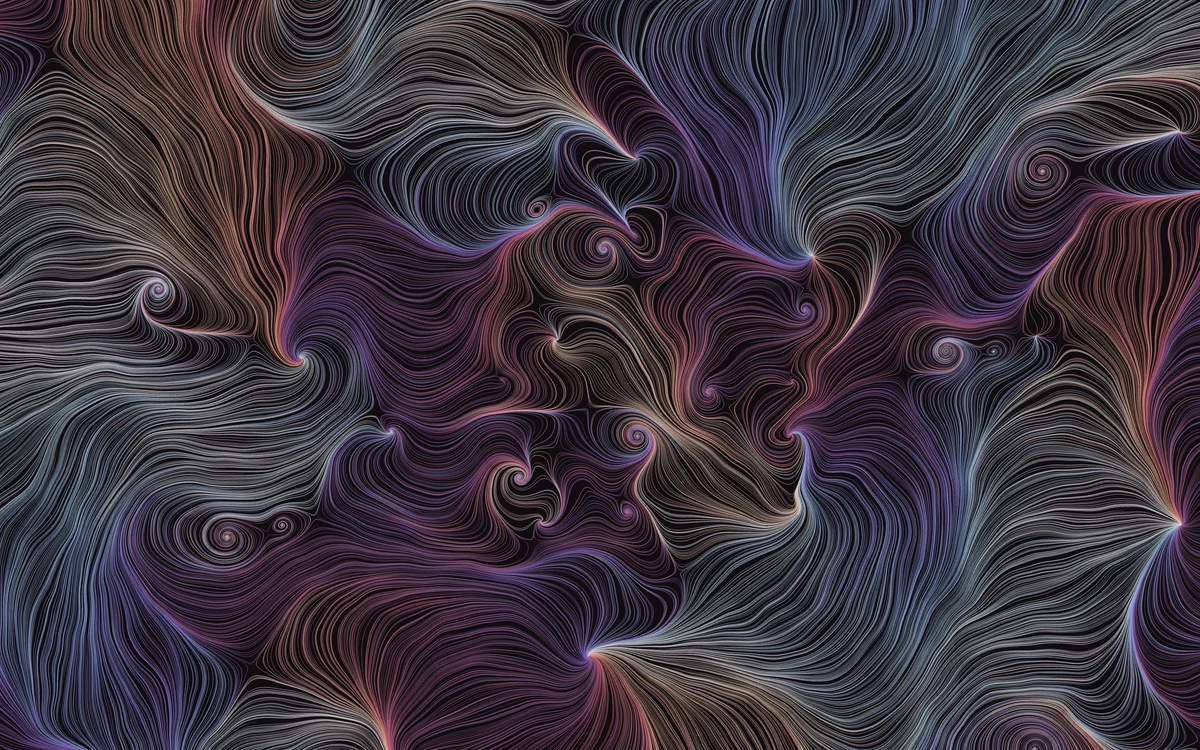 Statistical physics · live 2D The Topology of a Turn A field of compass needles on your graphics card. Heat it, quench it, pull vortex pairs out of it and watch them annihilate. After “Essential Singularity of the Correlation Length in the Planar XY Model”, 5 October 2026
-
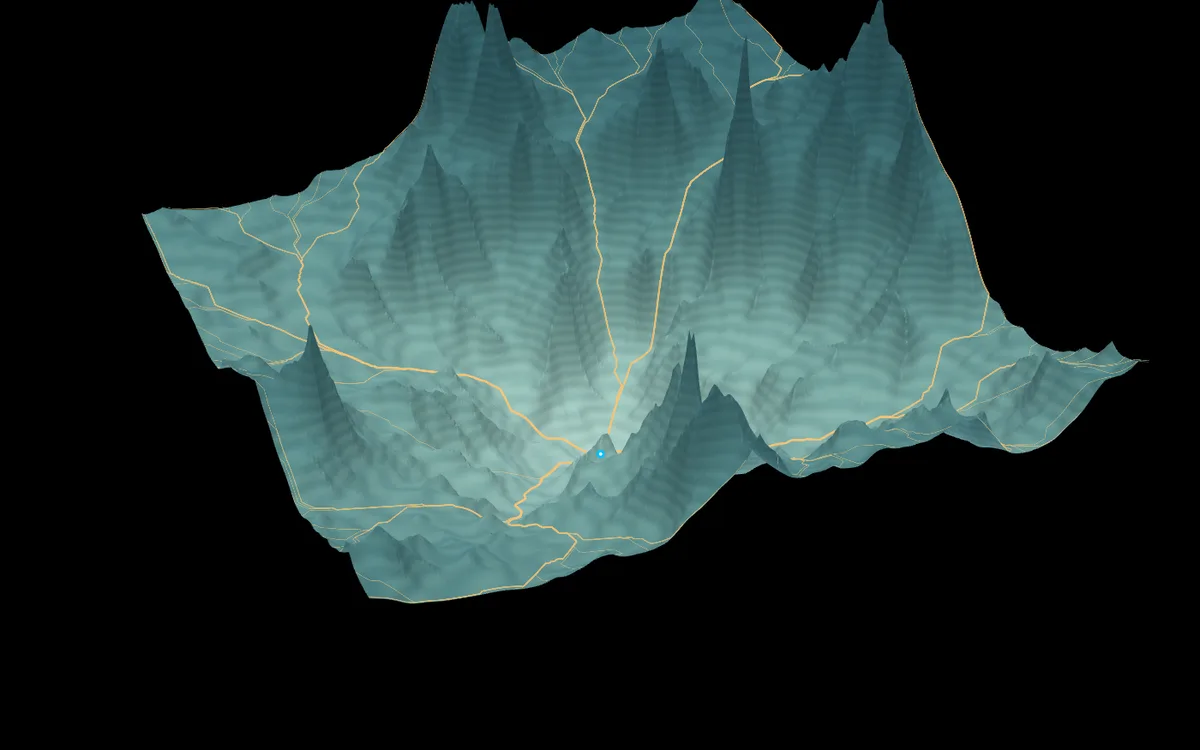 Random geometry · live 3D Geodesic Estuary Shortest paths through a random landscape. Change the disorder, place competing sources, send a distance front across the ground. After “Metric-measure limits of subcritical FK and spanning-tree planar maps”, 24 September 2026
-
 Number theory · live 3D · open problem The Collatz Plume Halve the even numbers, triple the odd ones and add one. Twenty thousand numbers take their roads down to 1 and merge into a single plume of light. The Collatz conjecture is still open. The page says what machines have tried.
The Topology of a Turn and Geodesic Estuary follow manuscripts in OpenAI’s mathematics repository, 719 manuscripts produced by an internal OpenAI model and released in October 2026; by OpenAI’s own account not all have been formally verified, and some could have issues. Each page states what its simulation does and does not show.
What this page is
Mathematics keeps lists of what it cannot yet do. This section follows those lists into 2026, the year machines began crossing items off, and keeps the results that leave something to see: a line of zeros, a field of vortices, a shortest path through noise. Each card above is one such picture, built to be played with. More will follow. The aim is narrow and visual: to find the patterns that AI mathematicians uncover, and to show them.
Reading the marks
Every problem below carries one of six marks. A mark given in 2026 says who made the claim, and the line beside it says who has checked it.
- Human-solved Settled by people, with a proof the community accepts.
- Human solved with AI A person led the work and an AI system did part of the finding or the checking.
- AI-solved The proof, or the counterexample, was produced by an AI system.
- Partly solved Answered in some cases, or shown to depend on the axioms one starts from.
- Open Nobody knows.
- Too vague to settle A direction for research more than a question with a yes or a no.
1900Hilbert’s 23 problems
On 8 August 1900, at the International Congress of Mathematicians in Paris, David Hilbert (1862–1943) did something unusual for a lecture. He was 38, a professor at the University of Göttingen, and instead of reviewing the century that had just ended he set the work of the one beginning. “Who of us would not be glad to lift the veil behind which the future lies hidden?” he asked, and then he listed what he thought mathematics most needed to find out. He had time to read ten problems aloud; the printed lecture carried twenty-three. Some were sharp questions, some were whole programmes of research. For a hundred years, solving one was a way into history.
Show the 23 problemsHide the 23 problems 8 Human-solved1 Human solved with AI10 Partly solved1 Open3 Too vague to settle
-
1The Continuum Hypothesis
Is there a size of infinity strictly between the whole numbers and the points of a line? Kurt Gödel (1940) and Paul Cohen (1963) showed that the usual axioms of mathematics can neither prove it nor refute it.
Partly solvedUndecidable from the standard axioms
-
2The Consistency of Arithmetic
Can arithmetic be proved free of contradiction? Gödel showed in 1931 that arithmetic cannot prove its own consistency. Gerhard Gentzen proved it in 1936, with stronger tools.
Partly solvedDepends on what one allows as proof
-
3Scissors and Polyhedra
Take two solids with flat faces and equal volume. Can one always be cut into finitely many pieces and reassembled into the other? No. Hilbert’s student settled it within the year.
Human-solvedMax Dehn, 1900
-
4Straight Lines as Shortest Paths
Describe every geometry in which the shortest route between two points is a straight line. Stated too loosely to have one answer.
Too vague to settle
-
5The Smoothness of Symmetries
Is a continuous family of symmetries automatically a smooth one? Yes, in the usual reading of the question.
Human-solvedGleason, Montgomery and Zippin, 1952
-
6The Axioms of Physics
Give physics the same rigorous foundations as geometry. A programme more than a question. Andrey Kolmogorov did it for probability in 1933.
Too vague to settle
-
7Transcendental Numbers
Is a number like 2 raised to the square root of 2 transcendental, out of reach of every polynomial equation with whole-number coefficients? Yes.
Human-solvedGelfond and Schneider, 1934
-
8The Primes
Three questions about prime numbers: the Riemann Hypothesis, Goldbach’s conjecture and the twin primes. A proof of the first was announced in November 2026. The other two remain open. See the companion page
Human solved with AIThe Riemann part only: machine-checked, awaiting peer review
-
9The General Reciprocity Law
Find the most general law saying when one number is a perfect power in the arithmetic of remainders. Emil Artin gave it in 1927 for a large class of number systems. The rest lives on in the Langlands programme.
Partly solved
-
10Equations in Whole Numbers
Is there a procedure that decides whether any polynomial equation has whole-number solutions? No. The proof builds on Martin Davis, Hilary Putnam and Julia Robinson.
Human-solvedYuri Matiyasevich, 1970
-
11Quadratic Forms
Classify expressions like x² + 3y² when the coefficients come from any number system. Helmut Hasse solved much of it in the 1920s.
Partly solved
-
12Kronecker’s Dream
Extend a theorem of Leopold Kronecker that builds whole number systems from special values of a single function. Done for a few families, open in general.
Partly solved
-
13Equations of the Seventh Degree
Can the general equation of degree seven be solved with functions of only two variables? Yes with continuous functions, by Vladimir Arnold and Andrey Kolmogorov in 1957. Still open for algebraic ones.
Partly solved
-
14The Finiteness of Invariants
Are certain collections of invariant expressions always generated by finitely many of them? No. A counterexample closed the question.
Human-solvedMasayoshi Nagata, 1959
-
15Schubert’s Counting Calculus
Put Hermann Schubert’s method for counting geometric configurations, such as the lines that meet four given lines, on firm ground. Largely done. Some cases remain.
Partly solved
-
16Ovals and Limit Cycles
How can the ovals of an algebraic curve be arranged, and how many isolated closed orbits can a polynomial flow in the plane have? Unsettled even in the simplest cases.
Open
-
17Sums of Squares
Can every ratio of polynomials that never goes negative be written as a sum of squares? Yes.
Human-solvedEmil Artin, 1927
-
18Tilings and Sphere Packing
Three questions about filling space: how many crystal symmetries exist, whether a tile can cover space only irregularly, and how to pack spheres most densely. All answered. Thomas Hales’s packing proof was checked in full by computer in 2014.
Human-solvedBieberbach 1910, Reinhardt 1928, Hales 1998
-
19Are Solutions Always Smooth?
When nature minimises something, a soap film its area for instance, is the resulting shape always perfectly smooth? Yes, for well-behaved problems.
Human-solvedBernstein 1904, De Giorgi and Nash 1957
-
20Boundary Value Problems
Do such problems always have a solution once conditions are fixed on the boundary? A century of work says yes in many settings, not in all.
Partly solved
-
21Prescribed Monodromy
Is there a differential equation for every prescribed way its solutions twist around their singular points? Yes, no or unknown, depending on how the question is made precise. Andrei Bolibrukh found a counterexample in 1989.
Partly solved
-
22Uniformization
Can a curve defined by an equation be traced out by a single well-behaved parameter? Settled for one variable by Paul Koebe and Henri Poincaré in 1907. Open beyond.
Partly solved
-
23The Calculus of Variations
Develop further the mathematics of finding the best possible shape or path. An invitation, not a problem.
Too vague to settle
2000The 7 Millennium Prize Problems
A century later the gesture was repeated, again in Paris. On 24 May 2000, at the Collège de France, the Clay Mathematics Institute named seven problems and attached one million dollars to each. Only one came straight from Hilbert’s list, the Riemann Hypothesis. For a quarter of a century a single prize was earned, and its winner turned it down.
Show the 7 problemsHide the 7 problems 1 Human-solved1 Human solved with AI5 Open
-
Birch and Swinnerton-Dyer Conjecture
An elliptic curve is an equation like y² = x³ − x. Does a single function attached to it tell whether it has finitely or infinitely many solutions in fractions? Proved in special cases only.
Open
-
Hodge Conjecture
On shapes defined by polynomial equations, which of the features that topology detects can be built from smaller shapes also defined by equations? Proofs of special cases written by an AI system were posted in 2026, and some were withdrawn.
Open
-
Navier–Stokes Existence and Smoothness
The equations of flowing water and air are two centuries old. Do their solutions in three dimensions always stay smooth, or can they blow up? Nobody knows.
Open
-
P versus NP
If a solution can be checked quickly, can it also be found quickly? Most researchers believe not. Nobody has proved it.
Open
-
Poincaré Conjecture
Is every closed three-dimensional shape without holes a sphere in disguise? Yes. Perelman declined the million dollars in 2010.
Human-solvedGrigori Perelman, 2002 and 2003
-
Riemann Hypothesis
Do all the meaningful zeros of the zeta function, which governs how the primes are spread, sit on a single line? Levent Alpöge announced a proof on 20 November 2026, found working with Claude and released as a formalization in the Lean proof assistant. See the companion page
Human solved with AIMachine-checked on 21 November 2026. Not yet peer-reviewed, no Clay award
-
Yang–Mills Existence and Mass Gap
Build the quantum theory behind the strong nuclear force with full mathematical rigour, and show that its lightest particle has a mass. In November 2026 an outside group reported that an OpenAI formal proof of part of the existence half holds up. The mass gap is untouched.
Open
Statuses of Hilbert’s problems follow the standard accounts of each problem; the Millennium Prize Problems follow the Clay Mathematics Institute, which has made one award. The curves beside the names are ornaments, one per problem, and encode nothing.