× Navigating the Anthropocene Strait
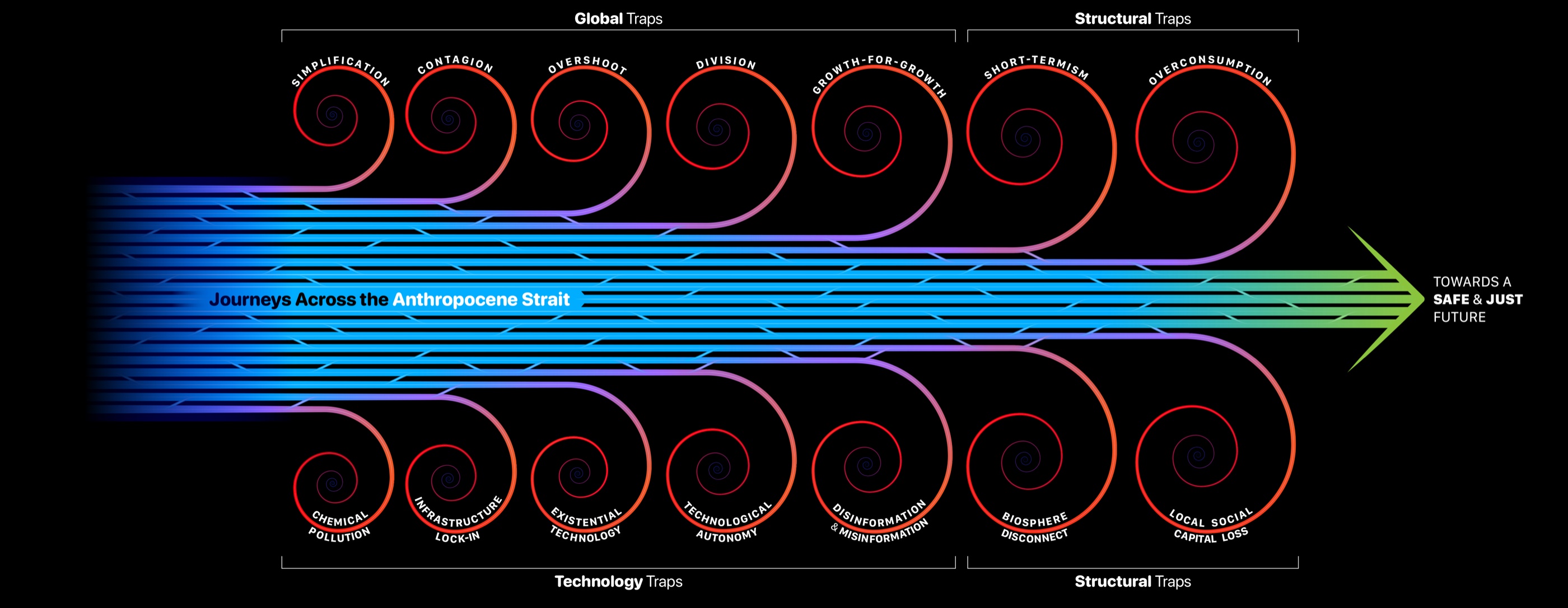
Our interconnected global society is sailing through uncertain waters. The
Anthropocene Strait is lined with 14 evolutionary traps — systemic forces that
capture human enterprise and prevent us from reaching a safe and just future.
Like whirlpools in a narrow passage, each trap pulls in resources, attention,
and momentum that would otherwise carry us forward.
The ship represents our collective voyage — our interconnected global society, with
its strengths and vulnerabilities, navigating an uncertain sea. Click the
ship button to activate it, then click anywhere on
the canvas to set waypoints. The ship is influenced by the flow field's currents but
follows your guidance. Steer wide of the vortices — sail too close and the whirlpool
takes hold, dragging the ship down its spiral before a new one sets out from the
starting line. Reaching the green safe zone means a successful passage.
The traps fall into four kinds, according to what generates them:
Global Technology Temporal Connectivity
Global traps come from the growing complexity of societies competing
and cooperating at world scale. Technology traps come from the
unintended consequences of the tools we build. Temporal traps come
from the gap between how fast the world now changes and how far ahead we plan —
short-termism is the only one, and it is the most damaging of the fourteen.
Connectivity traps come from the distance global connection puts
between an action and the place where its consequences land.
Each trap also carries a phase — how far it has already run, from
initiation through scaling and masking to trapping .
Traps still in early phases are the ones we can most plausibly steer out of.
Hover any whirlpool to see its phase; click it for the full account.
Counting the links between traps mapped in the 2024 study, GLOBAÏA finds 87 that are
not neutral — and 81 of them amplify another trap, against only six
that dampen one. That ratio is the polycrisis in a single number: these traps
overwhelmingly feed each other.
Use the scenario slider to explore different futures — from
transformative change (weakening traps) to polycrisis escalation (strengthening them).
Per-trap strength sliders let you explore "what if we addressed this trap?" scenarios.
The dice button randomizes trap positions for a fresh layout.
Escaping a trap takes what researchers call evolvability: recognizing the trap,
measuring and forecasting it, reorganizing and innovating, preparing for the unknown,
and navigating the conflict that change provokes.
A 2026 follow-up study put that idea to the test, checking all fourteen traps against
23 well-established capacities for resilience — 14 adaptive capacities
for absorbing shocks and bending without breaking, and nine
transformative capacities for changing the system itself.
The two kinds turn out to cover different ground, which is why we need both. Adaptive
capacities mostly reach the temporal and connectivity traps; transformative capacities
mostly reach the global and technology ones. Ten of the fourteen traps also push back,
undermining 18 of the 23 capacities — so capacity and trap are locked in a struggle,
each developing at the other's expense.
Two findings are worth dwelling on. Short-termism and
biosphere disconnect do the most damage, threatening more capacities
than any other trap — and they are also the traps the most capacities reach, so they
are the obvious places to push. Meanwhile overshoot is addressed
directly by none of the 23 capacities, and technological autonomy by
only one. The resilience toolkit we have inherited has a hole in it exactly where the
Earth system is concerned.
Switch on the corridor to see the passage that is
actually open. It is not drawn by hand: the simulation launches hundreds of trial
voyages down the left shore, follows each one through the currents, and keeps the ones
that reach the far side without being pulled under. The green band is where those
successful journeys run, and its edges fade because safety is a gradient, not a fence.
As resilience is worn away by long-term pressure — a warming climate, biodiversity in
decline, widening inequality, trust draining out of institutions — the corridor
narrows. That narrowing is what makes a shock dangerous. The same disturbance a wide
corridor would have absorbed becomes, in a narrow one, a full crisis. Push the traps
hard enough and the corridor stops being a corridor at all: it breaks into disconnected
pockets with no way through.
The resilience slider is the other half of the picture:
it sets how close we can sail to a trap without being pulled under.
Trap strength closes the corridor from the outside; resilience capacities hold it open
from the inside. Neither one alone decides the outcome, which is the point the 2026
study makes: adaptive and transformative capacities are both necessary, and they are
being contested by the very traps they are meant to address.
This is an educational visualization, not a predictive model. The ship metaphor
illustrates the challenge of navigating systemic traps, not an actual prediction
of outcomes.
Inspired by the frameworks of Planetary Boundaries
(Rockstrom et al. 2009, Steffen et al. 2015, Richardson et al. 2023),
Earth System Boundaries (Gupta et al. 2023), and the
Anthropocene Traps research (Søgaard Jørgensen et al. 2024),
which together define the safe operating space for humanity and map the systemic
forces that threaten it.
References
Søgaard Jørgensen P, Jansen REV, Avila Ortega DI, Wang-Erlandsson L,
Donges JF, Österblom H, Olsson P, Nyström M, Lade SJ, Hahn T, Folke C,
Peterson GD, Crépin A-S. 2024. Evolution of the polycrisis: Anthropocene
traps that challenge global sustainability.
Philos Trans R Soc Lond B Biol Sci 379(1893): 20220261.
DOI: 10.1098/rstb.2022.0261
Søgaard Jørgensen P, Delannoy L, Maniatakou S, Folke C, Moore M-L,
Olsson P. 2026. Both adaptive and transformative capacities are necessary
to navigate global polycrisis. Global Sustainability 9: e16.
DOI: 10.1017/sus.2026.10053
Visualization: GLOBAÏA, 2026. Particle simulation concept, design, and implementation.
Creative Commons CC BY 4.0
Suggested citation GLOBAÏA (2026). Navigating the Anthropocene Strait [interactive visualization]. globaia.org/anthropocene-traps/interactive/. Accessed