A black hole is the one object in nature that withholds itself entirely from sight; the whole of physics has had to be bent to infer it. What follows traces that inference — from Thales, who fell down a well while watching the sky, to the instruments that, in our own decade, at last photographed the dark.
Dinanzi a me non fuor cose create se non etterne, e io etterno duro. Lasciate ogne speranza, voi ch’intrate.
Before me nothing was created save eternal things, and I endure eternal. Abandon all hope, ye who enter here.
— Dante Alighieri, La Commedia, Inferno, Canto III
The Well
A droll episode is reported by Plato in his philosophical treatise on knowledge, the Theaetetus. It stages Thales of Miletus, first of the Pre-Socratic philosophers, in the 6th century BCE:
Thales […] having fallen into a well while gazing skyward, busy as he was with astronomy, a little Thracian servant girl — pert and full of good humour — is said to have mocked him for setting such ardour on knowing what is in the heavens, when he could not even see what lay before him and at his feet!
It seems that, ever since, this anecdote has been raised into an emblem, casting natural philosophers as creatures of otium cum dignitate — noble idleness — at times the bearers of brilliant and revolutionary ideas, but most often utterly absent from the affairs of this world. O reveries, at once so necessary and so useless!
This historical misjudgement stems in part from the quest for the arkhè / ἀρχή commonly ascribed to the Pre-Socratics — the search for the principle that presides over the origin of the world and that, at the same time, governs it. Indeed, wanting to get to the bottom of things does sometimes lead one straight into the well! This prospection of the principles upholding reality continues to this day; and, as is often the case, the probes cast by Thales’s descendants run aground at the edge of certainties, on shoals laden with great upheavals. For today, physicists are colliding with the all-but-perfect, all-but-total enigma of the gravitational well: the BLACK HOLE. What doors will this avatar of the Sphinx open? The road that leads to the understanding of this singular phenomenon allows us to better grasp the laws of nature — its commandment — and the extraordinary events that thronged at its genesis — its commencement.
A Prehistory of Black Holes
It all begins with the theory of universal attraction worked out by Isaac Newton. Published in his monumental work, the Philosophiae naturalis principia mathematica in 1687, this synthesis reconciles the terrestrial and the celestial worlds by positing that every body in the universe is subject to one and the same force: gravitation. This gravitational relation between heavenly bodies varies according to their mass and the distance separating them. By this conceptual reworking, Newton sutures a breach left gaping since the first Greek geometer-astronomers some 2,200 years earlier. At last, it is granted to humans to conceive the Universe as a single homogeneous whole, with no rupture between it (the incorruptible supralunary world) and us (inhabitants of a corruptible sublunary world). At the very least we can henceforth apprehend the Universe by means of the laws known down here…
It is in this positivist climate that the idea of the black hole is born. In 1784, John Michell expressed the pioneering idea that light, after the manner of little grains of matter, could be affected by gravitation.1 In this “ballistic optics” everything would be a matter of speed, light being slowed by the more or less great mass of the emitting star. One then understands that a star could be so massive that its own light could no longer escape it. In 1799, Pierre Simon de Laplace fell in behind Michell, formulating his theorem according to which “the attractive force of a heavy body can be great enough that light may not escape from it.” He spoke then of strange “obscure bodies”… Then Johann Georg von Soldner computed the deflection of light in the vicinity of the Sun — work he carried out in 1801 and published in 1804. But the corpuscular edifice was already crumbling: between 1801 and 1803, Thomas Young performs his famous double-slit experiment. He shows that light, when passing through a screen pierced with narrow slits before falling upon a viewing screen, traces interference patterns that betray its undulatory nature. The Newtonian conception of light as corpuscular is abandoned. Light being henceforth recognised as a wave, it was no longer permitted to succumb to gravitational influence. Exit Michell, Laplace and Soldner…2
A century goes by, during which savants gather the fruits of other arcana. In 1905, however, another coup de théâtre: one Einstein puts forward a theory that has the effect of a red-hot cannonball fired at the ever more rickety edifice of classical physics. His theory — the electrodynamics of moving bodies, or special relativity — establishes a relation of equivalence between the notions of mass and energy. By this theoretical recasting, the twenty-six-year-old shows that the speed of light is a universal constant to which space and time are subordinated. Then, in 1915, he shakes ideas yet again by integrating the Newtonian theory of gravitation into the broader frame of his own. General relativity, that great synthesis of space and time in which gravitation corresponds to deformations of space-time, sees the light of day and is enthroned in the pantheon of Great Explanations. It will be validated after being put to the test during a solar eclipse on 29 May 1919.
A Mathematical Possibility
Behind the phrase “black hole” — coined in 1967 by John A. Wheeler3 — there lurks the greatest of conundrums. A hole is indeed an “opening pierced from one side to the other through a surface.” Black expresses that which seems deprived of light. By saying that light “slides” along the depressions of space-time (always at 299,792 km/s in vacuum), Einstein’s idea invites us to think that space-time might twist itself singularly under the pressure of an extremely massive and dense body. Who knows — even to the point of being perforated… From such a well, no light would come back out.
Carried away by these conjectures, several researchers feverishly set to work and blackened countless sheets with their calculations. In 1916, Karl Schwarzschild surmised that the gravitational field exerted by a spherical mass in vacuum becomes, at a certain distance, infinite.4 According to these equations, the framework of general relativity allows us to envisage that regions of space-time may be infinitely curved, with parallels meeting within them. This threshold clinging to the lip of the abyss is called the “Schwarzschild radius,” or event horizon. Beyond this ultimate verge, nothing classical is any longer perceptible: which is to say, it is black.
These extravagant results greatly disturbed Einstein, who was nonetheless their progenitor. He even published a paper in 1939 in the hope of proving the non-existence in physical reality of these faults of space-time.5 In vain. With the years and the breakthroughs, the idea of the black hole has only grown — until, in our own time, it has been seen: in April 2019, the Event Horizon Telescope unveiled the first direct image of the shadow of the supermassive black hole at the centre of the galaxy M87; in May 2022, that of Sagittarius A*, at the heart of our own galaxy.6
Decline and Fall of a Star
To understand black holes, it is worth knowing the succession of stages that lead to their formation. A star is an enormous ball of plasma whose core is in nuclear fusion. The pressure generated by the colossal energy of the central nuclear reactions prevents it from collapsing under its own weight. For example, if our star, the Sun, endures and gladdens our days, it is because its contrary inner forces oppose each other and stabilise. Every second, it fuses 632 million tonnes of hydrogen into 628 million tonnes of helium: the 4-million-tonne difference is transmuted into pure energy, by virtue of Einstein’s mass-energy relation — whence its blinding light.
A star’s radiance thus implies a loss of mass. Its destiny and the circumstances of its death therefore depend on that mass. By convention, the masses of stars are gauged against the mass of the Sun, i.e. 1 M☉, which is equivalent to 1.99 × 10³⁰ kilograms.
So a day will come when the day will be no more: in five billion years, the Sun will have fused all its hydrogen. By gravity, its envelope of gas will begin to subside towards its throbbing core. But this solar implosion will not succeed, for nuclear reactions will resume — this time through the fusion of helium. The Sun will swell once more and enter its so-called “red giant” phase, now radiating far more energy than in its hydrogen-burning prime. Its size will reach the present orbit of the Earth.7 Eventually, gravitation will succumb to the shock waves of nucleosynthesis, and the upper layers of the dying star will dissipate into infinity. The centre of the newly formed planetary nebula will be inhabited by a residual clot — a white dwarf, a sort of ember the size of the Earth, very hot, made of overexcited degenerate matter. Thus shall the Sun die.
This white-dwarf endgame, although the most frequent in the Universe, does not set the rule among stellar populations. A minority of stars — the most massive — will end more dramatically, the black hole being the ultimate and exceptional demise. In 1925, Wolfgang Pauli formulated the exclusion principle, which accounts for the states of matter prevailing in white dwarfs. The degeneracy pressure due to the frantic agitation of electrons assures a certain cohesion to the white dwarf, insofar as it averts any further contraction. Then, in 1930, it was the turn of Subrahmanyan Chandrasekhar to lay his stone in the raising of this immense theoretical edifice. He computed that a white dwarf whose mass would exceed 1.4 M☉ would be too heavy for the pressure bound to Pauli’s exclusion principle to prevent its collapse.8 At the time, no one knew towards what new monster this theoretical auscultation of the limits of physics would lead.
But two years later, James Chadwick discovers the neutron. It is then realised that the collapse of a white dwarf drives its electrons (−) to break their orbits and cement themselves to the protons (+). From their embrace are born neutrons — particles largely responsible for an atom’s mass. And the unutterably dense sphere that ensues is an atomic nucleus of sidereal proportions: a neutron star.
To fix ideas: the diameter of a white dwarf is of the order of 10,000 km and its mass about 0.6 M☉ on average. A neutron star is far smaller, some 20 km across, but its density is a hundred million times greater — of the order of 10¹⁷–10¹⁸ kg/m³ at the core. Though hard to observe, these stellar cadavers are now legion — central stars of planetary nebulae such as the Ring Nebula (M57) in Lyra for the white dwarfs, and the Crab Pulsar at the heart of the Crab Nebula in Taurus for the neutron stars.
A Physical Possibility
One recalls that in 1939 Einstein published a paper denying his chthonian offspring — the black holes — the right to exist. Yet that same year, Robert Oppenheimer (sadly known for his involvement in the Manhattan Project) published two founding papers laying out the mechanisms by which compact objects collapse: with George Volkoff, the equation governing the equilibrium of a neutron star (today the Tolman–Oppenheimer–Volkoff equation); and with Hartland Snyder, the continued gravitational collapse of a sufficiently massive star into what we now call a black hole.9
Here is the gist. A neutron star whose mass exceeds roughly 2.2 M☉ collapses,10 no known force being able to resist gravity’s crushing supremacy. Its diameter shrinks and eventually becomes smaller than its Schwarzschild radius. The curvature this object then imprints on space-time being infinite, light would logically need an infinite speed to escape it.
Imagine the Herculean grip of gravitation as a wall of a certain height; to leap over it one must spring with a certain force. That leap is the escape velocity — the speed required to flee a celestial body’s pull. On Earth, one would need to jump at 11.2 km/s to clear the wall, or fall back down. On the Sun, which is more massive than Earth, an impulse of 618 km/s would be required. On a white dwarf, the jump should be some 5,000 km/s. On a neutron star, 200,000 km/s. We approach the unapproachable. In the case of a black hole, the wall of gravitation is so high that one would have to move faster than the swiftest of all speeds — that of light — to cross it. The undertaking is unavoidably doomed to failure…
Observing the Unobservable
Plato erected the first metaphysical doctrine of philosophy. He spoke of the sensible world — ours — as a pale copy of the world of intelligible forms, those eidetic objects that organise our thought. We approach physical reality through the senses; the intelligible forms, for their part, allow themselves to be brushed only by the exercise of discursive thought (dianoia / διάνοια) or, better, intuitive thought (noesis / νόησις). The case of black holes illustrates, in some sense, the Platonic descent of a concept from the ideal to the real: if black holes exist mathematically, as Schwarzschild inferred, they are also physically conceivable, as Oppenheimer and his fellows pointed out. The ultimate ordeal henceforth consisted only in rubbing theory against practice… A formidable trial — one that the twenty-first century has, at last, brought to fruition: in September 2015, the LIGO interferometers caught the gravitational-wave signal of two black holes merging more than a billion light-years away;11 and in 2019 and 2022 the Event Horizon Telescope returned the first images of black-hole shadows.
In principle, a black hole is, by essence, invisible. Yet the effects caused by its intense gravitational field, for their part, are turncoats and can betray its presence. But for that, one must scrutinise the sky assiduously, lying in wait for any strange behaviour. A whole array of observational methods and technologies fortunately sharpen our senses. In this task they are like auxiliaries that grope where our eyes get bogged.
The first candidate black hole emerged from the X-ray sky of the early 1960s and 1970s. The source was detected in 1964 by a rocket-borne experiment (Bowyer et al.) in the ample summer constellation of the Swan, then catalogued and monitored from 1970 onward by the Uhuru satellite — whence its name, “Cygnus X-1.” A burst of radio waves later revealed that these actinic emissions, difficult to localise, in fact came from the neighbourhood of a massive blue star — namely HDE 226868 — located, as we now know thanks to radio (VLBA) parallax, some 7,200 light-years from Earth.12 The correlation between the two objects was firmed up by two notable observations: (1) the analysis of the star’s emission spectrum proved that at times it was approaching, at times receding from us; and (2) the 5.6-day cyclic variation in the brightness of HDE 226868 indicated that it took 5.6 days to complete a revolution around its tiny invisible partner. This variation would be due to the angle at which the star presents itself — an angle that lets us see the stretching caused by the titanic tidal effect that Cygnus X-1 produces on its hapless companion.
Cygnus X-1 and HDE 226868 form a binary system — that is, a pair of stars — one member of which is in all likelihood a black hole. The masses can be estimated by Kepler’s third law of orbits combined with parallax: Cygnus X-1 weighs in at about 21 M☉, its companion at roughly 40 M☉. Nothing we know of, save a black hole, could be so small and yet attract so swiftly a star so massive.
This pairing intrigues: the dead star vampirises the widowed one. A bridge of matter would carry the shreds of the one to the abyss of the other across nearly 30,000,000 kilometres! The closer this matter draws to the gaping maw, the more it heats and swirls. The maelstrom of effervescent gas that orbits a black hole is called an accretion disk. That of Cygnus X-1 extends over millions of kilometres in radius, with an inner edge of a few hundred kilometres near the innermost stable circular orbit. Furthermore, as the spatiotemporal inflexion grows steeper while matter slides along its course, the trajectory followed by the star’s viscera becomes an ever-tightening spiral, courting with increasing obstinacy the fatal verge of the event horizon. This frenetic acceleration causes a state of intense excitation in the gas, whose constituents are stripped and ionised. These spallations engender the observed X-rays — witnesses of the carnage.
After more than half a century of black-hole hunting, astronomers have flushed out very many indeed, of every size. The Milky Way alone is thought to harbour of the order of 10⁸ stellar-mass black holes; and across the observable Universe the count climbs into the unimaginable. Some reach a few billion solar masses — notably the black holes that haunt galactic bulges. Let us cite at this point the one that doubtless fascinates most: Sagittarius A*, the supermassive black hole crouched at the heart of our own galaxy. At about 26,700 light-years from the solar system, this central ogre of roughly 4.15 × 10⁶ M☉ seems quite calm. Because of interstellar dust acting as a screen, little information manages to reach us, save snippets in the infrared and in the radio. One observes, however, that it sows mayhem in its surroundings: the S-cluster of more than forty named stars orbits it on tight ellipses, and the best-studied — S2/S0-2 — swings past it at nearly 7,700 km/s at periapsis, having now completed two full orbits whose precession and gravitational redshift confirm Einstein’s relativity to exquisite precision.13 For all that, Sagittarius A* is less active than the early models would have it. Although the radio source extends over some 120,000,000 kilometres (~7 light-minutes), the spectrum of Sgr A* is very tight-lipped at X-ray and gamma wavelengths. But this asthenia was abruptly interrupted on the night of 26–27 October 2000: for three hours, the Chandra satellite recorded an X-ray burst that, at its peak, was forty-five times brighter than normal — most likely a flare from accreted plasma reconnecting near the innermost stable orbit.14 Twenty-two years later, the Event Horizon Telescope would finally photograph its silhouette.
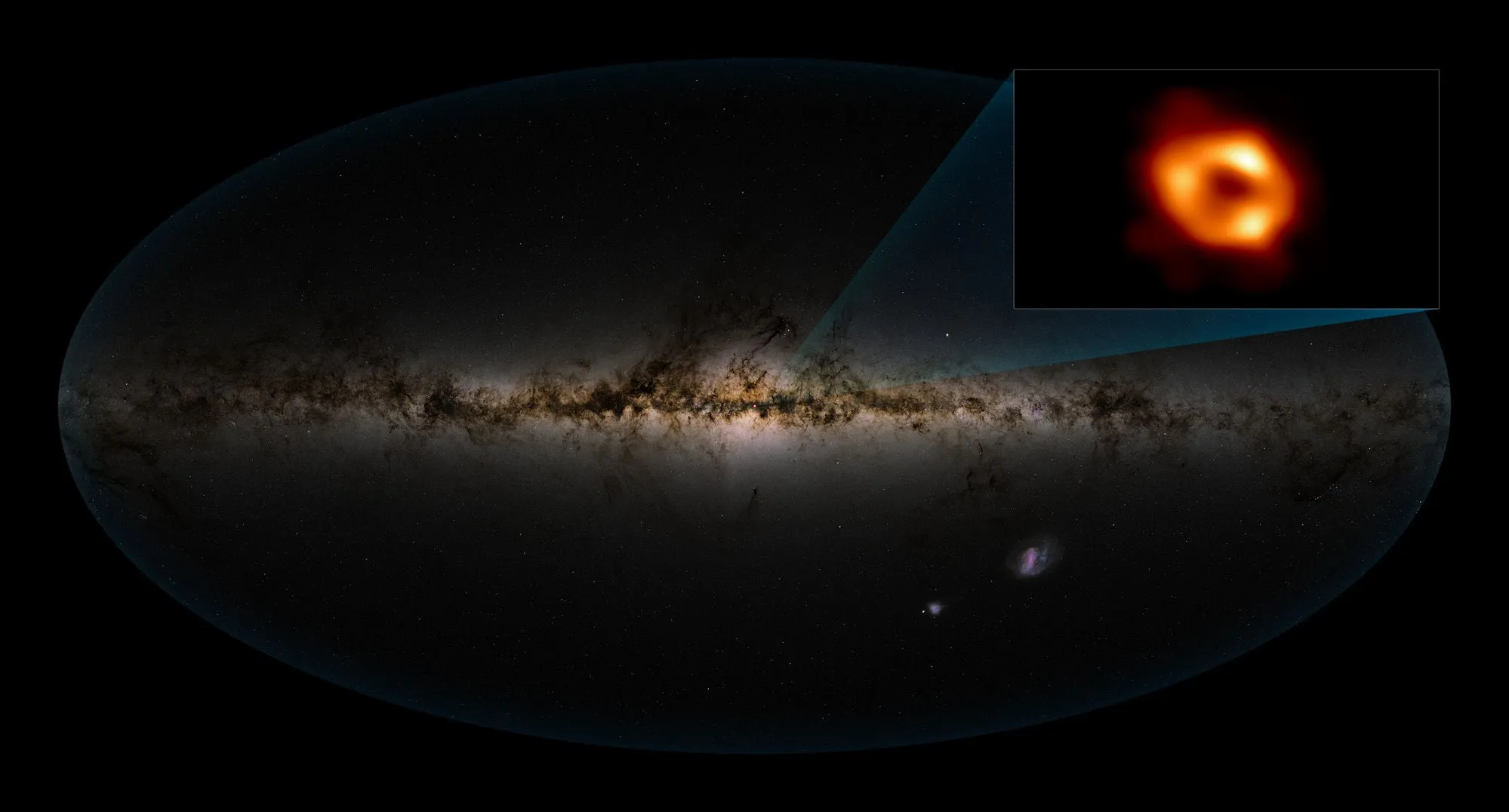
On 12 May 2022, the Event Horizon Telescope Collaboration unveiled the first image of Sagittarius A* (inset) — the supermassive black hole at the centre of our own galaxy — here set against a full-sky map of the Milky Way, centred on the Galactic core. The bright ring is light bent by the gravity of an object some four million times the mass of the Sun; the dark shadow it encircles is about as wide as the orbit of Mercury. To resolve a target that, at twenty-seven thousand light-years, appears no larger in our sky than a doughnut on the surface of the Moon, the collaboration linked eight radio observatories across the planet into a single, Earth-sized virtual telescope. The diameter of that ring agreed with the predictions of Einstein's general relativity — the same theory that, a century earlier, had first conjured the black hole as a mathematical possibility. Inset: Event Horizon Telescope. Milky Way: NASA / Goddard Space Flight Center Scientific Visualization Studio; Gaia DR2: ESA / Gaia / DPAC.
A Cyclops in the Void
In a passage of Virgil’s Aeneid, the Trojan Aeneas and his companions — still shaken by the waters of Charybdis — make landfall on the Cyclopes’ shore, near Etna, to rest. There, emerging from the groves, a trembling man runs towards them, his body wasted, lacerated, and clad in dangling rags. Left behind by Ulysses on this dreadful coast after the events made famous in Homer’s Odyssey, he tells them how his companions were devoured alive by the Cyclops Polyphemus. The monster has but a single frontal eye, immense and round, set beneath the thicket of an enormous brow. Their exchange barely finished, Polyphemus himself looms in the distance: monstrum horrendum, informe, ingens, cui lumen ademptum — a horrible monster, misshapen, enormous, deprived of light.
Black holes are like cyclopes in the void. Horrible, because they thwart our ability to understand them. Ghastly, because their throes are inexorable. Enormous, because their stomachs are bottomless. And, deprived of light, because they deprive us of theirs! The cyclops’s brow is the opaque horizon that hems the black hole; and if Polyphemus is anthropophagous, the black hole is “holophagous” — for all things nourish it. Its ramparts are semi-permeable: classically, everything enters and nothing escapes — though Stephen Hawking showed in 1974 that, by a delicate quantum-mechanical sleight of hand at the horizon, black holes do faintly radiate, slowly evaporating over time-scales unimaginably longer than the present age of the Universe.15
Beyond the event horizon, theory falls mute. No one knows what happens beneath the Schwarzschild cope, save that time and space within it are meaningless. Let us remember that the collapse of a very massive star is halted by nothing: its volume becomes epistemologically nil — of the order of the Planck length, 10⁻³⁵ metre — and its density, infinite. Lacking a unified theory that would explain how physics behaves when gravitation triumphs over all the other forces of nature on subatomic scales, one can only conjure hypotheses.
Gangways onto other universes for some, cosmological organs entrusted with the recycling of matter-energy for others — could black holes be mere spatiotemporal anomalies? To understand them, the great theories of the century — General Relativity and Quantum Mechanics — will have to be the object of yet another reconciling synthesis. The conditions that prevailed at the cosmogenesis, at the “big bang,” must have been akin to those that reign within those decomplexifiers that black holes are. Without a Grand Unification of the dominant paradigms, these fissures of the Cosmos will remain — for a while yet — mysteries, true sustenance for the great genesiacal and eschatological narratives, and bêtes noires of natural philosophers.
References
- Michell, J. (1784). On the Means of Discovering the Distance, Magnitude, &c. of the Fixed Stars, in Consequence of the Diminution of the Velocity of Their Light. Philosophical Transactions of the Royal Society of London, 74, 35–57. DOI: 10.1098/rstl.1784.0008
- Montgomery, C., Orchiston, W., & Whittingham, I. (2009). Michell, Laplace and the origin of the black hole concept. Journal of Astronomical History and Heritage, 12(2), 90–96. ADS: 2009JAHH…12…90M
- Ewing, A. (1964). “Black Holes” in Space. Science News Letter, 85(3), 39. JSTOR: 3947428
- Schwarzschild, K. (1916). Über das Gravitationsfeld eines Massenpunktes nach der Einsteinschen Theorie. Sitzungsberichte der Königlich Preussischen Akademie der Wissenschaften, 189–196. (English translation: arXiv:physics/9905030.)
- Einstein, A. (1939). On a Stationary System with Spherical Symmetry Consisting of Many Gravitating Masses. Annals of Mathematics, 40(4), 922–936. DOI: 10.2307/1968902
- Event Horizon Telescope Collaboration (2019). First M87 Event Horizon Telescope Results. I. The Shadow of the Supermassive Black Hole. The Astrophysical Journal Letters, 875, L1. DOI: 10.3847/2041-8213/ab0ec7
- Event Horizon Telescope Collaboration (2022). First Sagittarius A* Event Horizon Telescope Results. I. The Shadow of the Supermassive Black Hole in the Center of the Milky Way. The Astrophysical Journal Letters, 930, L12. DOI: 10.3847/2041-8213/ac6674
- Schröder, K.-P. & Smith, R.C. (2008). Distant future of the Sun and Earth revisited. Monthly Notices of the Royal Astronomical Society, 386(1), 155–163. DOI: 10.1111/j.1365-2966.2008.13022.x
- Chandrasekhar, S. (1931). The Maximum Mass of Ideal White Dwarfs. The Astrophysical Journal, 74, 81–82. DOI: 10.1086/143324
- Oppenheimer, J.R. & Volkoff, G.M. (1939). On Massive Neutron Cores. Physical Review, 55, 374–381. DOI: 10.1103/PhysRev.55.374
- Oppenheimer, J.R. & Snyder, H. (1939). On Continued Gravitational Contraction. Physical Review, 56, 455–459. DOI: 10.1103/PhysRev.56.455
- Rezzolla, L., Most, E.R., & Weih, L.R. (2018). Using Gravitational-wave Observations and Quasi-universal Relations to Constrain the Maximum Mass of Neutron Stars. The Astrophysical Journal Letters, 852, L25. DOI: 10.3847/2041-8213/aaa401
- Abbott, B.P. et al. (LIGO Scientific Collaboration & Virgo Collaboration) (2016). Observation of Gravitational Waves from a Binary Black Hole Merger. Physical Review Letters, 116, 061102. DOI: 10.1103/PhysRevLett.116.061102
- Miller-Jones, J.C.A., Bahramian, A., Orosz, J.A., et al. (2021). Cygnus X-1 contains a 21-solar mass black hole — Implications for massive star winds. Science, 371(6533), 1046–1049. DOI: 10.1126/science.abb3363
- GRAVITY Collaboration (2019). A geometric distance measurement to the Galactic centre black hole with 0.3% uncertainty. Astronomy & Astrophysics, 625, L10. DOI: 10.1051/0004-6361/201935656
- GRAVITY Collaboration (2018). Detection of the gravitational redshift in the orbit of the star S2 near the Galactic centre massive black hole. Astronomy & Astrophysics, 615, L15. DOI: 10.1051/0004-6361/201833718
- GRAVITY Collaboration (2020). Detection of the Schwarzschild precession in the orbit of the star S2 near the Galactic centre massive black hole. Astronomy & Astrophysics, 636, L5. DOI: 10.1051/0004-6361/202037813
- Baganoff, F.K., Bautz, M.W., Brandt, W.N., et al. (2001). Rapid X-ray flaring from the direction of the supermassive black hole at the Galactic Centre. Nature, 413, 45–48. DOI: 10.1038/35092510
- Hawking, S.W. (1974). Black hole explosions? Nature, 248, 30–31. DOI: 10.1038/248030a0
Footnotes
-
John Michell first set out the idea of a star so massive that its own light could not escape it in a paper read to the Royal Society in 1784 — the earliest known conception of what we now call a black hole. See Michell (1784). ↩
-
These eighteenth-century “dark stars” are not black holes in the modern sense. Michell’s and Laplace’s argument was purely Newtonian — a body whose escape velocity exceeds the speed of light — with no event horizon and no curvature of space-time; in that picture light merely slows, halts, and falls back. The relativistic black hole, bounded by a horizon beyond which space-time itself loses meaning, is a conceptually different object that had to await Schwarzschild. That the Newtonian “dark-star” radius and the Schwarzschild radius coincide (2GM/c²) is a striking arithmetical accident. See Montgomery, Orchiston & Whittingham (2009). ↩
-
The phrase “black hole” is conventionally credited to a 1967 lecture by John Wheeler, who popularised it; but it had appeared in print three years earlier, in a 1964 Science News Letter report by Ann Ewing on a meeting of the American Association for the Advancement of Science. See Ewing (1964). ↩
-
Karl Schwarzschild derived the first exact solution to Einstein’s field equations within weeks of their publication, while serving on the Eastern Front; it defines the radius — the event horizon — within which nothing escapes. The divergence at that radius is, in modern terms, a coordinate artefact; the true curvature singularity lies at the centre. See Schwarzschild (1916). ↩
-
Einstein argued that “Schwarzschild singularities” could not arise in physical reality. The same year, Oppenheimer and Snyder demonstrated the opposite (see note 6). See Einstein (1939). ↩
-
The Event Horizon Telescope Collaboration released the first image of a black hole’s shadow — M87* — on 10 April 2019, and that of Sagittarius A* on 12 May 2022. See EHT Collaboration (2019, 2022). ↩
-
Estimates of the Sun’s red-giant extent vary. At the tip of the red-giant branch its radius will reach roughly one astronomical unit — about the Earth’s present orbit — and tidal drag is likely to draw the Earth into the Sun even as the planet’s orbit drifts outward; Mars, at 1.5 AU, lies safely beyond. See Schröder & Smith (2008). ↩
-
Subrahmanyan Chandrasekhar showed that a white dwarf more massive than about 1.4 solar masses cannot hold itself up against gravity by electron degeneracy pressure alone — the “Chandrasekhar limit.” See Chandrasekhar (1931). ↩
-
Two foundational 1939 papers: Oppenheimer and Volkoff derived the equation of equilibrium for a neutron star (today the Tolman–Oppenheimer–Volkoff equation), and Oppenheimer and Snyder described the continued gravitational collapse of a sufficiently massive star into what we now call a black hole. See Oppenheimer & Volkoff (1939) and Oppenheimer & Snyder (1939). ↩
-
The maximum mass of a non-rotating neutron star — the Tolman–Oppenheimer–Volkoff limit — is now estimated at roughly 2.2–2.3 solar masses, a figure tightened by the 2017 neutron-star merger GW170817. See Rezzolla, Most & Weih (2018). ↩
-
GW150914, the first direct detection of gravitational waves, was recorded on 14 September 2015 and announced on 11 February 2016; the signal came from two black holes of about 36 and 29 solar masses merging some 1.3 billion light-years away. See Abbott et al. (2016). ↩
-
Radio (VLBA) trigonometric parallax places Cygnus X-1 at about 2.2 kiloparsecs (~7,200 light-years); the same study revised the black hole’s mass upward to roughly 21 solar masses and its companion to about 40. See Miller-Jones et al. (2021). ↩
-
The GRAVITY instrument at ESO’s Very Large Telescope has tracked the star S2 around Sagittarius A* precisely enough to detect both the relativistic gravitational redshift (2018) and the Schwarzschild precession (2020) of its orbit, and to fix the black hole’s mass and distance at about 4.15 million solar masses and 8.18 kiloparsecs. See GRAVITY Collaboration (2019, 2018, 2020). ↩
-
The first rapid X-ray flare from Sagittarius A* was observed with the Chandra X-ray Observatory on 27 October 2000, brightening roughly forty-five-fold over a few hours — attributed to energetic processes in plasma near the innermost stable orbit, not to a tidal disruption. See Baganoff et al. (2001). ↩
-
Stephen Hawking showed that quantum effects at the event horizon cause a black hole to emit thermal radiation and slowly evaporate; for astrophysical black holes the timescale exceeds the present age of the Universe by enormous factors. See Hawking (1974). ↩