AI Backbone · 2026
Drag to pan · scroll or pinch to zoom
↑ ↓ navigate↵ openesc close
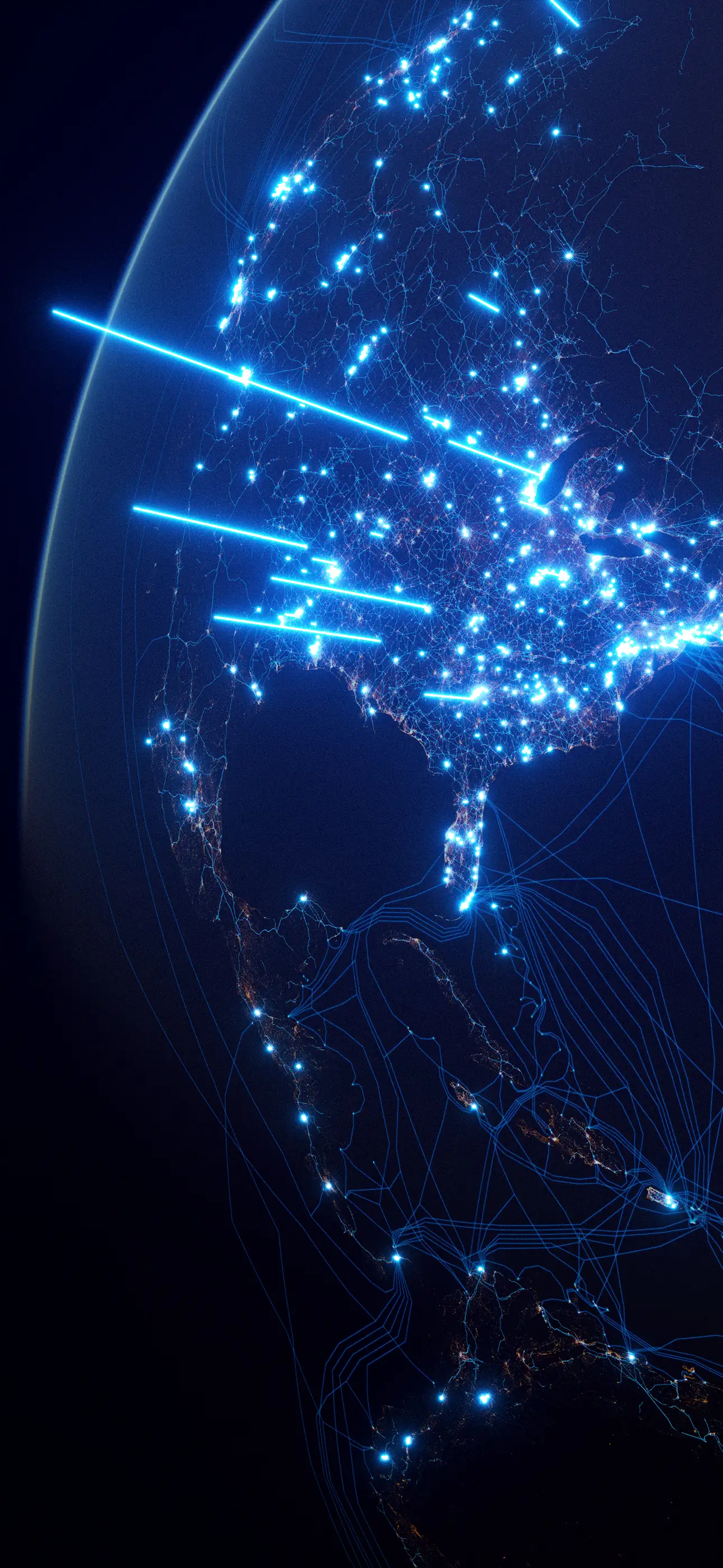
A portrait of the physical substrate that artificial intelligence runs on. What we now experience as ambient intelligence is, in fact, geographically concentrated and physically immense.
Four proxies of the AI backbone
The image is a composite of four geospatial datasets — each one a different physical layer of the same infrastructure. Together, they trace where compute is built, fed, and connected.
Terrestrial optical fibre
The luminous filaments threading the continents. National and inter-city backbones move bits at the speed of light through hair-thin glass — the nervous system that connects every data centre to every user.
Submarine cables
Roughly 600 systems crossing the seafloor, carrying ~99 % of intercontinental internet traffic. The cables are the only path between the model and the user when an ocean lies between them.
Data centres
The brightest knots in the image. Hyperscale and AI-cloud campuses concentrate gigawatts of power and millions of GPUs at a few thousand sites worldwide — the places where electricity becomes computation.
Chip fabrication plants
Semiconductor foundries, packaging plants, and memory fabs — the upstream factories that grow the silicon, etch the transistors, and stack the HBM that every AI accelerator depends on.
Sources
Mining Where the chain starts — raw minerals dug from the ground. Rare earths, gallium, quartz: a handful of countries supply most of what the world's chip factories need. Materials Refines those minerals into ultra-pure silicon ingots, photoresists, and specialty gases. Every modern chip relies on a small set of suppliers here. Substrates & masks Makes the blank silicon wafers chips are built on, and the photomasks that imprint each circuit pattern onto them. Wafers Polished silicon discs, ready for patterning. A small number of suppliers serve nearly every fab on Earth. Semiconductor equipment The lithography, etching, and deposition machines that physically build chips. Many cost tens of millions of dollars per unit; a few firms hold global monopolies. EDA & IP Software tools and reusable circuit blueprints. Engineers use them to design every modern processor; three companies dominate the field. Foundries The fabs themselves — where wafers become chips. Leading-edge fabs cost roughly twenty billion dollars apiece and exist in only a few countries. Packaging / OSAT Cuts, tests, and packages finished chips, and bonds AI processors to their stacks of high-bandwidth memory. A current bottleneck for AI hardware. Memory & HBM Makes the fast memory chips that sit next to every AI accelerator. High-bandwidth memory is the key constraint for AI training right now. AI chip design Companies that design the specialised processors powering AI — GPUs, TPUs, and custom accelerators built for training and inference. Hyperscalers Cloud-platform giants running most of the world's AI workloads. A small group — Amazon, Microsoft, Google, Meta, Oracle — operates the bulk of global AI compute. AI cloud Specialised providers that rent GPU clusters to AI labs, start-ups, and researchers, often at very large scale. Frontier labs Organisations building the largest and most capable AI models in the world — the labs setting the pace of the field. Research institutes Academic and national labs advancing the science behind AI — methods, evaluations, theory, and applications across the sciences. Safety & governance Institutes and bodies working on the evaluation, oversight, and governance of advanced AI — from international agencies to think tanks.