| Term | Category | Connected to |
|---|
Planetary Lexicon
An ongoing effort to define and clarify the terminology used in discussions about planetary phenomena, cultural evolution, and emerging concepts in planetary sustainability. A dynamic resource for fostering a shared understanding of these complex and interconnected topics, offering precise definitions, nuanced explanations, and contextual insights.
Affluence
The abundance of wealth and resources, typically characterized by a high standard of living, substantial income, and the ability to acquire and enjoy goods and services that exceed basic necessities. Affluence often reflects societal progress in terms of economic prosperity but is also deeply intertwined with patterns of overconsumption, ecological overshoot, and the disproportionate use of planetary resources. It highlights significant disparities in resource access and utilization across different regions and populations, contributing to global environmental pressures such as climate change, biodiversity loss, and the depletion of natural ecosystems. In the context of sustainability, affluence raises critical questions about equity, responsibility, and the need to redefine well-being beyond material accumulation. Affluence is also the A in the IPAT identity, one of the three multipliers — alongside population and technology — that together set humanity’s environmental footprint.
Anthropisation
The physical, material transformation of the Earth’s environment through humanity’s technical systems — the objective face of our relationship with the planet. In the lineage of anthropologist André Leroi-Gourhan, who traced how tools and gestures externalise human faculties into the world, anthropisation names the outward inscription of technics upon land, water, air, and living systems: the clearing of forests, the redirection of rivers, the paving of cities, the industrial reworking of the atmosphere and climate. It runs in parallel with Humanisation (the symbolic reworking of the same milieu) and feeds back into Hominisation (our ongoing biological and cognitive becoming). At planetary scale and accelerating pace — see the Great Acceleration — anthropisation crosses from local landscaping into a geological force, thickening the Technosphere and inscribing the stratigraphic markers of the Anthropocene. Its darker register is habitat destruction, pollution, and resource depletion: the milieu remade faster than it can be understood or inhabited well.
Ref: Leroi-Gourhan, A. (1964). Le geste et la parole. Éditions Gallimard.
Anthropocene
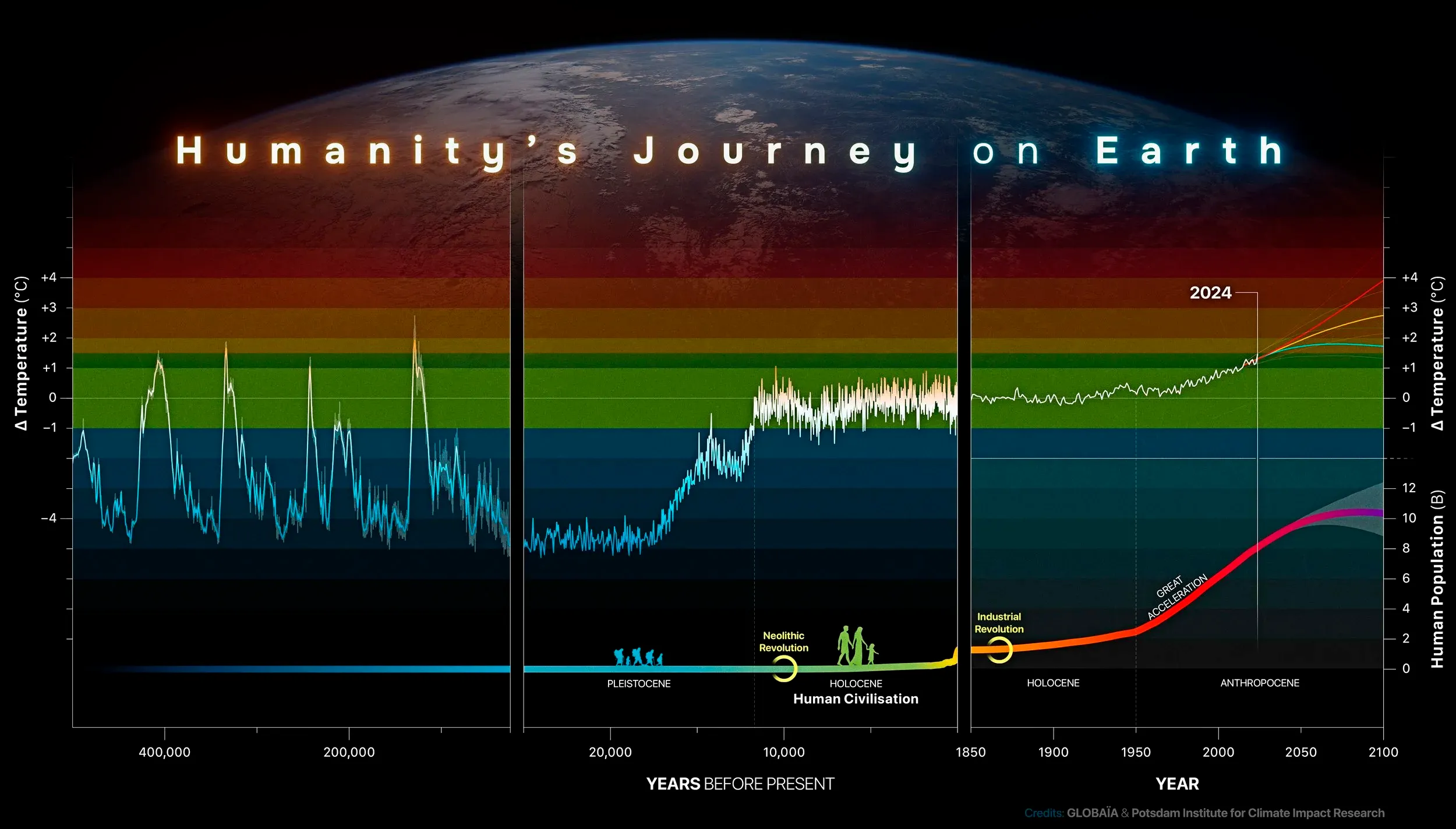
The Anthropocene is a proposed epoch in Earth’s history characterized by the unprecedented scale and intensity of human activities altering planetary systems. Its onset is typically associated with the mid-20th century “Great Acceleration,” a period marked by a rapid increase in anthropogenic impacts such as climate change, ecosystem degradation, biodiversity loss, environmental contamination, resource exploitation, and land-use transformations. These changes exceed the natural variability of the preceding Holocene epoch and are inscribed as stratigraphic markers in geological archives, reflecting a fundamental deviation in the Earth’s system dynamics.
The official definition of the Anthropocene according to the former Anthropocene Working Group of the Subcommission on Quaternary Stratigraphy: ”The ‘Anthropocene’ is a term widely used since its coining by Paul Crutzen and Eugene Stoermer in 2000 to denote the present geological time interval, in which many conditions and processes on Earth are profoundly altered by human impact. This impact has intensified significantly since the onset of industrialization, taking us out of the Earth System state typical of the Holocene Epoch that post-dates the last glaciation.”
On 20 March 2024 the International Union of Geological Sciences confirmed the vote of the Subcommission on Quaternary Stratigraphy rejecting the Anthropocene as a formal unit of the Geologic Time Scale, while conceding in the same statement that the term would remain “an invaluable descriptor of human impact on the Earth system.” Refused as a unit of rock, it stands as a name for a condition. The Anthropocene is widely embraced as a conceptual framework in the physical and social sciences and has gained significant traction in popular culture. Its classification remains contested, with debates over whether it constitutes an event, an epoch, or even an era. Proposed starting points range from the Agricultural Revolution, as suggested by the Early Anthropocene Hypothesis, to the Columbian Exchange and the Industrial Revolution, reflecting its multifaceted nature and ongoing relevance in scholarly discourse.
Ref: Anthropocene Working Group, International Commission on Stratigraphy, supported by extensive interdisciplinary research and peer-reviewed studies.
The Anthropocene could be generalized as a planetary state characterized by the emergence of a technologically advanced species that significantly alters the dynamics of its host planet’s systems. This transition represents a shift from biotic to “agency-dominated” biospheres, where human (or equivalent) activities become the primary drivers of planetary feedback. Rooted in thermodynamic principles, the Anthropocene marks a tipping point in the co-evolution of a civilization and its planetary environment, with potential outcomes ranging from sustainable equilibrium to collapse. While often associated with Earth, the Anthropocene can be generalized as a predictable phase for any energy-intensive civilization across the cosmos.
Ref: Frank, A., & Sullivan, W. T. (2018). The Anthropocene Generalized: Evolution of Exo-Civilizations and Their Planetary Feedback. Astrobiology, 18(4), 503–518.
Concepts Complementing or Challenging the Anthropocene
Anthropozoic (1873)
Proposed by Antonio Stoppani, this term signifies a new era in Earth’s history dominated by human influence, acknowledging humanity as a geological force.
Psychozoic (1878)
Proposed by Joseph Le Conte, this era is characterized by the emergence of human consciousness as a dominant force in Earth’s evolutionary processes.
Noosphere (1920s)
Developed by Pierre Teilhard de Chardin and Vladimir Vernadsky, this concept describes a layer of human thought and consciousness enveloping the Earth, representing the collective intellectual and cultural development of humanity.
Gaian Era (1970s)
Proposed by James Lovelock, this conceptual era acknowledges Earth as a self-regulating system (the Gaia hypothesis), with humans playing a role in maintaining—or disrupting—its balance.
Ecozoic (1988)
Proposed by Thomas Berry, this term envisions a future era where humans live in harmony with Earth, recognizing it as a communion of subjects rather than a collection of objects.
Homogenocene (1999)
Proposed by Michael Samways, this epoch is characterized by the global homogenization of biodiversity, driven by human activities that diminish ecological diversity.
Anthropocene (2000)
Proposed by Paul Crutzen and Eugene Stoermer, this epoch describes the dominant influence of human activity on Earth’s climate, ecosystems, and geology.
Technocene (2001)
Proposed by Alf Hornborg, this epoch emphasizes the transformative impact of technology on Earth’s systems and human societies.
Anthrobscene (2014)
Proposed by Jussi Parikka, this term critiques the environmental degradation linked to the digital economy and its material infrastructures.
Obscene Anthropocene (2014)
Proposed by Bruno Latour, this term critiques the exploitative aspects of the Anthropocene, highlighting the ecological and social consequences of unfettered human activities.
Pyrocene (2015)
Proposed by Stephen J. Pyne, this epoch is shaped by the pervasive role of fire, both natural and anthropogenic, in transforming Earth’s landscapes and ecosystems.
Plantationocene (2010s)
Proposed by scholars like Anna Tsing and Donna Haraway, this epoch focuses on the legacy of plantation economies and their role in environmental degradation, monocultures, and social inequalities.
Urbanocene (2010s)
Proposed by various urban ecologists, this epoch emphasizes the dominant role of urbanization in shaping Earth’s geology and ecosystems.
Plasticene (2010s)
Popularized by environmental scientists and journalists, this term highlights the massive global signature of plastic pollution—ranging from microplastics in oceans to plastic layers in sediment.
Misanthropocene (2010s)
Used in cultural and critical theory circles, this term critiques the Anthropocene, emphasizing inequities and the destructive aspects of human dominion.
Plutocene (2010s)
Proposed by Eileen Crist, this epoch focuses on the global dominance of extractive economies and the resulting planetary degradation.
Symbiocene (2010s)
Proposed by Glenn Albrecht, this era envisions human activities guided by symbiosis with natural systems, emphasizing interconnectedness and sustainability.
Sustainocene (mid-2010s)
Proposed by researchers like James Ward, this aspirational era envisions human civilization achieving sustainability through renewable energy, ecological stewardship, and equitable resource use.
Capitalocene (2016)
Proposed by Jason W. Moore, this epoch suggests that the dynamics of capitalism are the primary drivers of environmental change, rather than humanity as a whole.
Eremocene (2016)
Proposed by E. O. Wilson, this “Age of Loneliness” is marked by significant biodiversity loss and the resulting isolation of humanity from the natural world.
Chthulucene (2016)
Proposed by Donna Haraway, this concept emphasizes the entanglement of humans with other species and the environment, advocating for collaborative survival amid ecological challenges.
Neganthropocene (2018)
Proposed by Bernard Stiegler, this term focuses on human technologies and practices fostering regenerative, rather than destructive, planetary impacts.
Novacene (2019)
Proposed by James Lovelock, this epoch envisions a forthcoming era shaped by ultra-intelligent beings (e.g., advanced AI) collaborating with humanity to preserve planetary habitability.
Humilocene (2020)
Proposed by David Abram, this “epoch of humility” draws on the shared root of human and humility in humus (the soil), reframing our era around interdependence and restraint within the more-than-human world rather than human mastery over it.
Atasthalocene (2026)
Proposed by GLOBAÏA, this “age of reckless folly” is built like the Anthropocene itself — atasthalo- welded to -cene (from kainós, “new, recent”) — from the Homeric ἀτασθαλίαι (atasthalíai), the reckless follies by which Odysseus’ crew destroy themselves. In the proem of the Odyssey (1.32–34), Zeus complains that mortals blame the gods for evils they bring on themselves, suffering ὑπὲρ μόρον (hypèr móron), “beyond their allotted portion.” Where the Anthropocene is descriptive — the age of humans — the Atasthalocene is diagnostic: it names not the agent but the conduct, a species inflicting planetary harm past anything fate or nature had dealt it, then looking everywhere but inward for the cause. Unlike the Anthropocene, it offers an exit: recklessness is a way of behaving, not a species trait, and behaviour can stop. See the Anthropocene Traps.
Ref: Term coined by GLOBAÏA, 2026, from Homer, Odyssey 1.7 and 1.32–34; cf. Capitalocene (Moore, 2016), Thanatocene (Bonneuil & Fressoz, 2013).
Anthropocene Traps
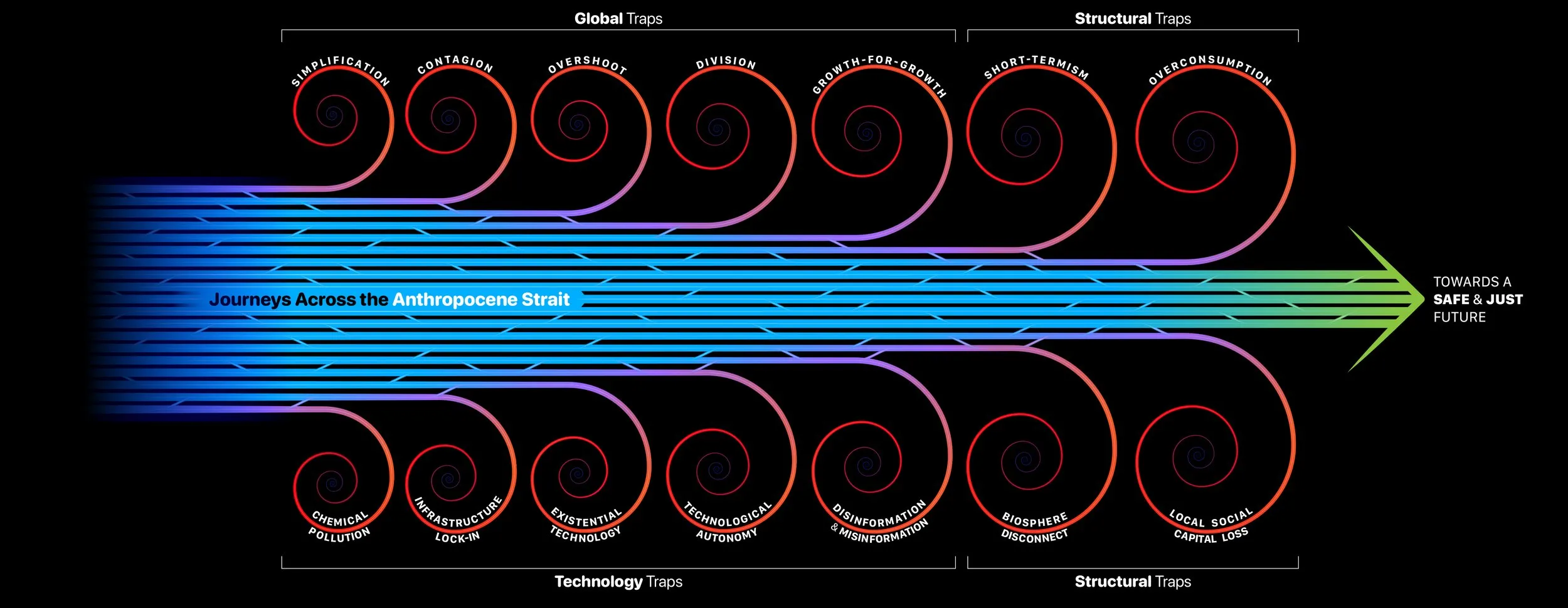
Anthropocene traps are identified as maladaptive phenomena that have emerged from initially adaptive processes, exhibit signs of undesirable impacts on global human well-being, and have a trapping mechanism making it difficult to escape their negative impacts once activated. Interacting traps are the proposed engine behind the Global Polycrisis.
The evolution of these traps occurs across four (4) distinct phases:
- Initiation This phase starts with social or technological innovations that set new trajectories in motion, focusing on immediate, local outcomes while often overlooking long-term, global consequences.
- Scaling Here, the initial trajectories gain momentum and expand globally, involving increased connectivity and system establishment, with a focus on adapting to and exploiting these changes.
- Masking In this phase, the global system’s failures, like ecosystem degradation, become obscured due to the complexities of global connectivity, leading to a lack of immediate awareness and response to these issues.
- Trapping The final phase where entrenched mechanisms make it extremely difficult to alter the established paths, resulting in persistent negative impacts. These mechanisms include ecological tipping points, cultural inertia, conflicts, and mismatches in global management and perception.
Fourteen (14) Anthropocene Traps have been suggested:
- Simplification Over-specialisation leading to systems vulnerable to shocks.
- Growth-for-Growth Institutional lock-ins that prioritise economic growth over well-being.
- Overshoot Continued material growth leading to surpassing Earth system limits.
- Division Unstable selection for global human cooperation, increasing conflict risks.
- Contagion Global connectivity heightening the risk of large-scale contagions, like pandemics.
- Infrastructure Lock-In Complex material infrastructures becoming maladaptive.
- Chemical Pollution Production of complex/persistent compounds harmful to humans/ecosystems.
- Existential Technology Technological arms-races leading to the evolution of destructive technologies.
- Technological Autonomy Reliance on automation potentially misaligned with human needs, e.g. AI.
- Disinformation & Misinformation Digitalisation amplifying the spread of false information.
- Short-Termism Prioritising short-term benefits, reinforcing other traps, and promoting conflict.
- Overconsumption Separation of production and consumption leading to excessive use of resources.
- Biosphere Disconnect Separation of human settlements from ecosystems, reducing environmental awareness.
- Local Social Capital Loss Digitalisation leading to reduced face-to-face interaction and community engagement.
Ref: Søgaard Jørgensen, P., Jansen, R. E. V., Avila Ortega, D. I., Lade, S. J., & Galaz, V. (2023). Evolution of the polycrisis: Anthropocene traps that challenge global sustainability. Philosophical Transactions of the Royal Society B: Biological Sciences, 379(1893), 20220261.
Anthroposphere
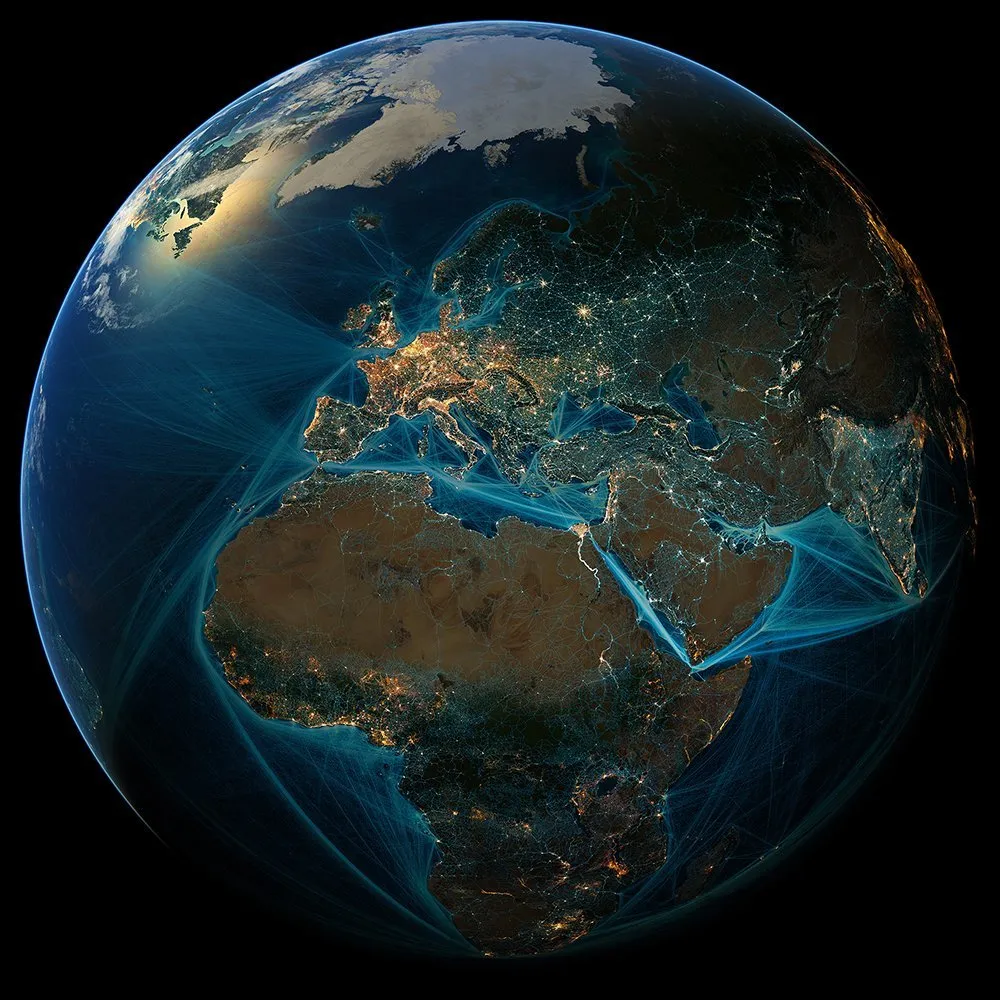
The Anthroposphere is to geography (space) what the Anthropocene is to Earth’s history (time). Sometimes also referred to as the technosphere, it is the part of the environment that is made or modified by humans for use in human activities and habitats. The Anthroposphere includes all human-generated systems and materials, such as the human population, urban environments, agriculture, transportation systems, and manufactured goods. The Anthroposphere is comparable to the Biosphere in that it represents the total mass of human-generated systems and their interaction with Earth’s systems. However, unlike the Biosphere, which efficiently produces and recycles materials through natural processes like photosynthesis and decomposition, the Anthroposphere is not self-sustaining and has a significant planetary-wide impacts. Indeed, it is a sobering reality that the expansion of the Anthroposphere occurs at the expense of the Biosphere, diminishing its complexity and equilibrium. The Anthroposphere is the youngest of Earth’s spheres but has rapidly influenced the planet and its natural systems (see Anthropocene).
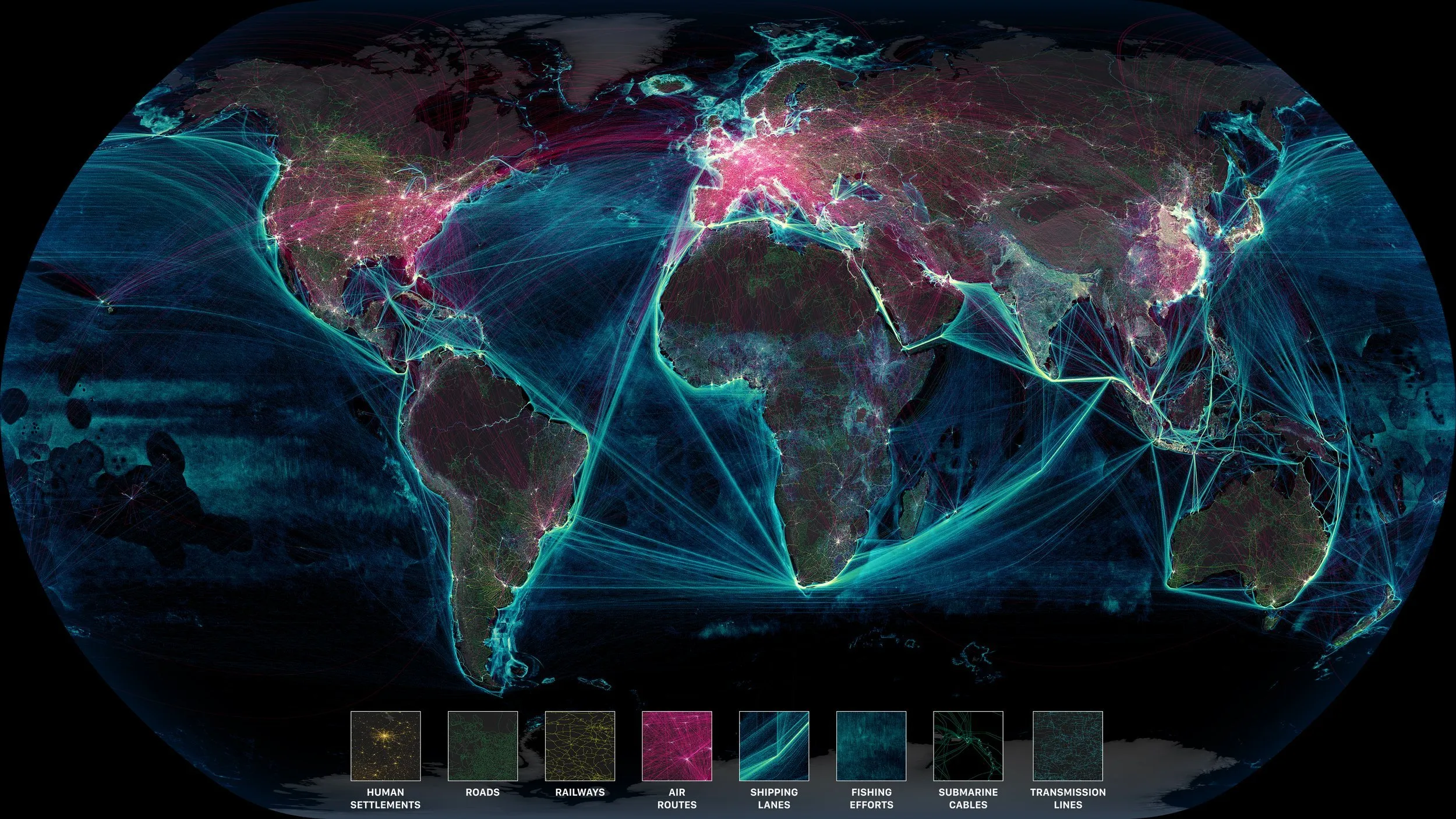
Big History
Big History is an interdisciplinary, science-based, and transdisciplinary approach to history that seeks to understand the integrated narrative of the Universe, Earth, Life, and Humanity from the Big Bang to the present by synthesizing insights from cosmology, astronomy, geology, biology, anthropology, and human history. It situates human existence within the broader context of cosmic, planetary, and biological evolution, identifying large-scale patterns, thresholds of increasing complexity, and emergent properties across time scales spanning 13.8 billion years. By transcending traditional disciplinary boundaries and embracing a unified temporal and spatial framework, Big History offers a macroscopic perspective that illuminates the interconnectedness of all phenomena and provides a scientifically grounded foundation for exploring the place of Homo sapiens in the unfolding continuum of the universe. Two entries in this lexicon extend the same impulse in opposite directions — Cosmicisation outward, Planetarisation inward toward Earth as one world among many.
Biosphere
The Biosphere is the totality of life on a planet: every living organism, and the diversity they embody at every level — of genes within species, of species, and of the ecosystems and functions they form together — along with the planetary-scale activity through which they capture energy, cycle matter and transform their surroundings. On Earth it has persisted without interruption for at least 3.5 billion years, holds roughly 550 billion tonnes of carbon in living matter, and is the only biosphere known in the universe.
The term was coined by the Austrian geologist Eduard Suess in 1875 and given its full scientific meaning by the mineralogist Vladimir Vernadsky, whose The Biosphere (1926) recast life not as a passenger on the planet but as a geological force that shapes rock, water, and air. The self-regulating dynamics his work anticipated were later formalised as the Gaia Hypothesis. The biosphere is the living core of the wider ecosphere — life together with the conditions it depends on — and intrinsically linked to habitability.
Ref: Suess, E. (1875). Die Entstehung der Alpen. Vienna: W. Braumüller. // Vernadsky, V. I. (1926). Биосфера (The Biosphere). Leningrad: Nauchnoe khimiko-tekhnicheskoe izdatel’stvo. (English: The Biosphere, translated by D. B. Langmuir, New York: Copernicus/Springer, 1998.)
Biosphere Disruptors
Biosphere disruptors are agents that force macroevolutionary change at global scale, permanently altering the composition and abundance of life on Earth. Across the geological record they resolve into two classes, distinguished not by the magnitude of the disturbance but by how long it acts on the biosphere: whether the disrupting force eventually dissipates from the Earth System or remains within it. Where the force comes from is not part of the definition, but the record shows a pattern: the short-lived kind usually arrives from beyond the living world, the long-lived kind from within it. The two classes carry opposite consequences for the biosphere.
Thirty-one intervals of global macroevolutionary change identified in the fossil record fall into:
- Transient disruptors — geologically short-lived and generally abiotic, usually driven from beyond the biosphere, though not in every case: asteroid impacts, the continent-scale volcanism of large igneous provinces, the reorganisation of ocean gateways by moving continents. Mean duration ~800,000 years (n = 25). Their kill mechanisms are rapid warming, ocean anoxia (oxygen loss), acidification, and acid rain. The depleted biosphere they leave behind can persist for millions of years in a condition of undesirable resilience: stable because it is simplified, and resistant to returning to a richer state. Recovery typically begins only once the disruptor has dissipated from the Earth System.
- Persistent disruptors — geologically long-lived and biological, originating primarily within the biosphere: oxygenic photosynthesis and the oxygenation of air and ocean, the colonisation of land by plants and the forests that followed, the rise of flowering plants and the mutualisms they formed with insects, birds, and mammals. Mean duration ~130 million years (n = 6), two orders of magnitude longer. Each reconfigured the structure and function of the biosphere, and each is associated with an increase in habitability, understood as the capacity to support life across biodiversity, productivity, biomass, and resilience together; an increase in any one alone is not sufficient, since an algal bloom is highly productive and a simplified system can be highly resilient.
The association between persistence and increased habitability is empirical rather than necessary. A runaway greenhouse or icehouse would constitute a persistent disruptor that forecloses habitability permanently — the condition described by the Gaian bottleneck hypothesis, in which life fails to establish planetary regulation before conditions move beyond the habitable range. The record documents a tendency rather than a law: the short-lived disruptors have degraded the biosphere, while the long-lived ones, each arising from within it, have to date enhanced it, over tens to hundreds of millions of years.
Humanity occupies an anomalous position in this scheme. Human activity originates within the biosphere, as persistent disruptors do, but its rate and its effect to date resemble those of a transient one. On current trajectory humanity ranks as the second-fastest driver of biosphere loss in Earth history, after the asteroid impact that ended the Cretaceous. That ranking is sensitive to assumption: a rate is a magnitude divided by a duration, and the durations assigned to both the impact and to human activity are the least-constrained quantities in the analysis. Two features are nonetheless specific to the human case. Humanity is the first disrupting agent able to observe and deliberately modify its own effect on planetary habitability; and pathways toward the persistent class are already documented — landscapes in which sustained human presence has raised local biodiversity, land and sea both spared and shared, and a shift in legal principle from freedom of the seas toward a common responsibility for the Earth System.
A typology reached independently, from comparative planetology rather than from the fossil record, sorts planetary change into four kinds — natural, biologically induced, inadvertently technological, and purposeful — and arrives at the same unresolved question about humanity. The correspondence is close but it is not an identity: that scheme sorts agents by whether life is involved and whether it intends what it does, this one sorts episodes by how long they act, and the palaeontologists stop short of assigning humanity to either class, placing it only on a transient trajectory so far.
Ref: Wong Hearing, T. W., Williams, M., Zalasiewicz, J., et al. (2026). Humans could become the greatest driver of biosphere net gain in Earth history but are currently the second fastest driver of biosphere loss. Proceedings of the Royal Society B, in press. doi:10.1098/rspb.2026.1941 · supplementary material · preprint. · Dornelles, A. Z., Boyd, E., Nunes, R. J., et al. (2020). Towards a bridging concept for undesirable resilience in social-ecological systems. Global Sustainability, 3, e20. · Chopra, A., & Lineweaver, C. H. (2016). The Case for a Gaian Bottleneck: The Biology of Habitability. Astrobiology, 16, 7–22. · Benton, M. J., Wilf, P., & Sauquet, H. (2022). The Angiosperm Terrestrial Revolution and the origins of modern biodiversity. New Phytologist, 233, 2017–2035.
Biosphere embeddedness
The recognition that human beings, their cultures, and their technologies are not separate from nature but are woven into the living fabric of the biosphere — continuously shaping it and being shaped by it. Biosphere embeddedness reframes humanity as a participant in, rather than a spectator of, the planet’s living systems, directly challenging the human–nature dualism that has long split Western science into separate “natural” and “social” domains. Where dualistic thinking treats the environment as an external backdrop to human affairs, embeddedness situates people within the continuum of living relations — alongside microbes, plants, animals, water, and the atmosphere.
Drawing on systems thinking, embeddedness can be examined along three complementary dimensions:
- Compositional — what a phenomenon is made of. Living things are built from interconnected elements: the human body, for instance, acts in concert with the trillions of microbes of its microbiome, themselves linked to the microbial life of soils and ecosystems.
- Relational — how a phenomenon is embedded. Entities come into being through flows and exchanges — of water, nutrients, energy, commodities, information, and culture — so that none can be fully understood in isolation from the relationships that constitute it.
- Evolutionary — why a phenomenon emerged. Compositions and relations unfold and transform over time through path-dependent histories and co-evolutionary feedbacks, from the domestication of plants and animals to the genetic legacies of agriculture.
This framing extends a long lineage of relational Earth-system thinking — from the Gaia hypothesis and social-ecological systems research to Indigenous and more-than-human philosophies — and answers the call to “reconnect to the biosphere.” By foregrounding embeddedness, sustainability science gains a vocabulary for studying humanity as an integral part of planetary dynamics, opening practical avenues through new practices of sensing, modelling, and commoning. It complements planetarity and geographicity, which describe, respectively, the ontological condition and the lived experience of belonging to the Earth. In spirit it echoes older notions of symbiosis (living-together), concrescence (a growing-together of many into one), and inherence (being-within).
Ref: Kaandorp, C., Wang-Erlandsson, L., Folke, C., et al. (2026). Opportunities to foreground human embeddedness in the Anthropocene biosphere. Cell Reports Sustainability, 3, 100734. · Folke, C., Jansson, Å., Rockström, J., et al. (2011). Reconnecting to the Biosphere. Ambio, 40, 719–738.
Carbon Pulse
The Carbon Pulse is the short, violent spike of fossil carbon that humanity is releasing into the atmosphere across a few centuries — a planetary-scale event compressing hundreds of millions of years of geologically buried sunlight into a single brief episode. Viewed on a millennial timescale, industrial civilisation’s oil, natural gas, and coal extraction appears as a narrow bell-shaped curve that rises almost vertically from the mid-19th century, peaks somewhere in the 21st, and declines as remaining reserves are drawn down. The pulse is the combustion half of the Great Acceleration: the energetic substrate that made the post-1950 surge in population, economic output, material flows, and Earth-system disruption physically possible.
The framing was given its modern scientific form by geophysicist David Archer, whose Long Thaw (2009) set the entire fossil episode against the ~100,000-year atmospheric lifetime of the CO2 it leaves behind — what Archer calls “the really long tail.” In that picture, humanity’s combustion of coal, oil, and gas is a geologically instantaneous event that will still be perturbing the climate long after the last well and mine have been abandoned. The expression itself has been carried into broader public discourse by Nate Hagens, the former Wall Street analyst whose Great Simplification podcast and lectures have made “the carbon pulse” a shorthand for the ~300-year energetic anomaly on which industrial civilisation is built — and from which it will have to descend.
The shape of the pulse is a consequence of both geology and choice. Geology sets an upper bound — the Ultimate Recoverable Resource (URR) of each fuel is finite, and the logistic depletion dynamics first described by M. King Hubbert in 1956 predict that production of a finite stock rises, peaks, and falls symmetrically. Choice governs the height and width of the curve: faster voluntary decline (steered by policy, electrification, and climate constraints) compresses the pulse and leaves a larger fraction of reserves in the ground; slow decline stretches it and locks in more warming. Either way, on a 1,000-year view the pulse is a vanishingly brief episode. The atmospheric, oceanic, and biospheric consequences of those few centuries of emissions — heat, acidification, sea-level rise, ice loss — will persist for tens of thousands of years. The pulse’s height and duration are what decide how far the climate Planetary Boundary is transgressed and how many Tipping Points (climate) are crossed along the way.
Ref: Archer, D. (2009). The Long Thaw: How Humans Are Changing the Next 100,000 Years of Earth’s Climate. Princeton University Press. · Archer, D., Eby, M., Brovkin, V., Ridgwell, A., Cao, L., Mikolajewicz, U., Caldeira, K., Matsumoto, K., Munhoven, G., Montenegro, A., & Tokos, K. (2009). Atmospheric lifetime of fossil fuel carbon dioxide. Annual Review of Earth and Planetary Sciences, 37, 117–134. · Hagens, N. (ongoing). The Great Simplification (podcast and lecture series). · Hubbert, M. K. (1956). Nuclear Energy and the Fossil Fuels. American Petroleum Institute. · Steffen, W., Broadgate, W., Deutsch, L., Gaffney, O., & Ludwig, C. (2015). The trajectory of the Anthropocene: The Great Acceleration. The Anthropocene Review, 2(1), 81–98. · Our World in Data / Energy Institute Statistical Review of World Energy 2025.
Carrying Capacity
The maximum population of a species that an environment can sustain indefinitely on the resources it regenerates — conventionally written K, and formally the population size at which the growth rate per individual reaches zero, births exactly offsetting deaths. Applied to human beings the concept is unstable, because we modify our environment to raise its productivity and because fossil energy lets us live on accumulated stocks — soil, groundwater, forests, fisheries, ancient carbon — rather than on annual regeneration. Efficiency gains can therefore raise the apparent ceiling while the resource base degrades beneath it.
Three distinct questions hide inside how many people can Earth support?: a biophysical maximum at bare subsistence, a demographic ceiling where births and deaths converge, and a sustainable or optimum capacity — how many could live well within annual regeneration. Published estimates span 650 million to 288 billion, with a median of 7.7 billion; the spread reflects differing assumptions about technology, diet and equity rather than measurement error, which makes carrying capacity partly a normative concept rather than a physical constant. Fitted to global population data from 1800 to 2023, the demographic ceiling falls at 11.7–12.4 billion, reached between 2067 and 2076. Growth rate began to decline consistently with rising population in 1962 — eight years before demand first exceeded the biosphere’s regenerative capacity (see Overshoot). Proposed figures for a sustainable capacity are far lower and are contested in the literature. What can be safely supported is not a property of the planet alone but a function of population, consumption per person and technology together (see IPAT).
Ref: Bradshaw, C. J. A., Judge, M. A., Blumstein, D. T., Ehrlich, P. R., Dasgupta, A. N. Z., Wackernagel, M., Weeda, L. J. Z., & Le Souëf, P. N. (2026). Global human population has surpassed Earth’s sustainable carrying capacity. Environmental Research Letters, 21(6), 064023. · Haubrock, P. J. (2026). Comment on ‘global human population has surpassed Earth’s sustainable carrying capacity’. Environmental Research Letters, 21(13), 138001. · Bradshaw, C. J. A., Judge, M. A., Blumstein, D. T., Dasgupta, A. N. Z., Wackernagel, M., Weeda, L. J. Z., & Le Souëf, P. N. (2026). Reply to comment on ‘Global human population has surpassed Earth’s sustainable carrying capacity’. Environmental Research Letters, 21(13), 138002. · van den Bergh, J. C. J. M., & Rietveld, P. (2004). Reconsidering the limits to world population: Meta-analysis and meta-prediction. BioScience, 54(3), 195–204. · Rees, W. E. (1996). Revisiting carrying capacity: Area-based indicators of sustainability. Population and Environment, 17(3), 195–215. · Daily, G. C., & Ehrlich, P. R. (1992). Population, sustainability, and Earth’s carrying capacity. BioScience, 42(10), 761–771. · Ellis, E. C. (2023). The Anthropocene condition: Evolving through social–ecological transformations. Philosophical Transactions of the Royal Society B, 379, 20220255.
Cascade Effect
A cascade effect refers to a causal sequence where a change in one system triggers a series of interconnected responses in other systems, leading to a significant transformation across the network. These effects are often nonlinear and involve feedback mechanisms that can amplify or stabilize the initial perturbation, depending on the nature of the system’s interconnections. Cascade effects, synonymous with chain reactions or domino effects, are characterized by their capacity to propagate uncertainty and complexity through interdependent systems.
In the context of climate systems, cascade effects play a critical role in understanding tipping element interactions. For example, the destabilization of the Greenland Ice Sheet could release freshwater into the North Atlantic, potentially disrupting the Atlantic Meridional Overturning Circulation (AMOC), which in turn could alter tropical rainfall patterns, impact other tipping elements, and disrupt the transatlantic transport of mineral-rich dust from the Sahara, reducing the Amazon Rainforest’s vital nutrient supply. These interactions may create feedback loops that amplify disturbances, triggering further tipping events or irreversible shifts. Alternatively, stabilizing interactions between elements can mitigate cascading impacts, depending on the strength and direction of feedbacks within the network. Where a cascade tips the whole system into a new configuration, the outcome is a Regime Shift.
Ref: Wunderling, N., von der Heydt, A. S., Aksenov, Y., Barker, S., Bastiaansen, R., Brovkin, V., Brunetti, M., Couplet, V., Kleinen, T., Lear, C. H., Lohmann, J., Roman-Cuesta, R. M., Sinet, S., Swingedouw, D., Winkelmann, R., Anand, P., Barichivich, J., Bathiany, S., Baudena, M., … Willeit, M. (2024). Climate tipping point interactions and cascades: a review. Earth System Dynamics, 15(1), 41–74.
Civilization
A civilization can be defined as a complex form of human social organization characterized by several interconnected features: hierarchical governance structures (including government and bureaucracy), the systematic capture and utilization of large amounts of energy (through agriculture and monument construction), dense populations living in close quarters (cities and urbanism), and sophisticated systems for coordinating collective human activity. While historically the term has carried problematic connotations of cultural superiority and has been misapplied to justify colonial attitudes, a more neutral understanding recognizes civilization as simply one mode of human organization among many—neither inherently superior nor inferior to other forms of social arrangement, but distinguished by its particular combination of social complexity, energy use, and population density. As a normative counterpoint, see ecocivilization — a civilizational paradigm in which the logic of human organization is redesigned to fit within, rather than override, the living systems on which it depends. Its most recent industrial form is examined under Industrial Modernity, and a proposed successor is sketched under Planetary Societies. · See also superorganism, ecocivilization.
Conservation Imperatives
The Conservation Imperative is a science-based framework developed to secure the last unprotected terrestrial sites harboring irreplaceable biodiversity. It identifies 16,825 sites covering approximately 164 million hectares globally, prioritizing regions critical for rare, range-restricted, and threatened species. These sites are concentrated in biodiversity-rich areas, particularly tropical and subtropical forests, and represent only 1.22% of Earth’s terrestrial surface. Protecting these areas addresses the urgent need to prevent imminent extinctions and serves as a cornerstone of global conservation strategies like the 30x30 target, which aims to protect 30% of Earth’s surface by 2030. The framework combines geospatial analysis of species rarity with fractional land cover mapping to refine the identification of these high-priority areas. It highlights the ecological and economic feasibility of integrating unprotected habitats into the global protected area network, with an estimated cost of $169 billion for tropical sites over five years. Moreover, the Conservation Imperative underscores the importance of collaboration with Indigenous Peoples and local communities, whose lands often overlap with critical conservation zones, emphasizing stewardship and sustainable practices as key to its success.
Ref: Dinerstein, E., Joshi, A. R., Hahn, N. R., Lee, A. T. L., Vynne, C., Burkart, K., Asner, G. P., Beckham, C., Ceballos, G., Cuthbert, R., Dirzo, R., Fankem, O., Hertel, S., Li, B. V., Mellin, H., Pharand-Deschênes, F., Olson, D., Pandav, B., Peres, C. A., Putra, R., Rosenthal, A., Verwer, C., Wikramanayake, E., & Zolli, A. (2024). Conservation Imperatives: Securing the last unprotected terrestrial sites harboring irreplaceable biodiversity. Frontiers in Science, 2, 1349350.
Corridor of Life
The Corridor of Life is the narrow band of global climate — roughly −1 °C to +1.5 °C relative to the preindustrial (1850–1900) baseline — within which human civilization emerged and has so far remained possible. It is, in essence, the safe operating space of the Planetary Boundaries framework read through time, with a strong emphasis on its climate dimension: the lived, historical envelope of conditions that the abstract boundaries describe.
Critically, “life” here does not mean life in general. The biosphere as a whole has endured far wider swings — surviving ice ages that buried continents under kilometres of ice and interglacials warmer than today. What is fragile is us: the dense, sedentary, agricultural and urban arrangements we call civilization. In this context “life” means human lives, cultures and societies as we know them, which took shape only once the climate settled into the unusually stable Holocene, and which remain bound to its narrow envelope — predictable seasons, stable coastlines, reliable harvests.
The corridor is the temporal expression of the safe operating space first defined by the Planetary Boundaries (Rockström et al., 2009; Steffen et al., 2015) and sharpened by the Earth System Boundaries of the Earth Commission (Rockström et al., 2023), which adds justice to delineate a safe and just space — the inner −1 °C to +1 °C core, or “Safe and Just Climate Space.” Its outer edge at +1.5 °C echoes the threshold of the Paris Agreement and the IPCC Special Report on 1.5 °C, beyond which the risk of crossing climate tipping points rises sharply (Steffen et al., 2018).
Recent work reframes the corridor as more than a passive band. Across the glacial–interglacial cycles, interglacial periods like the Holocene behave as convergence zones — phases in which the climate system actively pulls disturbances back toward their path rather than amplifying them. The Holocene, together with its deep-time analogue Marine Isotope Stage 11 (~400,000 years ago), stands out as the strongest of these self-correcting windows (Harteg, Wunderling & Donges, 2026). The unsettling corollary: this stabilising pull holds only while Earth’s orbital rhythm keeps us in an interglacial. As anthropogenic emissions drive the system out of that regime — global temperature has already reached about +1.4 °C — we lose the very mechanism that once returned the climate home, and the further we drift, the harder the return becomes.
Ref: Rockström, J., Steffen, W., Noone, K., et al. (2009). A safe operating space for humanity. Nature, 461, 472–475. · Steffen, W., Richardson, K., Rockström, J., et al. (2015). Planetary boundaries: Guiding human development on a changing planet. Science, 347, 1259855. · Rockström, J., Gupta, J., Qin, D., et al. (2023). Safe and just Earth system boundaries. Nature, 619, 102–111. · Steffen, W., Rockström, J., Richardson, K., et al. (2018). Trajectories of the Earth System in the Anthropocene. Proceedings of the National Academy of Sciences, 115(33), 8252–8259. · Harteg, J., Wunderling, N., & Donges, J. F. (2026). Quantifying resilience in non-autonomous and stochastic Earth system dynamics with application to glacial-interglacial cycles. Earth System Dynamics, 17, 673–686.
Cosmoctony
The destruction of a way of seeing the world — the death of a cosmovision or worldview, and with it a whole manner of inhabiting the Earth. Framed within geographer Augustin Berque’s mésologie (the study of human milieux), the term names not the loss of a species or a landscape but the loss of a sense of the world: the coherent cosmology through which a people orders the heavens, the land, the living, and its own place among them. Because every culture dwells within its own milieu, or écoumène, the erasure of that milieu’s meanings is a genuine ending. Its counterpart is the deliberate keeping of a world alive, as in Kaitiakitanga or the endurance of Place-based Societies. The ongoing collapse of biocultural diversity — the intertwined loss of languages, traditional knowledge, and the ecosystems they read and sustain — can thus be seen as a cosmoctonic event: each vanished language or cosmology is a world extinguished, a way the universe knew itself that will not return.
Ref: Berque, A. (2000). Écoumène: Introduction à l’étude des milieux humains. Éditions Belin.
Cosmicisation
The process by which humanity opens itself to the cosmos: the set of anthropological, philosophical, technological, and spiritual changes that arise as human consciousness and human societies come into contact with realities beyond the Earth. If Anthropisation and Humanisation describe how we remake our terrestrial milieu materially and symbolically, cosmicisation describes the widening of that milieu outward — the slow incorporation of the sky, the solar system, and deep space into the horizon of human meaning and action. It runs from the earliest sky-watching and cosmologies through the Copernican decentring of the Earth to spaceflight, planetary science, and the Overview Effect: the shift in perspective reported by astronauts who see the whole planet at once, suspended and borderless. Cosmicisation is thus the outward counterpart to Planetarisation — as we grasp Earth as one planet among many, we begin to think, feel, and dwell at cosmic scale. It is the extension of the écoumène beyond the very planet that engendered it.
Ref: Sevastyanov, V., Ursul, A., & Shkolenko, U. (1981). The Universe and Civilization.
Critical Zone (Earth as)
The Critical Zone concept, as developed by Bruno Latour, redefines humanity’s relationship with the Earth by focusing on the fragile layer where life is sustained. Originating in Earth system science, the Critical Zone encompasses the soil, water, atmosphere, and biosphere—the interactive interface that makes life possible.
Latour sets this against the globe: the abstract, uniform view of Earth seen from afar, deeply rooted in modernity, which treats the planet as a passive resource and reinforces the illusion of human mastery over nature. The Critical Zone instead reveals an active, dynamic system defined by local specificity and constant interaction among its components—one in which humans are not external observers but deeply embedded, shaping and shaped by their environment.
Latour connects this to the Anthropocene, the era in which human activity has become a dominant geological force, exposing the inadequacy of the modernist separation between nature and culture. The Critical Zone bridges that divide, reframing environmental challenges such as climate change and biodiversity loss not as abstract global problems but as localized phenomena with interconnected global consequences. In the same spirit, Latour recasts Gaia, the Earth’s self-regulating system, not as harmonious and stable but as turbulent and unpredictable, demanding a new ethic of care and responsibility.
This perspective has profound implications for governance, science, and ethics. It challenges top-down, technocratic solutions in favor of grounded, localized responses informed by diverse knowledge systems, including indigenous practices and scientific insights. Politically, it demands institutions that recognize humanity’s entanglement with non-human systems, fostering planetary stewardship rather than domination—urging humanity to “land” in the tangible realities of Earth’s fragile systems.
DPSIR
Driving forces → Pressures → State → Impact → Response
A framework for tracing environmental change back to its social causes and forward into its policy consequences. Driving forces are the underlying socio-economic dynamics — population, affluence, energy demand, agricultural expansion. These generate Pressures: emissions, extraction, land conversion, nutrient loading. Pressures alter the State of the environment: atmospheric composition, soil fertility, species abundance, ocean chemistry. Altered states produce Impacts on ecosystems and human wellbeing. Impacts provoke Responses — regulation, pricing, technology, behaviour — which feed back onto any earlier link in the chain.
Proposed in 1995 by the Netherlands’ National Institute for Public Health and the Environment as a recommendation to the newly formed European Environment Agency, which adopted it and made it standard, DPSIR extended the earlier Pressure–State–Response model of the Organisation for Economic Co-operation and Development — itself an adaptation of the stress–response framework built at Statistics Canada, with the ecosystem’s own response stripped out and only society’s left — by separating the underlying drivers from the pressures they exert. It became the default architecture for environmental indicator reporting across Europe and, later, for the United Nations Environment Programme’s Global Environment Outlook.
Its strength is bookkeeping. It obliges the analyst to declare what causes what, and to distinguish a symptom from its origin — a discipline that survives translation across ministries and datasets. Its weaknesses are those of any chain: it implies single-line causation where Earth systems have feedbacks (see Feedback Loops), thresholds and multiple simultaneous causes; it partitions “human” from “environment” in a way the Anthropocene makes untenable; and it is silent on power — on who drives and who is impacted. It is also spatially mute: the driving force and the pressure it generates are routinely separated by an ocean (see Telecoupling). Later refinements — DPSWR, which replaces Impact with Welfare, and DAPSI(W)R(M), which splits out Activities and Measures — sharpen the definitions rather than close these gaps: both were proposed to end the confusion over what each term means, and neither addresses power.
Where IPAT compresses causation into a multiplication, DPSIR unfolds it into a sequence. Both are heuristics rather than theories: useful for organising the question, insufficient for answering it. Where both stay silent is on the recurring shapes such chains take — the gap that Syndromes of Global Change was proposed to fill.
Ref: Smeets, E., & Weterings, R. (1999). Environmental indicators: Typology and overview. European Environment Agency, Technical report No 25. · OECD. (1993). OECD core set of indicators for environmental performance reviews. Environment Monographs No. 83. · Gari, S. R., Newton, A., & Icely, J. D. (2015). A review of the application and evolution of the DPSIR framework with an emphasis on coastal social-ecological systems. Ocean & Coastal Management, 103, 63–77. · Cooper, P. (2013). Socio-ecological accounting: DPSWR, a modified DPSIR framework, and its application to marine ecosystems. Ecological Economics, 94, 106–115. · Elliott, M., Burdon, D., Atkins, J. P., Borja, A., Cormier, R., de Jonge, V. N., & Turner, R. K. (2017). “And DPSIR begat DAPSI(W)R(M)!” — A unifying framework for marine environmental management. Marine Pollution Bulletin, 118(1–2), 27–40. · Patrício, J., Elliott, M., Mazik, K., Papadopoulou, K.-N., & Smith, C. J. (2016). DPSIR — Two decades of trying to develop a unifying framework for marine environmental management?. Frontiers in Marine Science, 3, 177.
Earth Charter
The Earth Charter is an international ethical framework for building a just, sustainable, and peaceful global society in the twenty-first century. Drafted by the independent Earth Charter Commission as a follow-up to the 1992 Rio Earth Summit, it was the product of nearly a decade of cross-cultural consultation involving more than five thousand contributors, and was launched in 2000. It has since been formally endorsed by UNESCO, the IUCN, and thousands of governments, organizations, and educational institutions worldwide.
The document is structured as a Preamble followed by sixteen interdependent principles organized into four pillars:
- Respect and Care for the Community of Life — recognising the inherent value of all beings, the duty of stewardship, and the rights of present and future generations.
- Ecological Integrity — protecting and restoring Earth’s ecological systems, applying precaution, and adopting patterns of production and consumption that safeguard regenerative capacity.
- Social and Economic Justice — eradicating poverty, ensuring equitable economic activity, advancing gender equality, and securing the rights of indigenous peoples and minorities.
- Democracy, Nonviolence, and Peace — strengthening transparent and participatory institutions, integrating sustainability into education, treating all living beings with respect, and building a culture of peace.
Where the Universal Declaration of Human Rights (1948) framed the post-war ethical order around individual political and civil rights, the Earth Charter widens the moral circle to include the entire community of life — proposing that “the protection of Earth’s vitality, diversity, and beauty is a sacred trust.” Its principles foreshadow much of the vocabulary now used in Earth-system thinking, and remain a foundational reference for Earth Stewardship, Earth System Justice, Planetary Stewardship, and Ecocivilization.
Ref: Earth Charter Commission (2000). The Earth Charter.
Ecocide
Ecocide is the proposed international crime of mass destruction of the living world — the severe and either widespread or long-term damaging of nature by human action. The word joins the Greek oikos (house or home, later understood as our shared environment) to the suffix -cide (to kill): literally, the killing of our common home. It was coined in 1970 by the American biologist Arthur Galston in response to the herbicidal defoliation of forests during the Vietnam War, and entered the international stage in 1972, when Swedish Prime Minister Olof Palme used it in his opening address to the UN Conference on the Human Environment in Stockholm. Like genocide — a term invented by the jurist Raphael Lemkin in 1944 — it names a harm understood to be so grave that it concerns humanity as a whole.
In June 2021, an Independent Expert Panel convened by the Stop Ecocide Foundation and co-chaired by the international lawyers Philippe Sands and Dior Fall Sow proposed a concrete legal definition for adoption into the Rome Statute of the International Criminal Court. In their formulation, ecocide means:
unlawful or wanton acts committed with knowledge that there is a substantial likelihood of severe and either widespread or long-term damage to the environment being caused by those acts.
The definition turns on five elements, each given a deliberately practical meaning:
- Severe — damage involving very serious adverse changes, disruption or harm to any element of the environment, including grave impacts on human life or on natural, cultural or economic resources.
- Widespread — damage that extends beyond a limited geographic area, crosses national boundaries, or is suffered by an entire ecosystem, a species, or a large number of people.
- Long-term — damage that is irreversible, or that cannot be repaired through natural recovery within a reasonable period of time.
- Unlawful or wanton — the acts must either break existing law, or be wanton: carried out with reckless disregard for harm that would be clearly excessive in relation to the social and economic benefits expected. This second test is meant to spare legitimate, responsibly run development.
- Environment — understood in the widest sense: the Earth and its biosphere, cryosphere, lithosphere, hydrosphere and atmosphere, as well as outer space.
Crucially, ecocide is framed as a crime of endangerment rather than of outcome: what would be punishable is knowingly creating the substantial risk of such damage, whether or not the worst harm ultimately comes to pass. If adopted, it would become the fifth international crime — standing alongside genocide, crimes against humanity, war crimes and the crime of aggression — and the first added to the Rome Statute since 1945. Unlike the existing protection for the environment during armed conflict, it would apply equally in peacetime, when most serious environmental destruction in fact occurs.
No act has yet been tried as ecocide, since the crime is still under consideration. But the cases most often named in public debate as the kind of harm it is meant to capture give a sense of its reach: the defoliation of Vietnam with Agent Orange, the wartime episode in which the word was born; the desiccation of the Aral Sea, an entire inland sea drained to near-nothing by diverted rivers; the 2010 Deepwater Horizon blowout that fouled the Gulf of Mexico; and the continuing clearance and burning of the Amazon rainforest. Each shows how damage to a shared biosphere can outlast borders, generations, and the lifespans of those responsible.
As a legal idea, ecocide belongs to a wider effort to give the living world standing in law — kin to Earth System Law, Earth System Justice, and the protection of the Global Commons and Planetary Commons — extending to nature the principle that the gravest harms deserve the gravest accountability. A harm one scale larger has since been proposed under the name Globocide: not the destruction of an ecosystem but of the biosphere as a whole.
Ref: Independent Expert Panel for the Legal Definition of Ecocide (2021). Commentary and Core Text. // Stop Ecocide International. stopecocide.earth.
Ecocivilization
Ecocivilization (also ecological civilization; in Chinese 生态文明 shēngtài wénmíng) names a civilizational paradigm in which human flourishing is pursued in conscious harmony with the living systems on which it depends. The term has dual roots: it emerged in Chinese environmental thought from the 1980s — later inscribed into the Communist Party’s guiding doctrine in 2007 and into the Chinese Constitution in 2018 — and has been independently developed by international networks such as the Institute for Ecological Civilization (EcoCiv), drawing on process philosophy, Indigenous cosmologies, and Earth-system science. Where industrial modernity assumes that economic expansion and technological mastery are the proper organizing logic of society, ecocivilization treats the biosphere itself as the bedrock to which all institutions — economic, political, technological, educational — must be redesigned to fit.
EcoCiv’s working synthesis distils the paradigm into six interlocking design principles:
- Intrinsic value of all life — honouring the sacredness of life and its right to thrive in healthy ecosystems.
- Primacy of dignity of all people — recognising everyone’s right to flourish, and setting the conditions for sustainable wellbeing.
- Heterogeneity and diversity — encouraging and supporting diverse pathways to flourishing for people and cultures.
- Subsidiarity — pushing power down to the lowest feasible level of the system.
- Structural equity — equivalent opportunity for all, and the deliberate transformation of historical patterns of injustice.
- Design for cooperation — core design rules that reward prosocial behaviour over zero-sum competition.
Together these principles describe not a programme of reform but a successor regime — a coherent alternative to the Worldviews, Institutions, and Technologies (WIT) of industrial modernity. The framework is closely aligned with the Earth Charter (2000), which expresses many of the same commitments: respect for life in all its diversity, intergenerational responsibility, ecological integrity, social and economic justice, and a culture of peace. Ecocivilization can be read as an operationalisation of those ethical principles into a design grammar for the institutions, infrastructures, and economies of a post-industrial era — a sister vocabulary to Planetary Societies, Earth Stewardship, and Earth System Justice.
Ref: Institute for Ecological Civilization. EcoCivilization Design Principles. // Earth Charter Commission (2000). The Earth Charter.
Ecosphere
The Ecosphere is a planet’s biosphere together with the air, water, ice, rock and soil it depends on and continually reshapes, understood as one coevolving system. Its defining property is habitability — the capacity to sustain life over time, a capacity that life itself helps maintain. On Earth that habitability has been relatively stable: evidence for liquid water reaches back more than four billion years, through ice ages, Snowball Earths and five mass extinctions, held within liveable bounds by feedbacks between life, climate and rock, without design or purpose. Its resilience — the capacity to absorb shocks and reorganise without leaving a habitable state — is finite: pushed far enough, the system can shift into a different state, one that may no longer suit the life it carries now. The Ecosphere is bounded in space by the reach of life, and in time by the window in which star, galaxy and planet keep those conditions possible. Where the biosphere names the living part, the ecosphere names the whole. Kin to the Critical Zone and to the Habitable Zone.
The word was coined in 1958 by the American ecologist LaMont C. Cole, who fused two existing ideas — Eduard Suess’s biosphere and Arthur Tansley’s ecosystem — into a single name for “the sum total of life on earth together with the global environment and the earth’s total resources.” Five years earlier the space physiologist Hubertus Strughold had used the same word in an astronomical sense, for the zone around a star warm enough to support life — the thermal “ecosphere” of the Sun — a meaning that still sits in some dictionaries beside the ecological one, and that we know today as the habitable zone. Three names have since competed for the global system: biosphere, ecosphere and Gaia. Because biosphere carries at least three distinct meanings (all living things; the space life occupies; life together with its life-support systems) and Gaia carries connotations of a self-regulating superorganism that most Earth system scientists do not accept, ecosphere remains the least ambiguous term for the whole — life and the conditions for life, named as one object. Not all scholars agree: Jacques Grinevald and Nicholas Polunin regard it as a superfluous coinage that narrows Vernadsky’s achievement.
Ref: Cole, L. C. (1958). The Ecosphere. Scientific American 198(4), 83–92. // Strughold, H. (1953). The Green and Red Planet: A Physiological Study of the Possibility of Life on Mars. Albuquerque: University of New Mexico Press. // Huggett, R. J. (1999). Ecosphere, biosphere, or Gaia? What to call the global ecosystem. Global Ecology and Biogeography 8(6), 425–431.
Ecumene (Oecumene)
The ecumene refers to the emerged and habitable lands of the planet where humans can live and societies can develop, encompassing the biosphere regions where human activity intertwines with the natural environment. Drawing on Augustin Berque’s insights, it represents not only the physical space shaped by anthropisation but also the symbolic and cultural dimensions that arise from the reciprocal relationship between humans and their environment. The ecumene is both a technical and symbolic domain (anthroposphere), shaped by human practices and cultural systems, reflecting how societies transform and are transformed by their landscapes. It highlights the dynamic interplay between natural ecosystems and the mediating forces of human action, encompassing the physical, ecological, and cultural processes that sustain life and meaning on Earth. In Berque’s mesological reframing, the ecumene is less a zone on the map than a relation — the relation of humanity with the Earth — comprising the totality of human milieus, each one a given society’s interpretation of its raw environmental surroundings. This passage from undifferentiated environment to a lived, meaningful milieu is what he calls trajection.
Ref: Berque, A. (1990). Médiance: De milieux en paysages. Paris: Reclus. // Berque, A. (2000). Écoumène: Introduction à l’étude des milieux humains. Paris: Belin.
Earth Stewardship
Earth Stewardship encapsulates the ethos of responsibly managing Earth’s resources and ecosystems to sustain ecological resilience and human well-being. This comprehensive approach integrates 6 guiding principles:
- Multi-scale action to address global challenges;
- Multi-faceted solutions for simultaneous issues;
- Aligning incentives with stewardship goals;
- Ecological and socio-cultural compatibility in decision-making;
- Valuing the aesthetic, cultural, and spiritual aspects of ecosystems;
- And leveraging demographic changes like urbanisation for stewardship opportunities.
It underscores the synergy between ecological science, policy, interdisciplinary collaboration, and an ethic of care towards nurturing a sustainable future. A practical counterpart to Planetary Stewardship and grounded in the Earth Charter’s ethic of care for the community of life.
Ref: Earth Stewardship: science for action to sustain the human-earth system, 2011.
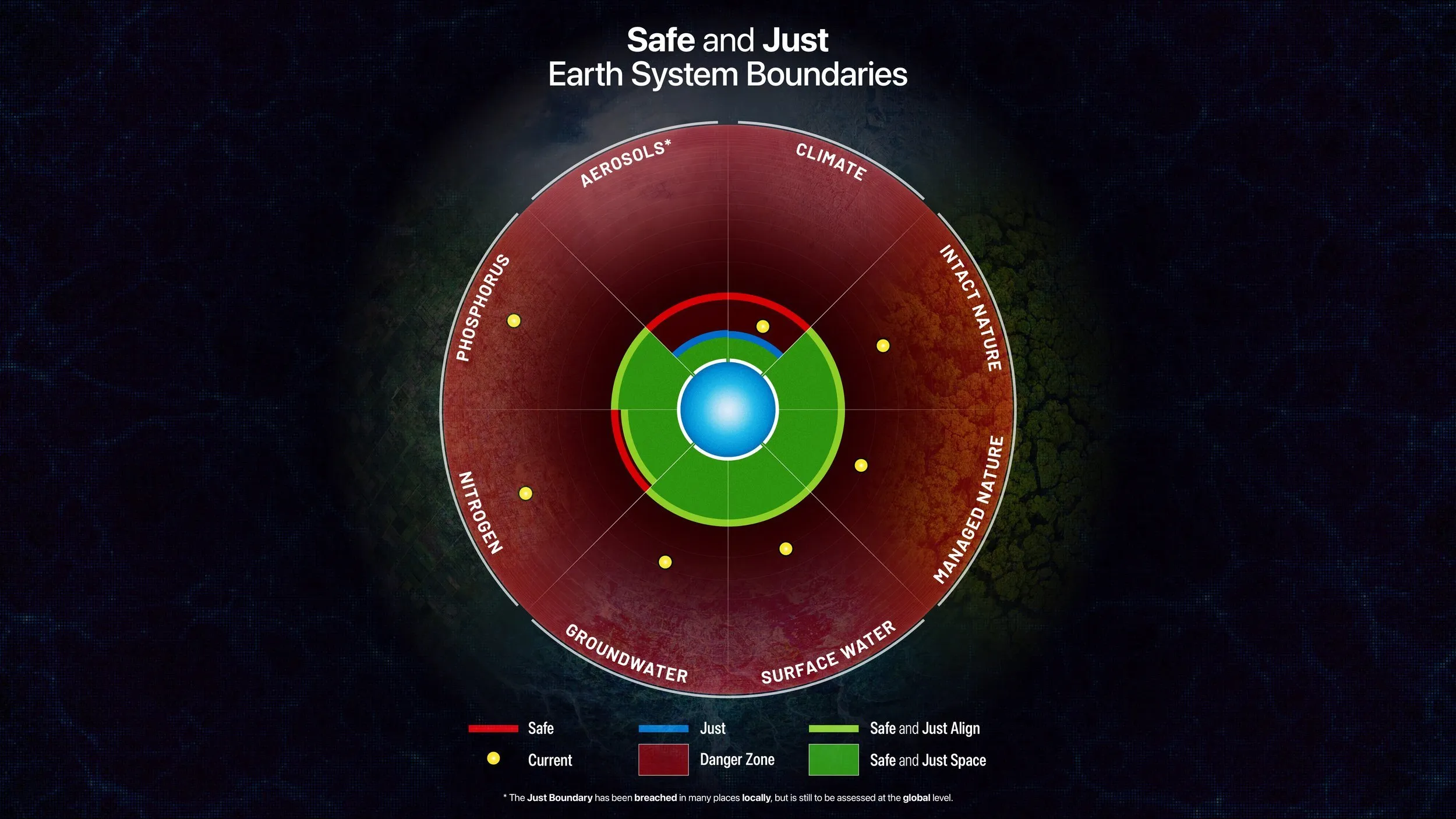
Earth System Boundaries (ESBs)
Earth System Boundaries are an evolution of the Planetary Boundaries (PBs), integrating concepts like doughnut economics and Sustainable Development Goals to define a ‘safe and just’ operating space. Developed by the Earth Commission, ESBs scale quantitative boundaries from local to global levels, incorporating justice to prevent significant human harm such as loss of lives, livelihoods, and nutritional insecurity.
This framework identifies 8 control variables across 5 planetary processes:
- Climate Change;
- Biosphere Integrity (intact nature & managed nature);
- Nutrients/Biogeochemical Flows (phosphorus & nitrogen);
- Freshwater Change (surface water & groundwater), and;
- Aerosol Loading.
Ref: Safe and just Earth system boundaries, 2023.
Earth System Governance
The distributed web of rules, institutions, and actor-networks — from local communities to international bodies — through which humanity collectively responds to planetary environmental change. Rather than top-down control, Earth System Governance describes how diverse actors at every scale negotiate shared responsibilities for the Earth system, experiment with practices and norms, and coordinate learning across boundaries. Its central challenge is aligning plural forms of agency with the coherence the biosphere requires — not subordinating them to it.
The framework emphasizes five analytical problems: architecture (how governance systems fit together), agency (who has the capacity to act), adaptiveness (how institutions learn and transform), accountability & legitimacy (who is answerable, and to whom), and allocation & access (how benefits and burdens are distributed). It treats governance not as a single global authority but as a cooperative ecology of formal and informal rule-systems working in concert. This is the register in which Earth System Law and Global Constitutionalism operate as well.
Ref: Biermann, F., Betsill, M. M., Gupta, J., Kanie, N., Lebel, L., Liverman, D., Schroeder, H., Siebenhüner, B., & Zondervan, R. (2010). Earth system governance: a research framework. International Environmental Agreements, 10, 277–298.
Earth System Law
An emerging legal paradigm that treats Earth as a single, interdependent socio-ecological system and designs norms aligned with planetary boundaries, rather than fragmented by sector or confined within state borders. It responds to a basic mismatch: most international environmental law evolved in the 20th century as a patchwork of issue-specific treaties — climate, biodiversity, oceans, chemicals — each governed separately. Yet the Earth system behaves as a whole, with feedbacks that cross every legal boundary.
Earth System Law seeks to embed ecological integrity, intergenerational responsibility, and the planet’s life-support capacity into binding law. It draws on advances in Earth system science to reimagine legal concepts — personhood, rights, jurisdiction, accountability — around planetary realities rather than inherited political geographies. It sits alongside Earth System Governance and Earth System Justice as attempts to give Earth-system science institutional and legal form. Proponents argue that, without such a shift, the law cannot keep pace with the Anthropocene.
Ref: Kotzé, L. J., & Kim, R. E. (2019). Earth System Law: The Juridical Dimensions of Earth System Governance. Earth System Governance, 1, 100003.
Earth System Interventions (ESIs)
Earth System Interventions encompass a broad spectrum of intentional, large-scale actions aimed at modifying Earth systems. These interventions range from historical practices like land reclamation, reservoir creation, irrigation, intentional extinction, nitrogen cycle management, and ecosystem restoration to emerging technological approaches such as carbon dioxide removal, solar geoengineering, genetic modification of in situ populations, gene drive organisms, de-extinction, and advanced ecosystem restoration. While these interventions hold the potential to address critical sustainability and human welfare challenges, they also bring forth significant environmental, social, political, and ethical considerations, necessitating informed and cautious governance in line with the precautionary principle. This oversight role belongs to Earth System Governance and Earth System Law.
Ref: Earth system interventions as technologies of the Anthropocene, 2021.
Earth System Justice
Earth System Justice is defined as an equitable sharing of nature’s benefits, risks and related responsibilities among all people in the world, within safe and just Earth System Boundaries (ESBs) to provide universal life support.
It includes the 3 Is of Justice:
-
Interspecies & Earth System Stability This principle emphasizes rejecting human exceptionalism and focuses on the more-than-human world. It advocates for viewing humans as guardians of the natural world, with a responsibility to maintain the stability of Earth’s ecosystems for the benefit of all species.
-
Intergenerational This principle is divided into two parts:
- 2.1. Past and Present: It involves acknowledging and respecting the connection and responsibilities between past and present generations.
- 2.2. Present and Future: It focuses on the responsibilities of the current generation towards future generations, ensuring the sustainability and health of the planet for those who come after.
-
Intragenerational This principle relates to equity and justice within the current generation. It addresses disparities between countries, communities (including Indigenous peoples), and individuals, advocating for fair and equitable treatment and distribution of resources and responsibilities. This same ethic underlies proposals to criminalise mass ecological harm as Ecocide.
Ref: Earth system justice needed to identify and live within Earth system boundaries, 2023.
Existential Moods
Defined by Émile P. Torres, Existential Moods are a subset of worldviews that encapsulate historically contingent orientations toward the permanence, fragility, and ethical significance of life on Earth, shaping and being shaped by the emotional and conceptual climate through which humans understand their place in the cosmos, the stability of their environment, and their moral obligations to preserve it. These moods evolve over time as new knowledge, technologies, and institutional arrangements emerge, and as global challenges shift collective perceptions of risk, responsibility, and human agency.
Throughout history, distinct Existential Moods have arisen and receded, often tied to formative eras:
-
Eternalist Era (Ancient Times to 1850s)
Characterized by a sense of an enduring natural order, often sustained by divine or mythic principles.
-
Cosmic Fragility (1850s to 1950s)
Marked by the growing scientific awareness of deep time, evolution, and geological upheaval, revealing Earth’s delicate life-support systems.
-
Brink of Oblivion (1950s to 1980s)
Defined by the nuclear age’s stark realization that humanity could unleash planet-wide destruction, bringing the notion of self-inflicted extinction into sharp focus.
-
Unforeseen Hazard (1980s to 2000s)
Influenced by the discovery of catastrophic events like asteroid impacts and sudden climate shifts, underscoring life’s vulnerability to unforeseen cosmic and planetary forces.
-
Age of Polycrisis (2000s to Present)
Encompassing interwoven threats—climate change, mass extinctions, pandemics, and more—this era intensifies the recognition of systemic fragility, sparking new moral imperatives for planetary stewardship — the mood in which Existential Risks and the Global Polycrisis entered public consciousness.
Ref: Torres, É. P. (2024). Human extinction: A history of the science and ethics of annihilation. Routledge
Existential Risks
Existential risks are global-scale threats that could irreversibly compromise humanity’s future by causing human extinction, the collapse of global civilization, or the permanent establishment of a dystopian societal state. These risks are distinguished by their scale (global impact affecting all of humanity), intensity (extreme severity of consequences), and irreversibility (permanent outcomes that preclude recovery or adaptation). Their significance lies not only in their potential to end human life but also in their capacity to foreclose humanity’s ability to flourish in the future.
These risks are composed of four critical components. (1) The threat refers to the specific event, process, or condition capable of causing catastrophic outcomes, such as climate change, nuclear war, or unregulated biotechnological advancements. (2) Vulnerability encompasses the weaknesses or systemic fragilities in societal, ecological, or technological structures that increase humanity’s susceptibility to such threats. (3) The response includes the measures, strategies, and policies enacted to mitigate or adapt to the risk. (4) Exposure describes the extent to which human systems, populations, or infrastructures are positioned within the scope of the threat, shaped by factors such as geography, technology, and societal organization.
Anthropogenic existential risks—those arising from human actions and decisions—highlight the dangers of an interconnected world. These risks include scenarios such as human extinction caused by nuclear or biotechnological events, global societal collapse due to the failure of critical systems like food or energy networks, or a dystopian lock-in where oppressive regimes permanently inhibit freedoms, innovation, and human well-being. Such risks are exacerbated by humanity’s dependence on complex global systems, which amplify vulnerabilities and increase exposure to cascading failures.
Climate change serves as a paradigm of how existential risks operate and interact. It demonstrates the potential for risk cascades (chains of adverse effects triggered by an initial event) and tipping points (thresholds in ecological or climate systems beyond which irreversible changes occur). For example, feedback loops, such as the thawing of permafrost that releases greenhouse gases, can amplify warming, destabilize ecosystems, and trigger widespread societal disruption. These effects strain already vulnerable infrastructures, leading to systemic failures across interconnected networks like supply chains, financial systems, and global food production.
Addressing existential risks demands a proactive and integrated approach. This involves analyzing worst-case scenarios, exploring the interplay of systemic vulnerabilities, and developing robust mitigation strategies. By improving societal resilience (the capacity to absorb, recover from, and adapt to shocks) and fostering international cooperation, humanity can reduce vulnerabilities and prepare for these profound threats.
See also: Precipice (the) and Global Polycrisis
📍 Our dedicated page on X-Risks
Feedback Loops
A feedback loop is a closed causal sequence within a system where the effects of an initial change influence the same system, either amplifying or dampening the original change. These loops are fundamental to determining the stability and dynamics of complex systems. Feedback loops can be positive (reinforcing), where the outcome magnifies the initial change, or negative (balancing), where the outcome counteracts the initial change. They are the mechanism at the heart of the Gaia Hypothesis’s account of planetary self-regulation.
In climate systems, at least 41 physical and biological feedback loops have been identified, showcasing the intricate interdependence of Earth’s processes. Positive feedback loops, such as Arctic ice melt reducing albedo (reflectivity) and accelerating warming, amplify external forcings and can push the system toward tipping points—thresholds beyond which irreversible and self-sustaining shifts occur. Negative feedback loops, such as increased atmospheric carbon dioxide stimulating vegetation growth and enhancing CO₂ removal, stabilize the system by counterbalancing changes.
The interaction of feedback loops often leads to cascading effects, where changes in one system trigger amplifying or stabilizing responses in others. For instance, permafrost thaw releases greenhouse gases, driving further warming and activating other feedbacks, such as forest dieback or changes in ocean circulation. These interconnected loops influence climate sensitivity, the remaining carbon budget (the permissible carbon emissions to limit warming), and the likelihood of crossing critical thresholds. Feedback loops frequently exhibit non-linear behavior, where small changes can have disproportionately large effects. Their operation spans diverse time scales, ranging from immediate impacts to changes unfolding over centuries or millennia. Moreover, these loops integrate biophysical, biological, and human systems, highlighting the complexity and uncertainty of interactions that shape the Earth’s climate trajectory.
Ref: Ripple, W. J., Wolf, C., Lenton, T. M., Gregg, J. W., Natali, S. M., Duffy, P. B., Rockström, J., & Schellnhuber, H. J. (2023). Many risky feedback loops amplify the need for climate action. One Earth, 6(2), 85-91.
Gaia Hypothesis
The Gaia Hypothesis posits that Earth functions as a self-regulating system, where living organisms interact with physical and chemical processes to maintain conditions favorable for life. First proposed by James Lovelock in the 1970s, the hypothesis was significantly shaped by the contributions of Lynn Margulis, who emphasized the role of microorganisms in Earth’s biogeochemical cycles, and Dian Hitchcock, who collaborated on atmospheric research that refined its core ideas. The name “Gaïa” (Γαῖα) was inspired by the ancient Greek goddess of the Earth, whose name derives from the root ga meaning “earth” or “land”.
The hypothesis centers on the concept of feedback loops, where life modifies its environment in ways that stabilize planetary conditions. For example, marine phytoplankton influence cloud formation, which affects global temperatures and sunlight levels. These interactions demonstrate the interconnectedness of biological and physical processes in sustaining Earth’s habitability.
Gaia challenges traditional scientific boundaries, uniting biology, geology, and atmospheric science in a single framework. It portrays Earth as an emergent system where self-regulation arises from countless interactions, without implying consciousness or intent. While initially controversial, the hypothesis has inspired fields like Earth system science and planetary boundaries, highlighting the fragility of Earth’s systems and the risks of human-driven disruptions. The Gaia 2.0 concept, proposed by Timothy Lenton and Bruno Latour, builds on this framework by introducing the potential for deliberate human participation in Earth’s self-regulation, emphasizing autotrophy, adaptive networks, heterarchy, and self-aware regulation as key features to foster planetary sustainability. Similar concept: Terra sapiens.
Ref: Gaia as seen through the atmosphere (1972) / Atmospheric homeostasis by and for the biosphere: the gaia hypothesis (1974) / Gaia 2.0 — Could humans add some level of self-awareness to Earth’s self-regulation? (2018)
Genesity
Genesity is the capacity of a system—planetary, ecological, or technological—to not only sustain life but also generate and foster the emergence of new forms of biodiversity and complexity. It expands on the concept of habitability by emphasizing life’s dynamic, regenerative potential to adapt and evolve over time. While habitability focuses on maintaining the conditions necessary for existing life, genesity centers on the processes that enable life to innovate, diversify, and create entirely new ecological possibilities. A planet may be habitable without being generative, but a system with high genesity inherently drives ongoing ecological and evolutionary creativity.
In planetary systems, genesity arises from feedback loops, ecological resilience, and the interplay between biotic and abiotic processes that promote adaptation and renewal. Unlike habitability, which often emphasizes stability and resource availability, genesity acknowledges that change and disturbance can be vital forces for fostering life’s potential. This concept aligns with planetary boundaries by framing habitability as the foundation and genesity as the engine of life’s flourishing, both of which must operate within the limits of Earth’s life-support systems. The technosphere, as humanity’s contribution to planetary systems, plays a pivotal role in either enhancing or undermining genesity depending on how it integrates with natural processes. Genesity challenges human systems to move beyond conservation, fostering regenerative practices that enhance ecosystems’ creative potential while adapting to environmental change.
Ref: Wong, M. L., Bartlett, S., Chen, S., & Tierney, L. (2022). Searching for life, mindful of lyfe’s possibilities. Life, 12(6), 783.
Geographicity
The fundamental and irreducible relationship between humans and the Earth, encompassing the ways in which humans experience, understand, and engage with their terrestrial environment as a lived reality filled with meaning, symbolism, and emotional attachments. It is the existential and experiential dimension of human life on Earth, shaping our sense of place, belonging, and identity across various scales, from the intimate to the planetary. Geographicity complements the concept of planetarity by emphasizing the human-Earth relationship and the lived experience of being embedded within the planet’s systems and processes. While planetarity highlights the ontological condition of being inextricably connected to the Earth’s complex and interconnected systems, geographicity focuses on how this condition is experienced, understood, and navigated by humans as inhabitants of the Earth. Together, these concepts provide a holistic understanding of the human-Earth relationship, recognizing both the objective reality of our planetary embeddedness and the subjective, experiential dimensions of our terrestrial existence.
Ref: Dardel, É. (1952). L’Homme et la Terre: Nature de la Réalité Géographique. Presses Universitaires de France.
Global Change
Global change is the name Earth-system science gave, from the 1980s onward, to the suite of planet-wide environmental transformations driven by human activity — climate, the biogeochemical cycles, land cover, freshwater, biodiversity — studied together rather than one at a time. It was the organising idea of the International Geosphere-Biosphere Programme (1987–2015), whose central finding was that these changes are coupled: nitrogen loading, forest clearing and carbon emissions are one process seen from three angles, not three problems standing in a queue. The mid-20th-century surge in that coupled signal is the Great Acceleration.
The word carries an assumption worth naming. Global describes the world as a surface — the sum of everywhere, reached by adding places together. It is the vocabulary of globalisation, global markets, global governance: a totality that human activity extends across and that human institutions might in principle administer. The framing served the science well and still names most of its literature, but it holds humanity at the centre and casts Earth as the arena in which change happens rather than as the thing that is changing. Planetary change is the wider term, and the one this Lexicon prefers.
Ref: Steffen, W., Persson, Å., Deutsch, L., et al. (2011). The Anthropocene: From Global Change to Planetary Stewardship. AMBIO, 40, 739–761. · Steffen, W., Broadgate, W., Deutsch, L., Gaffney, O., & Ludwig, C. (2015). The trajectory of the Anthropocene: The Great Acceleration. The Anthropocene Review, 2(1), 81–98.
Global Safety Net
The Global Safety Net (GSN) is a science-based framework aimed at protecting 50% of Earth’s terrestrial surface to conserve biodiversity, stabilize the climate, and enhance ecosystem resilience. It integrates ecological and carbon priorities, emphasizing the significant overlap between them, and highlights the essential role of Indigenous lands, which often coincide with critical conservation areas. By serving as a strategic roadmap for sustainability, the GSN ensures the continued provision of ecosystem services and the resilience of both natural systems and human societies. At its core, the GSN identifies sites of species rarity, including Alliance for Zero Extinction (AZE) sites, Key Biodiversity Areas (KBAs), and the ranges of threatened vertebrates and rare plants. It also prioritizes distinct species assemblages found in high beta-diversity regions and biodiversity hotspots, as well as rare phenomena like intact large mammal assemblages and globally significant ecological processes. Habitat intactness is a key focus, with wilderness areas and the “Last of the Wild” regions identified as essential for ecological stability. To address climate objectives, the GSN includes carbon-rich areas categorized as Tier 1 and Tier 2 Climate Stabilization Areas (CSAs) based on their carbon density. It also incorporates wildlife and climate corridors to connect protected and intact habitats, ensuring species migration and adaptation under changing environmental conditions. By combining biodiversity conservation with climate action, the GSN offers a comprehensive solution to addressing global ecological and climate crises. It complements the smaller-footprint Conservation Imperatives, which targets the last unprotected sites of irreplaceable biodiversity.
Ref: Dinerstein, E., Joshi, A. R., Vynne, C., Lee, A. T. L., Pharand-Deschênes, F., França, M., Fernando, S., Birch, T., Burkart, K., Asner, G. P., & Olson, D. (2020).A “Global Safety Net” to reverse biodiversity loss and stabilize Earth’s climate. Science Advances, 6(36), eabb2824.
Global Constitutionalism
A body of thought proposing that shared global norms — human rights, ecological integrity, intergenerational justice — be legally entrenched as constitutional principles across the international order, rather than left to voluntary treaties or bargaining between states. The argument begins from a diagnosis: the international system remains structurally anchored in state sovereignty, while the problems it must address — climate change, biodiversity collapse, pandemics, planetary commons — are irreducibly transnational.
Global constitutionalism draws on several traditions: cosmopolitan political theory (global citizenship, post-sovereign authority), international legal scholarship (on the judicialization and constitutionalization of international law), and emerging debates on planetary governance. Proposals range from entrenching a core of global constitutional norms within existing institutions to more ambitious designs for a democratically legitimated world constitutional order. By grounding planetary obligations in legal authority rather than political discretion, constitutional framings aim to give sustainability norms not only ethical force but legal standing. It is a close cousin of Earth System Law, which pursues similar ends through international rather than constitutional doctrine.
Ref: Lang, A. F. Jr., & Wiener, A. (Eds.). (2023). Handbook on Global Constitutionalism (2nd ed.). Edward Elgar Publishing.
Global Commons
Common resources at a planetary scale that are outside national jurisdictions. International law identifies four global commons which are recognised as the common heritage of humankind (UNEP Division of Environmental Law and Conventions):
- High Seas
- Atmosphere
- Antarctica
- Outer Space
In the Anthropocene, humanity must act as stewards of the planet’s resources that regulate the stability and resilience of the Earth System. There is an urgent need to expand the definition of global commons — see Planetary Commons.
Ref: Nakicenovic, N., Rockström, J., Gaffney, O., & Zimm, C. (2016). Global Commons in the Anthropocene: World Development on a Stable and Resilient Planet. IIASA Working Paper. IIASA, Laxenburg, Austria, WP-16-019.
Global Polycrisis
A global polycrisis is an emergent phenomenon characterised by the causal entanglement of crises in multiple global systems in ways that significantly degrade humanity’s prospects. It is the Cascade Effect writ across the whole Earth system, rather than confined to a single tipping-element network.
It encompasses 2 core implications:
- Intra-systemic impact: A disruption affecting one part or area of a single system quickly spreads, disturbing the entire system. This occurs through multiple, ramifying chains of cause and effect, or some form of contagion, navigating through the system’s causal network.
- Inter-systemic impact: The disruption of the initial system may extend beyond that system’s boundaries, leading to the disruption of other systems.
Additionally, 4 vectors can carry a crisis within and across systems and from one part of the world to another, thereby leading to a global polycrisis:
- Energy, such as the kinetic energy generated by earthquakes and hurricanes.
- Matter, such as the toxins and pollutants that harm organisms and ecosystems.
- Information, consisting of instructions and symbolic representations—including genetic and digital codes, news feeds, ideologies, money, policies, and laws—that can be communicated between agents.
- Biota, such as viruses, bacteria, and other organisms that can disrupt the biological and physiological functions of other organisms. (This category may be considered a special combination of energy, matter, and information that involves lifeforms.)
Ref: Lawrence, M. J., Homer-Dixon, T., Janzwood, S., Rockström, J., & Renn, O. (2024). Global Polycrisis: The Causal Mechanisms of Crisis Entanglement. Global Sustainability, 3, e25.
Globocide
Globocide names a harm one scale larger than ecocide. Where ecocide is the destruction of a part of the living world — a forest, a river, a species — globocide is the endangerment of the biosphere as a whole: the disruption of the Earth System on which all life depends. It is planetary in the strict sense — not the loss of a place or a people, but of the living planet itself.
The word was coined by the philosopher Günther Anders (Ten Theses on Chernobyl, 1986) for a nuclear age able to threaten “all life on earth” — a wrong he placed beyond even genocide. Revived in 2026 by the marine-conservation organisation BLOOM, it is turned from the bomb’s sudden violence to the slow, knowing devastation of fossil-fuelled industrial life, and proposed as a new crime in law: where ecocide is a crime against the environment, globocide is a crime against the Earth System itself. The demand answers a legal void — emitting greenhouse gases, prosecutors have held, “is not in itself illegal” — and belongs to the wider effort to give the planet standing in law, kin to Earth System Law, Earth System Justice, and the protection of the Global Commons and Planetary Commons.
Ref: Anders, G. (1986). Ten Theses on Chernobyl. // BLOOM (2026). L’appel des 100 pour la reconnaissance du crime de globocide. // BLOOM. Dismissal of the criminal complaint against TotalEnergies.
Great Acceleration
The Great Acceleration encapsulates the mid-20th-century step-change in anthropogenic global environmental impact. It integrates evidence of humans transforming Earth’s functioning into a coherent overview of global change. This phenomenon, sparked by the post-WWII industrial surge, encompasses complex, multi-causal processes altering the Earth System – from land domestication to significant modifications of the atmosphere, hydrosphere, and biosphere. The Great Acceleration also highlights the emergence of tipping points, leading to rapid, non-linear, and potentially irreversible changes in Earth’s climate system, symbolising humanity’s substantial influence on the planet’s geology and ecosystems.
Ref: The trajectory of the Anthropocene: The Great Acceleration, 2015 / Planetary Health Check, 2025.
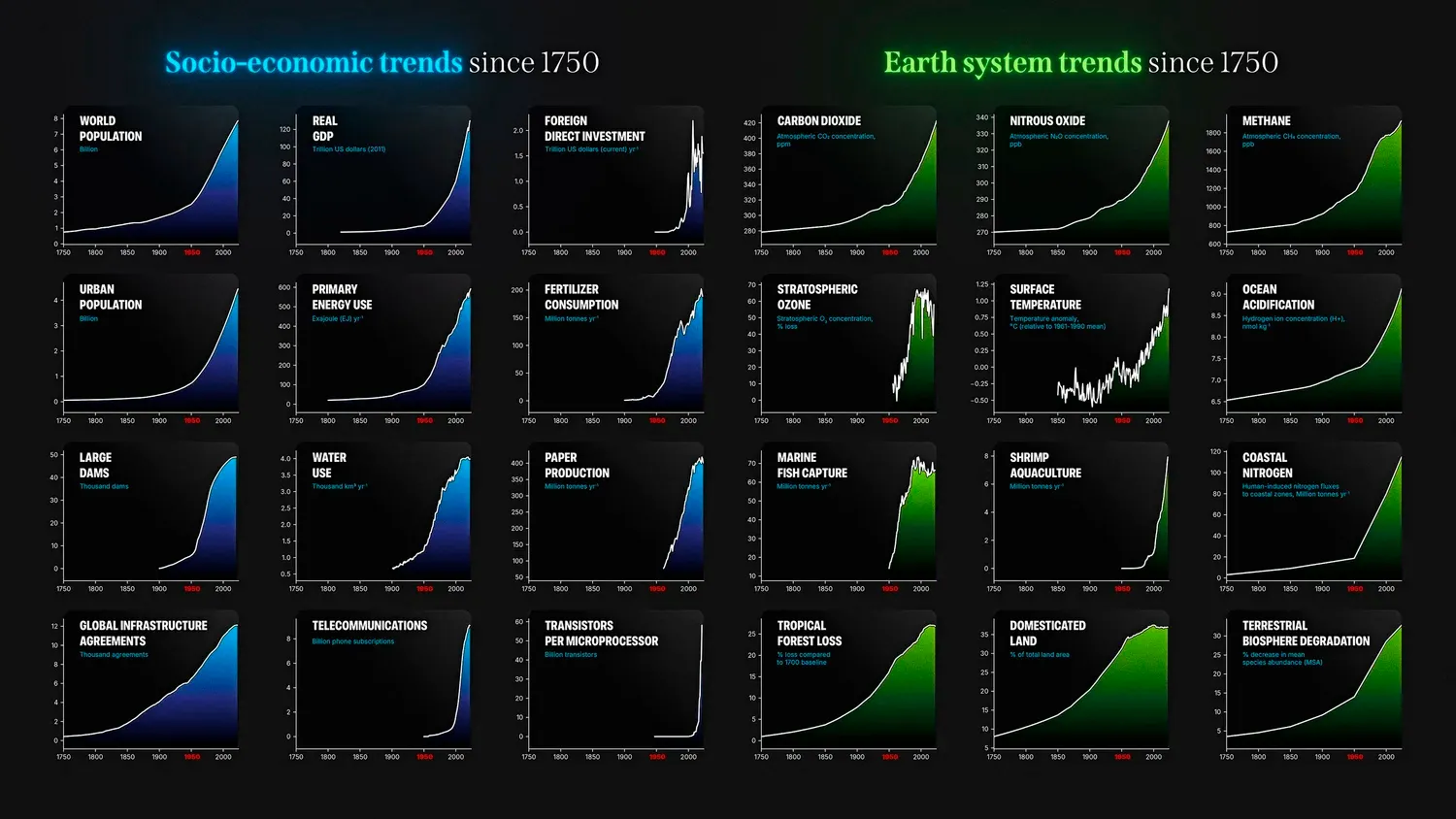
Habitability (biophysical)
Habitability refers to the capacity of an environment, whether terrestrial or extraterrestrial, to support and sustain life as we know it. It encompasses the physical, chemical, ecological, and cosmic conditions necessary for life, integrating astrobiology and sustainability science, and highlights the interplay between stability, resilience, and the systems that maintain the delicate balance life requires.
At a planetary level, habitability is shaped by geophysical stability, which ensures long-term conditions favorable for life, and protection mechanisms like magnetic fields and atmospheres that shield against harmful cosmic radiation. These, coupled with essential resources such as liquid water and heavy elements, create a foundation for life’s persistence. The gradual reduction of catastrophic cosmic events over time, such as supernovae and gamma-ray bursts, has further enhanced the potential for habitable conditions to emerge and endure.
On Earth, habitability is closely tied to the Safe Operating Space, which integrates habitability, ecological resilience, and systemic stability to define the conditions within which humanity can thrive while preserving planetary systems. The Planetary Boundaries framework formalizes this, identifying key thresholds—for climate regulation, biosphere integrity, freshwater use, and biogeochemical cycles—that safeguard Earth’s life-support systems. Exceeding them risks simplifying Earth’s intricate ecological and geophysical systems, reducing their resilience and their capacity to sustain life. Habitability also encompasses life’s adaptability to extreme conditions, as demonstrated by extremophiles that thrive where once thought impossible—broadening the concept to include niche ecosystems on Earth and the potential for life on other worlds.
Habitability admits of degrees, not only thresholds: an environment can be habitable and nearly empty. In deep-time analysis it is therefore measured as the capacity to support life in a way that maximises functional and taxonomic biodiversity, productivity, biomass, and resilience together. The four must increase in concert, since an increase in one alone is not sufficient — an algal bloom raises productivity without raising habitability. Resilience is the least straightforward of the four, as it is not a good in itself: a biosphere that has been simplified and then locked in that state is highly resilient, stable because it is impoverished, a condition termed undesirable resilience and one that transient biosphere disruptors have repeatedly imposed for millions of years at a time. Its generative counterpart — the capacity not just to sustain life but to diversify it — is Genesity. On this definition habitability is not a binary property of a planet but a quantity that Earth’s own history has raised and lowered, and that human activity now moves in both directions.
We view planetary habitability as a defining idea for the 21st century and beyond. Its conceptualization dates to the mid-20th century, with key moments such as the “habitable zone” concept introduced by Su-Shu Huang and Robert Jastrow in 1959, the Drake Equation in 1961, and the discovery of the first confirmed exoplanet in 1992. It gained momentum following the 2009 launch of NASA’s Kepler space telescope, designed to search for potentially habitable exoplanets, yet has only recently entered widespread public consciousness.
Ref: Williams, M., & Zalasiewicz, J. (in press). A disharmony of the spheres in the Anthropocene. In Planetary Metaphysics: Scientific, Religious, and Philosophical Perspectives on the Human-Earth Relationship. Indiana University Press. · Dornelles, A. Z., Boyd, E., Nunes, R. J., et al. (2020). Towards a bridging concept for undesirable resilience in social-ecological systems. Global Sustainability, 3, e20.
Habitability (relational)
Relational Habitability refers to the emergent, dynamic quality of the interaction between people and their environment, enabling healthy, meaningful, and dignified lives (ensuring well-being and agency). It transcends biophysical habitability (climate, water, land, etc.) to integrate socio-cultural (values, traditions, spiritual ties), economic (access to livelihoods and resources), and political dimensions (governance, power structures), acknowledging the role of historical context (legacies of colonialism or development pathways), cultural values (interpretations and practices shaping place attachment), spiritual connections (ties to ancestors or sacred places), and power dynamics (who controls and defines habitability).
Habitability is intersectionally differentiated (experienced differently based on age, gender, socioeconomic status, and other factors), shaped by inequalities in access to resources, vulnerabilities, and lived experiences (varying opportunities and risks for different groups), and exists on a continuum (not binary, with thresholds and tipping points marking transitions). It is inherently relational (shaped by connections across places and scales), influenced by connectivity (flows of resources, people, and ideas) and local and global feedback loops (interdependent socio-ecological systems).
This holistic perspective requires integrating top-down systemic analysis (broad, scientific perspectives) with bottom-up local knowledge (lived experiences and cultural insights), respecting diverse epistemologies (recognizing multiple ways of knowing, including indigenous knowledge) and addressing the ethical implications (who decides and benefits) of defining and enacting habitability. It shares this relational lens with Geographicity and Biosphere embeddedness.
Ref: Habitability for a connected, unequal and changing world, 2024.
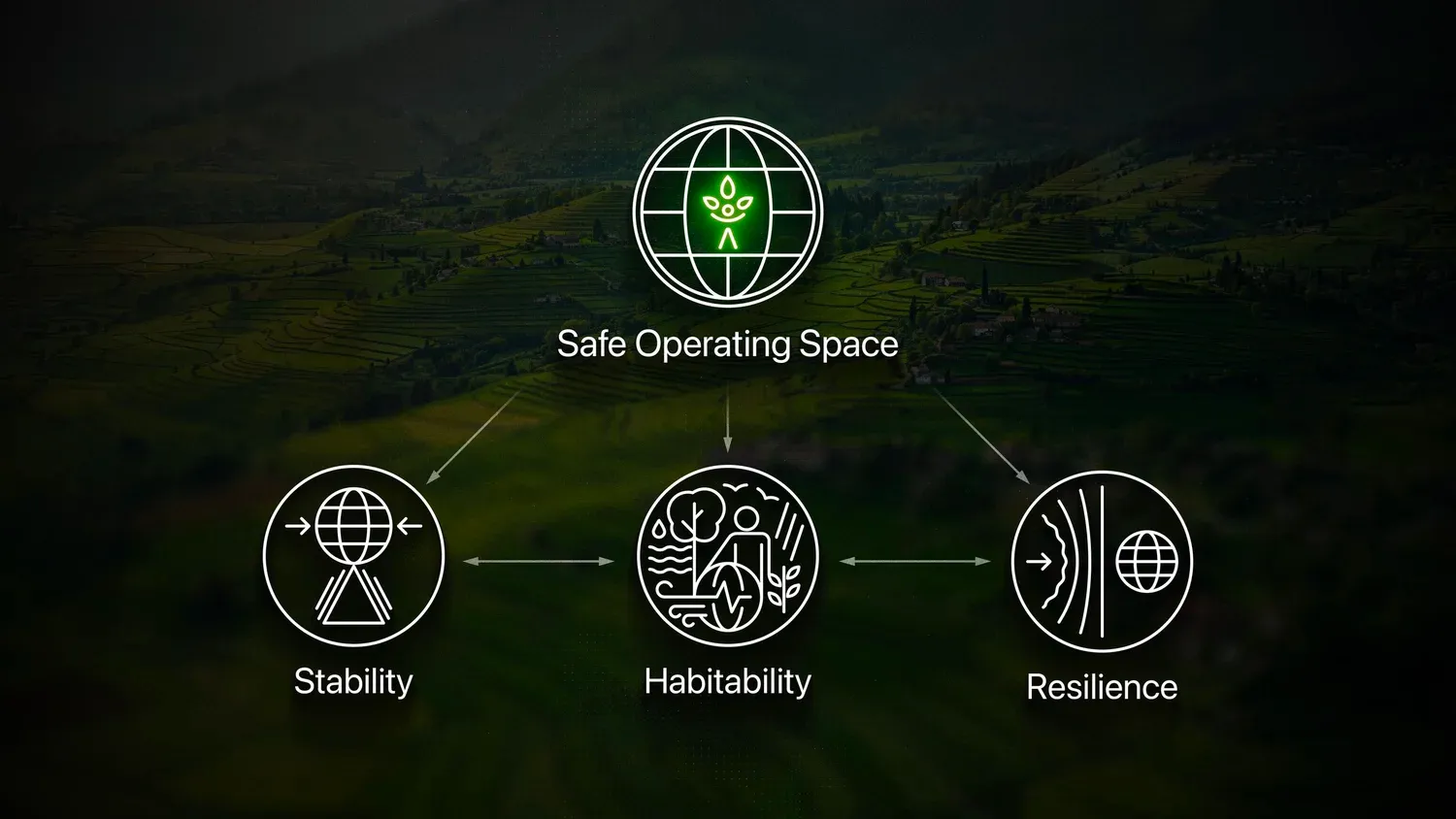
Habitable Zone
Often referred to as the ‘Goldilocks Zone,’ the concept of the Habitable Zone in astronomy and planetary science defines the range of conditions under which a planet can possess liquid water on its surface and potentially support life. The boundaries of this zone vary based on factors such as the type and characteristics of the star (size, temperature, and brightness), the planet’s atmosphere, and its orbital path. However, habitability is not limited to individual star systems and can be applied at larger scales.
• The Super-Galactic Habitable Zone considers regions within large cosmic structures, such as superclusters, where conditions allow for the development of life. These regions benefit from sufficient metallicity and moderate stellar activity while avoiding intense cosmic threats near galaxy cluster centers or active galactic nuclei.
• The Galactic Habitable Zone refers to areas within a galaxy that are favourable for life, typically within a galactic disk but far enough from the center to avoid destructive forces like supernovae, gamma-ray bursts, and black hole activity, while still ensuring access to the heavy elements required for planet formation.
• The Circumstellar Habitable Zone specifically defines the region around a star where conditions allow for the existence of liquid water. This zone depends on the star’s properties and the planet’s ability to maintain a stable atmosphere and protection from stellar radiation and other local catastrophic events.
• The Cosmic Habitable Age extends the idea in time: the era in which the universe has held enough of the heavy elements planets are made of, and has grown calm enough, for life like Earth’s — on most estimates opening several billion years after the Big Bang, and set to last far into the future.
These zones nest inside one another, and each is uncertain: the bounds of the Galactic Habitable Zone in particular remain actively debated, and being inside a habitable zone does not make a planet habitable — the Moon orbits within the Sun’s. The circumstellar zone’s first name was the ecosphere, coined by Hubertus Strughold in the 1950s.
HANPP · Human Appropriation of Net Primary Production
The share of the land’s annual production of new plant matter that human activity harvests, destroys or prevents from growing at all. Green plants convert sunlight into living tissue; what remains after the plants’ own respiration is net primary production, the energy income on which almost every other organism ultimately draws — the exceptions being the chemosynthetic communities of hydrothermal vents and the deep subsurface, which live on chemistry rather than sunlight. HANPP measures how much of that income one species now claims — a single number for the human share of the land’s metabolism. The accounting is terrestrial: the ocean, which produces roughly as much new plant matter again, is outside every figure below.
The accounting is subtractive rather than additive. It compares the production a landscape would generate under its potential natural vegetation with what it actually generates today, then adds what is removed from it. Three components make up the total: the biomass harvested as crops, timber, grazing and fodder; the productivity forgone because cropland, pasture, plantations and pavement are usually less productive than the ecosystems they replaced, together with what soil degradation and desertification remove; and the biomass lost to human-set fires. The second term can run negative: irrigated and fertilised farmland sometimes out-produces the vegetation it displaced. The measure is therefore not a flow of goods but a claim on capacity — the difference between the biosphere that is and the biosphere that would otherwise be.
Whittaker and Likens made the first attempt in 1973 and arrived at about 3%. It was Vitousek and colleagues in 1986 who added the forgone-productivity tier, and their high estimate — 40% of potential terrestrial production, describing the biosphere of the 1970s — is the figure that entered public argument and has been quoted ever since. Later work put the claim at roughly a quarter of potential terrestrial production, about 15.6 billion tonnes of carbon a year around 2000. The gap between the two is definitional, not a correction: Vitousek’s high tier counts the entire production of human-dominated land as appropriated, where the later accounting counts only what is harvested plus the productivity that land-use change removed. Recalculating Vitousek’s own definitions against a far richer year-2000 dataset confirmed his original numbers.
On that later definition the twentieth-century trend is a doubling: from about 6.9 to 14.8 billion tonnes of carbon a year between 1910 and 2005, with the share rising from 13% to 25%. The 2005 quantity is smaller than the year-2000 one above because it comes from a later revision of the same accounting, not because the claim fell. What restraint there is shows against the drivers rather than in the share: over the same span population quadrupled and economic output rose seventeenfold. Agricultural intensification bought a real reprieve — humanity’s claim grew far more slowly than its numbers or its wealth. It still grew.
HANPP is the biosphere’s answer to the questions that IPAT and Overshoot pose in economic terms. It converts population, consumption and technology into a single physical quantity, and unlike ecological footprint accounting it is counted in tonnes of carbon rather than in area-equivalents — a claim on the biosphere’s energy flow, measured as the mass of living matter that carries it. It is also a measure of what is not left: production appropriated by people is production unavailable to everything else, which makes HANPP one of the more direct pressures behind biodiversity loss — and a quantitative reading of the carrying capacity problem, of biosphere embeddedness, and of how far the technosphere now runs on the biosphere’s account.
Ref: Whittaker, R. H., & Likens, G. E. (1973). Primary production: The biosphere and man. Human Ecology, 1(4), 357–369. · Vitousek, P. M., Ehrlich, P. R., Ehrlich, A. H., & Matson, P. A. (1986). Human appropriation of the products of photosynthesis. BioScience, 36(6), 368–373. · Haberl, H., Erb, K. H., Krausmann, F., Gaube, V., Bondeau, A., Plutzar, C., Gingrich, S., Lucht, W., & Fischer-Kowalski, M. (2007). Quantifying and mapping the human appropriation of net primary production in earth’s terrestrial ecosystems. Proceedings of the National Academy of Sciences, 104(31), 12942–12947. · Krausmann, F., Erb, K. H., Gingrich, S., Haberl, H., Bondeau, A., Gaube, V., Lauk, C., Plutzar, C., & Searchinger, T. D. (2013). Global human appropriation of net primary production doubled in the 20th century. Proceedings of the National Academy of Sciences, 110(25), 10324–10329.
Holocene
According to the International Commission on Stratigraphy (ICS), the Holocene is the geological epoch that began at the end of the last ice age 11,700 years ago (before year 2000) and that has continued until now. The Holocene has been characterised by a remarkably stable climate, which helped human civilisations to flourish. When the Anthropocene is officially adopted (ICS), its starting date will likely mark the end date of the Holocene. Its stability defines the temporal reach of the Corridor of Life.
“The Holocene is (or was) an extraordinarily stable state of the Earth system: temperatures on Earth stabilised at 14±0.5°C. Ecosystems, precipitation patterns, seasons and temperatures settled within narrow “life-supporting” ranges, providing us with the states of the biosphere, hydrosphere, and cryosphere of the Earth as we know it. Earth had barely settled in this stable Holocene state, when we went through the Neolithic revolution, domesticating plants and animals simultaneously across continents on Earth some 10 000 years ago. We became farmers, living in sedentary communities. This was the starting point of civilisations as we know them today. The Holocene state of the planet is the only state of the planet we know for certain can support the modern world as we know it.”
Ref: Potsdam Institute for Climate Impact Research
Holochtony
Holochtony is a proposed concept describing the growing awareness, shared by an increasing number of people, of their collective belonging to Earth as a common habitat. It calls for the rehabilitation of an ethical, spiritual, and ecological relationship with the planet, grounded in the recognition of our deep co-evolution with terrestrial ecosystems. This notion does not seek to appropriate or dilute the specific struggles of Indigenous peoples, but rather encourages non-Indigenous people to develop practices of respect and responsibility toward the Earth — practices inspired by Indigenous ancestral knowledge and enriched by modern scientific understanding. Holochtony holds that, while not all humans have historical roots in a particular territory, we share a fundamental belonging to this planet and bear a collective responsibility for maintaining its stability and resilience. It is therefore an invitation to rethink our relationship with the living world — not as a return to an idealized past, but as a deliberate reorientation toward ways of inhabiting the Earth that acknowledge our dependence on it, while honoring the rights and knowledge of Indigenous peoples. The idea runs parallel to the Māori concept of Kaitiakitanga, to the guardianship ethic of Place-based Societies, and to the systems view of Biosphere embeddedness — though, unlike them, it addresses those without inherited territorial ties.
Ref: Term coined by GLOBAÏA, 2023.
Hominisation
The evolutionary process of becoming human — the biological, cognitive, and cultural transformation that carried early hominins toward modern Homo sapiens. It encompasses upright walking (bipedalism), the enlargement and reorganisation of the brain, the emergence of complex language, and the invention of durable cultural practices. Crucially, hominisation is not a finished event but a feedback loop: in the lineage of André Leroi-Gourhan, the same technics and symbols that drive Anthropisation (the material remaking of the milieu) and Humanisation (its symbolic remaking) recoil upon the species, reshaping bodies, brains, and behaviour in turn. Tool and hand, word and cortex, culture and biology co-evolve. In this sense humans are self-producing animals, continually made by the very world they make — a co-becoming that Berque’s mésologie situates within the écoumène. Also called anthropogenesis.
Ref: Leroi-Gourhan, A. (1964). Le geste et la parole. Éditions Gallimard.
Humanisation
The symbolic, semantic transformation of the environment through our systems of meaning — the subjective counterpart to Anthropisation. Where anthropisation reworks the milieu materially, humanisation reworks it in sense: the ways human perception, language, memory, and value invest the world with significance, turning mere surroundings into a named, storied, meaningful place. It includes the attribution of human-like qualities to non-human beings and phenomena, and the cultural, linguistic, and artistic expressions through which societies interpret their surroundings and, increasingly, the planet as a whole. In the mésologie (study of milieux) of geographer Augustin Berque, the two faces are inseparable: the human milieu, or écoumène, is trajective — at once physical and symbolic, never one without the other. Humanisation is how a landscape becomes a homeland and the Earth becomes Terre-Patrie rather than a neutral globe. Its scaling-up toward a shared, self-aware planetary meaning is what GLOBAÏA elsewhere calls Planetarisation and Planetary Awareness.
Ref: Berque, A. (2000). Écoumène : Introduction à l’étude des milieux humains. Paris: Éditions Belin.
Industrial Modernity
Industrial Modernity names the dominant way of organising human life that emerged with the fossil-fuelled Industrial Revolution and now underpins almost every contemporary society. Following Kanger and colleagues, it is best understood as a bundle of mutually reinforcing ideas (foundational beliefs and assumptions), institutions (formal and informal rules), and practices (characteristic behaviours) spanning how we treat the natural environment — chiefly as a source of inputs — alongside science, technology, and innovation. These elements cohere across two or more successive great surges of development: the waves of transformation, from steam and steel to electricity, mass production, and digital automation, that have carried the same underlying logic ever more widely. Because it is embedded in almost any socio-technical system, Industrial Modernity functions as civilisation’s default operating system — the taken-for-granted background that the sustainability concepts in this glossary, from Ecocivilization to Earth Stewardship, are attempts to revise, redirect, or transcend. It is the water in which industrial societies swim — and the base condition from which the Great Acceleration launched after 1950.
Ref: Kanger, L., Tinits, P., Pahker, A. K., Orru, K., Tiwari, A. K., Sillak, S., Šeļa, A., & Vaik, K. (2022). Deep transitions: Towards a comprehensive framework for mapping major continuities and ruptures in industrial modernity. Global Environmental Change, 72, 102447.
IPAT
The IPAT equation is a conceptual formula proposed to estimate the impact of human activity on the environment. It is expressed as:
Impact = Population × Affluence × Technology
Where:
- Impact Refers to the environmental impact, often measured in terms of resource depletion, depredation, waste, and pollution.
- Population Denotes the number of people. Greater population increases demand for resources and leads to more waste and pollution.
- Affluence Represents the level of consumption per person. Higher affluence typically increases per capita consumption, which can lead to greater environmental impact.
- Technology Refers to the processes and methods used to produce goods and services. Technology can either increase or decrease the environmental impact depending on how it affects resource use and waste production. Its emissions-specific descendant, the Kaya Identity, decomposes emissions into the same four multiplied terms, while DPSIR traces analogous causal forces as a sequence rather than a product.
Kaitiakitanga
Kaitiakitanga is a Māori word with no true equivalent in other languages — a single term carrying an entire worldview of care: to guard, tend, protect, restore, and hand on the living world undiminished to those not yet born. Formed from tiaki, “to guard, to care for” — a kaitiaki is a guardian — it names an obligation that is inherited rather than chosen, and reciprocal rather than managerial: the duty to protect the mauri (life force) of a world one belongs to. Every near-translation — stewardship, conservation, resource management — quietly fails, because each presupposes an agent standing outside the thing cared for. Kaitiakitanga presupposes a relative acting within a family. Through whakapapa (genealogy), people, rivers, mountains, and forests descend from common ancestors, so obligation toward a river is of the same order as obligation toward a grandparent; particular whānau, hapū, and iwi hold guardianship of particular places by descent, exercised through practices such as rāhui — temporary closures that let a depleted place recover, precaution operating as inherited custom rather than regulatory afterthought.
Its present resonance lies precisely here. What Earth-system science now labours to articulate — humanity’s embeddedness within the biosphere, responsibility that binds across generations, the search for a planetary sapience adequate to our planetary reach — kaitiakitanga has carried in ordinary speech for centuries: not a conclusion reached by science but a premise never surrendered. Aotearoa New Zealand’s Resource Management Act 1991 wrote it into statute, and the legal-personhood settlements of Te Urewera (2014) and Te Awa Tupua, the Whanganui River (2017), mark a modern state’s first attempts to legislate in its grammar. It stands as kin vocabulary to Earth Stewardship, Planetary Stewardship, and the More-than-Human World — with the difference that here, the guardian was never outside.
Ref: Kawharu, M. (2000). Kaitiakitanga: A Maori anthropological perspective of the Maori socio-environmental ethic of resource management. The Journal of the Polynesian Society, 109(4), 349–370.
Kardashev Scale
The Kardashev Scale, formulated by Soviet astronomer Nikola Kardashev in 1964, is a system for measuring and categorising the technological advancement of a civilisation based on its energy consumption. It defines three types of civilisations:
- Type I · Planetary Civilisation This civilisation type consumes about 10^16 watts of power, utilizing all major energy sources available from its home planet, including fossil fuels, nuclear energy, wind, solar, geothermal, and tidal power. While humanity is advancing toward this stage, it is currently estimated to be at 0.7276 on the Kardashev Scale as of 2020, with projections reaching 0.7449 by 2060 under current energy trends.
- Type II · Stellar Civilisation Consuming 10^26 watts, a Type II civilisation can harness and store all the energy released by its parent star. This level of power consumption may involve immense constructions like a Dyson sphere, Matryoshka Brain, or other forms of planetary system networks or star lift. This civilisation might also harness energy from black hole accretion disks and matter-antimatter annihilation.
- Type III · Galactic Civilisation With an energy consumption of 10^36 watts, a Type III civilisation can access and control a significant portion of the energy generated by its entire galaxy. This could involve manipulating space-time and leveraging highly theoretical energy sources like white holes and supermassive black holes. Because it measures civilisational advance purely by energy throughput, it is often read alongside the Great Acceleration and the IPAT identity, which track that same throughput’s human and technological drivers here on Earth.
Ref: Zhang, A., Yang, J., Luo, Y., & Fan, S. (2023). Forecasting the progression of human civilization on the Kardashev Scale through 2060 with a machine learning approach. Scientific Reports, 13, Article 11305.
Kaya Identity
The emissions-specific counterpart of IPAT, proposed by the Japanese energy and environmental systems engineer Yoichi Kaya in 1990 for the Intergovernmental Panel on Climate Change. It decomposes a country’s energy-related carbon dioxide emissions into four factors:
CO₂ = Population × (GDP ÷ Population) × (Energy ÷ GDP) × (CO₂ ÷ Energy)
Read left to right: how many people there are, how much each produces, how much energy that production takes, and how much carbon that energy carries. The last two terms are usually named energy intensity — the energy cost of a unit of economic output — and carbon intensity — the carbon cost of a unit of energy. Kaya wrote the identity with gross national product; the modern statement uses gross domestic product.
It is an identity, not a theory. The denominators cancel and the expression collapses to CO₂ = CO₂; it is true by construction and can never be falsified by data. This is precisely what makes it useful, and precisely what makes it treacherous. Because it is always true, any pathway for energy emissions can be written in its terms — which is why the fossil-carbon core of a decarbonisation scenario published by the Intergovernmental Panel on Climate Change or the International Energy Agency can be read as a set of assumptions about the growth rates of these four numbers. Only the core: those scenarios also carry land-use emissions, gases other than carbon dioxide, and deliberate carbon removal, none of which the identity contains. And because it is only ever true, it explains nothing about why any of the four move.
Its disciplinary value lies in the arithmetic it forces. If population and income per person are expected to keep rising, then the entire burden of reducing emissions falls on energy intensity and carbon intensity — and they must fall faster than the first two rise, not merely fall. To drive energy emissions to zero the product must approach zero, and since none of the first three terms will — output cannot be produced on no energy at all — carbon intensity must go to zero rather than simply improve. Net zero is a weaker condition, and one the identity cannot express: it allows residual emissions to stand against deliberate removal, for which there is no term. Set against this, the historical record is sobering: fossil fuels supplied about 81% of world primary energy in 2024, against roughly 87% in 1990 — six points in thirty-four years, because low-carbon supply has largely been added on top of fossil supply rather than in place of it. Efficiency gains that the identity records as progress are also routinely spent on more consumption rather than less fuel.
Where DPSIR unfolds causation into a sequence and IPAT compresses it into a multiplication, the Kaya Identity does the latter with enough specificity to be operational — which is its distinction and its limit. It tells governments exactly which four levers exist, and nothing whatever about who is able to pull them. See also Affluence and the Carbon Pulse.
Ref: Kaya, Y. (1990). Impact of carbon dioxide emission control on GNP growth: Interpretation of proposed scenarios. Paper presented to the Energy and Industry Subgroup, Response Strategies Working Group, Intergovernmental Panel on Climate Change, Paris. · Kaya, Y., & Yokobori, K. (Eds.) (1997). Environment, Energy, and Economy: Strategies for Sustainability. Tokyo: United Nations University Press. · Raupach, M. R., Marland, G., Ciais, P., Le Quéré, C., Canadell, J. G., Klepper, G., & Field, C. B. (2007). Global and regional drivers of accelerating CO₂ emissions. Proceedings of the National Academy of Sciences, 104(24), 10288–10293.
Minervan Reversal (the)

The passage from retrospective understanding to anticipatory planetary wisdom: the capacity of a civilisation to comprehend its own world-transforming activity while the consequences remain open to influence. In the preface to his Philosophy of Right (1820), G. W. F. Hegel warned that philosophy “always comes on the scene too late” to instruct the world on what it ought to be, and gave the warning its image: “the owl of Minerva spreads its wings only with the falling of the dusk.” In his own German: „die Eule der Minerva beginnt erst mit der einbrechenden Dämmerung ihren Flug.“ Wisdom, on this account, understands an age once its shape is settled; it does not steer it.
The Anthropocene turns that lateness into a danger. Humanity has become a planetary force, yet much of what it sets in motion — warming, ice loss, ocean acidification, the erosion of the biosphere — unfolds over spans longer than a lifetime or an electoral cycle, and some of it, past tipping points, cannot be undone once it is plainly visible. The gap has been named before: Günther Anders’s Promethean gap (1956) between what we can make and what we can imagine; the imbalance of power and wisdom that defines the Precipice; the documented decades between early warning and action in Late Lessons from Early Warnings (European Environment Agency, 2001). David Collingridge’s control dilemma (1980) adds its cruellest form: while a trajectory is still easy to change, too little is known; by the time enough is known, it is locked in — the logic of Anthropocene Traps. The interval between knowing enough and losing the power to act may be called the Minervan window.
What makes the reversal conceivable now is new. By Hegel’s logic even the Great Acceleration was seen only in hindsight. But Earth-system observation and modelling now let a civilisation watch its own trajectory from inside it: scenario projections show diverging futures while the choice between them is still being made. They are the owl taking flight before dusk. The reversal does not promise perfect foresight or mastery over Earth. It asks that science, historical reflection, cultural imagination and ethical responsibility become consequential before history has finished unfolding — wisdom that participates in the making of an age rather than recording it.
The idea of an owl before dusk is not new; Michio Nagai used it in 1975 for an education able to anticipate the future rather than interpret the past. What the Minervan Reversal adds is the planetary stake. It gives Planetary Sapience a temporal condition: planetary wisdom must arrive not merely in response to transformation, but early enough to change its course. See also Planetary Awareness and Planetary Stewardship.
The owl of Minerva must learn to fly before dusk.
Ref: Expression coined by GLOBAÏA, 2026. · Hegel, G. W. F. (1820/1821). Grundlinien der Philosophie des Rechts, Preface, p. xxiv: first edition, Berlin: Nicolai, 1821, digitised by the Bayerische Staatsbibliothek (trans. T. M. Knox, Hegel’s Philosophy of Right, Clarendon Press, Oxford, 1942, pp. 12–13). · Anders, G. (1956). Die Antiquiertheit des Menschen, Vol. 1. C. H. Beck. · Nagai, M. (1975). An Owl Before Dusk. Carnegie Commission on Higher Education. · Collingridge, D. (1980). The Social Control of Technology. Frances Pinter. · European Environment Agency (2001). Late Lessons from Early Warnings: The Precautionary Principle 1896–2000. Environmental issue report No. 22.
More-than-Human World
The living, sensuous world of animals, plants, soils, waters, weather, and landforms within which humanity is wholly embedded — and of which the human is one expressive part among many. Coined by the philosopher David Abram, the phrase deliberately refuses the opposition of “nature” to “culture”: the prefix more-than includes the human rather than setting it apart, naming a community of beings to which we belong rather than an “environment” we stand outside of and observe. Abram grounds the term etymologically — human shares a root with humus, the soil — enjoining an abiding humility before the Earth’s exuberant multiplicity.
As a framing, it turns “the environment” (a passive backdrop) into a commonwealth of subjects, and lends ordinary language to the relational ontologies that Earth system science implies but rarely articulates: that perception, agency, and expressiveness are distributed throughout the biosphere rather than confined to the human. Widely taken up across the environmental humanities, it serves as a bridge between phenomenology and planetary thought. Its closest indigenous parallels include Kaitiakitanga, the Māori ethic of guardianship, and the enduring relational knowledge of Place-based Societies.
Ref: Abram, D. (1996). The Spell of the Sensuous: Perception and Language in a More-than-Human World. Pantheon Books. · David Abram · Essays.
Mythurgic Age
Mythurgy — from mythos, story, and -ourgia, work, the root that gives us metallurgy, dramaturgy, and liturgy, from leitourgia, public work — is story as labour: fiction that does not merely describe worlds but works on this one. Where mythopoeia (Tolkien’s word) names the making of myths — their composition as art — mythurgy names myths at work: stories operating as engines that route capital, pour concrete, name machines, and organise institutions. The Mythurgic Age is a cultural diagnosis within the Anthropocene — not a rival name for the epoch, but an account of how the epoch is now being steered. Because myth-work is perennial — every civilisation has steered itself by fictions it treated as real — the term marks not a new activity but a new intensity: story run industrially, ambiently, and at planetary scale, faster than anyone can tell whether it is true.
It names the present condition in which science-fictional ideas no longer merely predict the future but train, fund, name, direct, and accelerate it. The operating myths of twentieth-century imagination — the thinking machine, the alien encounter, the space colony, the resurrected species, the godlike superintelligence, the planetary computer — cease to be speculative devices and become investment theses, corporate roadmaps, military doctrines, and shared anxieties. A science-fictional idea attracts talent, capital, fear, regulation, and imitation, and those reactions make it more real; the story need not be true at the outset, only compelling enough to organise behaviour.
The diagnosis knowingly inherits — and inverts — hyperstition: fiction that makes itself real, “a positive feedback circuit including culture as a component”, coined in the 1990s by the Cybernetic Culture Research Unit (CCRU), a heterodox theory collective at the University of Warwick whose members included Sadie Plant, Mark Fisher, and Nick Land. The lineage is not innocent: Land later drifted into the anti-democratic politics of the “Dark Enlightenment”, and hyperstition remains cherished by accelerationists who want the feedback loop spun faster. Turned against that inheritance, the concept becomes a diagnostic instrument for asking who is engineering self-fulfilling futures — not a licence to engineer them. The underlying mechanism is one social science has long recognised: the self-fulfilling prophecy (Robert K. Merton, 1948), the sociotechnical imaginaries — collectively held visions of desirable futures that steer science and technology (Sheila Jasanoff & Sang-Hyun Kim) — and the fictional expectations that drive capitalist investment (Jens Beckert). What hyperstition adds — and mythurgy keeps — is the loop’s velocity and the fiction’s own agency: the story behaves less like a forecast than like an actor.
The lens is not confined to science fiction. This older insight — articulated by the historian Yuval Noah Harari, among others — names the fictions in question: money, nations, corporations, gods, and human rights are imagined orders that coordinate behaviour precisely because enough people act as if they were real. The Mythurgic Age asks which of these are now being hardened into infrastructure — which axiologies (systems of value: what a civilisation treats as good, worth pursuing, or beyond price), which ontologies (accounts of what exists and what counts as real), which worldviews and grand narratives are cast into data centres, markets, weapons, and machines — who benefits from their realisation, and what other futures are being crowded out. In turn it asks whether we might take up the story-work ourselves and compose better mythurgies: not only conquest, escape, and resurrection, but repair, planetary care, and the recognition that we are embedded in the living world we are remaking.
Ref: Expression coined by GLOBAÏA, 2026, from mythos + -ourgia; cf. hyperstition (CCRU, c. 1995), Merton’s self-fulfilling prophecy (1948), Jasanoff & Kim’s sociotechnical imaginaries (2009), Beckert’s Imagined Futures (2016).
Nature Futures Framework
The Nature Futures Framework (NFF) is a conceptual tool developed by the Intergovernmental Science-Policy Platform on Biodiversity and Ecosystem Services (IPBES). It is designed to facilitate the development of scenarios and models that envision desirable futures for nature and people. The framework emphasizes the diverse values that underpin relationships between people and nature, aiming to bridge various ways humans value nature in efforts to create more nature-centered visions and scenarios.
The framework identifies three main value perspectives that influence the relationship between people and nature:
- Nature for Nature (NN) This perspective emphasizes the intrinsic value of nature, focusing on conservation and protection.
- **Nature for Society (NS)**This perspective underscores the instrumental value of nature, highlighting its utility for human society.
- Nature as Culture/One with Nature (NC) This perspective values the relational aspects of nature, emphasizing cultural and spiritual connections with the natural world. The framework’s value perspectives inform Nature Positive’s 2030 targets and the proposed Nature Relationship Index (NRI), which would track a nation’s progress toward them.
Ref: Kim, H., Pereira, H. M., Peterson, G. D., Cheung, W. W. L., Ferrier, S., Alkemade, R., Arneth, A., Kuiper, J. J., Okayasu, S., Pereira, L., et al. (2023). Towards a better future for biodiversity and people: Modelling Nature Futures. Global Environmental Change, 82, 102681.
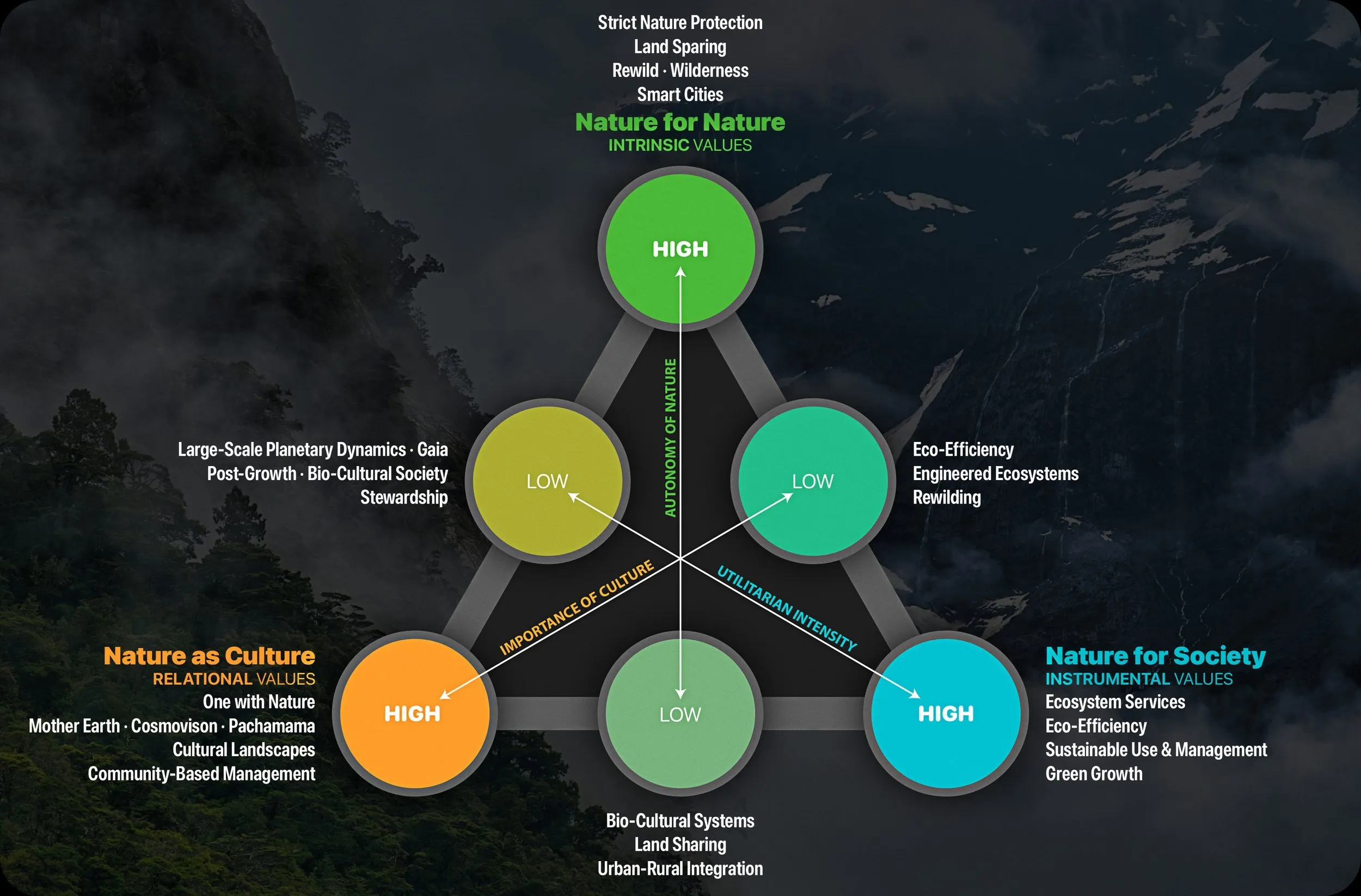
Nature Positive
A global goal for humanity to halt and reverse the loss of nature by 2030, positioning the health and resilience of the Earth system as the fundamental basis for human prosperity. Nature Positive (NP) names both a measurable outcome — more nature in 2030 than in 2020, with continued recovery thereafter — and a conceptual shift in how the environment is understood in relation to society and the economy.
The shift is hierarchical rather than balanced: rather than treating the environment as one competing interest alongside society and the economy (the overlap-based Sustainable Development Goals “sweet spot”), Nature Positive recognises the environment as the encompassing context for all human existence, with the economy understood as a subset of society, which in turn exists within the biosphere. In this framing, biodiversity and natural processes are not externalities to be managed but the preconditions for a stable, habitable planet.
Nature Positive was codified through the Kunming-Montreal Global Biodiversity Framework (GBF), adopted under the UN Convention on Biological Diversity in December 2022. The GBF operates as a biodiversity counterpart to the Paris Agreement on climate, with a 2050 vision of “living in harmony with nature” and concrete 2030 targets. Achieving Nature Positive requires integration with climate, ocean, and human-development agreements — since environmental targets cannot be met in isolation.
Locke and colleagues (2026) propose the Three Global Conditions Framework (3Cs) as a practical implementation tool, categorising every landscape and seascape by its level of human impact:
- C1 — Cities and Farms (≈17.7% of land) Human-dominated areas where nature is integrated back into cultivation, settlement, and infrastructure — protecting remaining native vegetation, managing pollutants, and restoring hydrological connectivity.
- C2 — Shared Lands (≈55.7% of land) Mixed landscapes where conservation, sustainable use, and Indigenous stewardship coexist — securing species recovery, reintroducing missing keystone species, and maintaining ecological connectivity.
- C3 — Large Wild Areas (≈26.6% of land) Intact biomes and ecosystems where the priority is strict protection of irreplaceable natural heritage — because preventing loss is always less costly and more certain than attempting restoration.
The framework extends to freshwater and marine realms (with “marine wilderness” roughly analogous to C3 on land). Its core strategic insight: preventing the loss of intact biomes, ecosystems, and species assemblages is the most critical action, since these cannot be quickly restored, while species already at risk require urgent recovery measures. Incorporating Indigenous and traditional knowledge alongside scientific methods is considered essential to equitable and effective conservation outcomes.
Ref: Locke, H., Rockström, J., Plowright, R. K., Laffoley, D., Little Bear, L., Peres, C. A., Wei, F., Karanth, K. K., Zemke, L., Seetal, R., & Hauer, F. R. (2026). Nature Positive: halting and reversing biodiversity loss toward restoring Earth system stability. Frontiers in Science, 4, 1609998.
Nature Relationship Index (NRI)
A proposed national index — analogous to the Human Development Index — that would track nations’ progress toward mutually beneficial relationships with the rest of life on Earth. The Human Development Index (HDI), introduced by the United Nations Development Programme in 1990, was a turning point in how global progress is measured: rather than reducing development to GDP per capita, it combined life expectancy, education, and standard of living into a single composite that shifted world attention toward human capabilities. The NRI proposes an analogous shift, this time extending the aspirational horizon of development to include humanity’s relationship with nature.
The index is built around three dimensions: Nature is thriving and accessible (protected areas, thriving landscapes where people can experience nature); Nature is used with care (lower per-person emissions and land use in ways that do not degrade the living world); and Nature is safeguarded (legal and financial protections for the biosphere). Unlike boundary frameworks, which focus on limits to harm, the NRI is explicitly aspirational — it measures progress toward a future in which both people and the rest of life on Earth thrive together, and has no predetermined ceiling. If adopted, it could be released through the 2026 UNDP Human Development Report. It complements Nature Positive’s 2030 targets and draws on the plural values mapped by the Nature Futures Framework.
Ref: Ellis, E. C., Malhi, Y., Ritchie, H., Montana, J., Díaz, S., Obura, D., Clayton, S., Leach, M., Pereira, L., Marris, E., Muthukrishna, M., Fu, B., Frankopan, P., Grace, M. K., Barzin, S., Watene, K., Depsky, N., Pasanen, J., & Conceição, P. (2025). An aspirational approach to planetary futures. Nature, 642, 889–899.
Overshoot
The condition in which humanity’s demand on the biosphere exceeds the rate at which it regenerates resources and absorbs wastes. Because the excess is met by drawing down accumulated stocks and by letting wastes accumulate, overshoot does not register as immediate scarcity but as depleted reserves and deferred cost — biodiversity loss, deforestation, aquifer decline, climate change. The threshold it is measured against is the biosphere’s regenerative capacity, which makes overshoot the applied, measurable form of carrying capacity.
It is quantified through Ecological Footprint accounting, which expresses demand and supply in a single unit: the global hectare, a hectare of world-average biological productivity for a given year. A population’s footprint is the area required to produce what it consumes and to absorb its carbon dioxide emissions; its biocapacity is the regenerative capacity of the productive area actually available — cropland, grazing land, forest, fishing grounds and built-up land. Global demand first exceeded global biocapacity around 1970 and now stands at roughly 1.7 Earths. Both the ratio and the crossing date are revised as methods and underlying data are updated, and the aggregation method remains debated in the peer-reviewed literature: the global deficit is dominated by the carbon component, the notional forest area needed to sequester fossil emissions.
The Living Planet Index tracks the biological consequence rather than the resource balance. It measures the average rate of change in the size of monitored vertebrate populations relative to 1970, and its 2024 edition reports a 73% decline across almost 35,000 populations of 5,495 species over 1970–2020, steepest in freshwater systems. It is a mean of rates of change within a non-random sample of monitored populations, not a census — a 73% decline does not mean that 73% of animals have been lost — and its sensitivity to a small number of extreme declines, and to the statistical handling of population fluctuation, is contested. The crossing follows the same post-1950 curve as the Great Acceleration, and marks a breach of the Safe Operating Space at the planetary level.
Ref: Wackernagel, M., et al. (2002). Tracking the ecological overshoot of the human economy. PNAS, 99(14), 9266–9271. · Borucke, M., et al. (2013). Accounting for demand and supply of the biosphere’s regenerative capacity: The National Footprint Accounts’ underlying methodology and framework. Ecological Indicators, 24, 518–533. · Lin, D., et al. (2018). Ecological Footprint accounting for countries: Updates and results of the National Footprint Accounts, 1961–2014. Resources, 7(3), 58. · Wackernagel, M., et al. (2021). The importance of resource security for poverty eradication. Nature Sustainability, 4, 731–738. · On the metric’s limits: Blomqvist, L., et al. (2013). Does the shoe fit? Real versus imagined ecological footprints. PLoS Biology, 11(11), e1001700 — with the reply by Rees, W. E., & Wackernagel, M. (2013). The shoe fits, but the footprint is larger than Earth. PLoS Biology, 11(11), e1001701. · Giampietro, M., & Saltelli, A. (2014). Footprints to nowhere. Ecological Indicators, 46, 610–621. · Galli, A., et al. (2016). Questioning the Ecological Footprint. Ecological Indicators, 69, 224–232 — a joint assessment by the metric’s critics and developers. · Living Planet Index method: Collen, B., et al. (2009). Monitoring change in vertebrate abundance: The Living Planet Index. Conservation Biology, 23(2), 317–327. · McRae, L., Deinet, S., & Freeman, R. (2017). The diversity-weighted Living Planet Index: Controlling for taxonomic bias in a global biodiversity indicator. PLOS ONE, 12(1), e0169156. · On its limits: Leung, B., et al. (2020). Clustered versus catastrophic global vertebrate declines. Nature, 588, 267–271. · Buschke, F. T., Hagan, J. G., Santini, L., & Coetzee, B. W. T. (2021). Random population fluctuations bias the Living Planet Index. Nature Ecology & Evolution, 5, 1145–1152. · Puurtinen, M., Elo, M., & Kotiaho, J. S. (2022). The Living Planet Index does not measure abundance. Nature, 601, E14–E15. · Toszogyova, A., Smyčka, J., & Storch, D. (2024). Mathematical biases in the calculation of the Living Planet Index lead to overestimation of vertebrate population decline. Nature Communications, 15, 5295. · Current figures: WWF (2024). Living Planet Report 2024: A System in Peril. WWF, Gland. / Global Footprint Network · Earth Overshoot Day
‘Overview Effect’
The Overview Effect, coined in 1987 by space philosopher Frank White, describes the profound psychological shift experienced by astronauts when observing Earth from space. This effect combines an overwhelming sense of awe with a cognitive reorientation, often leading to feelings of self-transcendence—a dissolving of personal and national boundaries in favor of seeing Earth as a singular, interconnected whole. Viewing Earth against the vast blackness of space highlights its vulnerability, as the thin atmosphere protecting all life becomes strikingly apparent. This perception of fragility often fosters a deepened commitment to environmental protection, an awareness of humanity’s shared fate, and a sense of responsibility that transcends individual or national interests.
Anthropologically, the Overview Effect is significant as it reveals an innate human capacity to shift perspectives when encountering radically new contexts. Many astronauts describe this experience as akin to a “cosmic consciousness,” reshaping their understanding of human identity and emphasizing the insignificance of ideological divisions. Philosophically, the Overview Effect challenges individuals to reconsider humanity’s place within the universe, often prompting existential reflection on the finite nature of Earth’s resources and the ethical implications of planetary stewardship.
As of 2024, more than 710 people (0.0000086% of the world’s population) have traveled to space, with a significant number reporting this transformative experience. The Overview Effect has since inspired educational and environmental movements, utilizing this rare perspective to promote global citizenship, empathy, and a collective commitment to sustaining the planet’s ecosystems.
Ref: Yaden, D. B., Iwry, J., Slack, K. J., Eichstaedt, J. C., Zhao, Y., Vaillant, G. E., & Newberg, A. B. (2016). The overview effect: Awe and self-transcendent experience in space flight. Psychology of Consciousness: Theory, Research, and Practice, 3(1), 1–11. // Weibel, D. L. (2020). The overview effect and the ultraview effect: How extreme experiences in/of outer space influence religious beliefs in astronauts. Religions, 11(8), 418.
Place-based Societies
Indigenous peoples and local communities with deep, generations-long histories of shaping and sustaining the lands and waters they inhabit. Their relational, kin-based, and reciprocal ways of knowing and acting have sustained some of the most biodiverse and ecologically vibrant regions remaining on Earth — offering living evidence that human presence in a landscape can be generative rather than merely extractive.
Place-based societies are not defined by isolation from the global economy, but by the continuity and depth of their relationship with a particular territory. Their knowledge systems tend to integrate land, kinship, ritual, and livelihood into a single fabric, and to treat non-human beings as relatives with whom responsibilities are shared. The lands held or governed by Indigenous peoples and local communities harbor a disproportionate share of the world’s remaining biodiversity — a fact increasingly recognised in international frameworks through categories such as Indigenous and Community Conserved Areas and Territories (ICCAs). Honoring and supporting these societies is widely understood as a prerequisite for any credible global response to biodiversity and climate crises. That overlap between Indigenous stewardship and irreplaceable biodiversity is central to frameworks such as the Conservation Imperatives, while in Aotearoa New Zealand the same ethic carries the name Kaitiakitanga.
Ref: Brondízio, E. S., Aumeeruddy-Thomas, Y., Bates, P., Carino, J., Fernández-Llamazares, Á., Ferrari, M. F., Galvin, K., Reyes-García, V., McElwee, P., Molnár, Z., Samakov, A., & Shrestha, U. B. (2021). Locally based, regionally manifested, and globally relevant: Indigenous and local knowledge, values, and practices for nature. Annual Review of Environment and Resources, 46, 481–509.
Panarchy
A theory of how complex systems persist by changing — proposed by ecologist C. S. Holling and colleagues as the structure that links adaptive cycles running at different speeds and scales. The name is deliberate: Pan, the Greek god of unpredictable change, melded with the idea of nested hierarchy. Holling wanted the nesting but not the word — “hierarchy” carries a connotation of top-down control that his structure does not have. A panarchy is a hierarchy of a particular kind: not a ladder of control but a nest of cycles, each with its own tempo, each able to disturb and to rescue its neighbours.
At its core is the adaptive cycle, a four-phase loop that ecosystems, institutions, industries and societies all traverse. Growth (r) is rapid colonisation of open opportunity: resources abundant, connections few, plenty of room to fail. Conservation (K) accumulates capital and efficiency; the system becomes richer, tighter and more optimised — and, precisely because it is optimised, brittle, an accident waiting to happen. Release (Ω) is the accident: fire, drought, disease, insect outbreak or a crash arrives as the triggering agent, and the capital sequestered over the whole cycle is freed in a chaotic instant. Reorganisation (α) is the improvisational aftermath, where novelty and invention decide what the next cycle will be. Three properties move through the loop: accumulated potential, internal connectedness, and resilience — and the crucial insight is that resilience runs against connectedness. It shrinks as the system tightens towards K, and expands again through the back loop from Ω to α, where potential and resilience are both high while internal control is at its weakest. Systems become most vulnerable at the height of their success.
What makes panarchy more than a life-cycle diagram is what happens between scales. Levels can connect at many points, but two of those connections do most of the work. Revolt runs upward: a small, fast collapse — a spark, a bankruptcy, a local uprising — cascading into a larger, slower level that had grown vulnerable enough to catch it (see Cascade Effect). Remember runs downward: after a collapse, the slower, larger level supplies the memory, seed bank, legal order or institutional legacy from which renewal is assembled. Change and continuity are not opposites here; each is the other’s condition. Cycles can also fail to turn, and Holling named two ways they lock: the rigidity trap, where potential, connectedness and resilience are all high at once — a perverse resilience that preserves a maladaptive system and will not let it release — and the poverty trap, where a collapse has stripped out all three together, leaving reorganisation unable to accumulate enough potential to build anything larger — kin to the Anthropocene Traps.
Panarchy is the counter-model to linear frameworks. Where DPSIR reads causation as a chain from driver to response, panarchy reads it as recurring loops nested inside one another, in which today’s response becomes tomorrow’s driver and the interesting causation runs across scales rather than along one. It supplies the temporal architecture that Regime Shift and Stable State describe only at the moment of transition, and it is the intellectual ancestor of much of what World-Earth Resilience and Planetary Antifragility now attempt at planetary scale. Its uncomfortable corollary: a system that never releases is not stable, only overdue.
Ref: Gunderson, L. H., & Holling, C. S. (Eds.) (2002). Panarchy: Understanding Transformations in Human and Natural Systems. Washington, DC: Island Press. · Holling, C. S. (2001). Understanding the complexity of economic, ecological, and social systems. Ecosystems, 4(5), 390–405. · Allen, C. R., Angeler, D. G., Garmestani, A. S., Gunderson, L. H., & Holling, C. S. (2014). Panarchy: Theory and application. Ecosystems, 17(4), 578–589.
Planetarisation
The cultural process of collectively becoming aware of the planetary characteristics and attributes of our habitat. This involves recognising its natural cycles, tipping points, planetary boundaries, synergies and processes as integral components of an interconnected and resilient equilibrium. This equilibrium is unique to the planetary nature and scale, reflecting the complex interplay of global systems that cannot be replicated or fully understood at smaller scales.
The term draws on the work of French philosopher and sociologist Edgar Morin, who placed planétarisation at the heart of his account of the planetary era (l’ère planétaire). For Morin, this era opens around 1492, when the voyages linking the continents began to put “everything in communication with everything,” weaving previously scattered societies into a single, materially interdependent planetary system. Planetarisation is therefore not only an idea but a long historical movement: the progressive binding-together of economies, technologies, ecologies, and human fates into one shared whole.
Crucially, Morin insists this process is dialectical — at once the best and the worst. The same forces that unify the planet also fragment it, generating homogenisation alongside conflict, interdependence alongside inequality. This is why he distinguishes planetarisation from mere globalisation (mondialisation), which he reads as its narrower techno-economic face. Planetarisation, by contrast, includes the decisive missing element: a prise de conscience — the awakening of a shared awareness that humanity now inhabits a community of common destiny (communauté de destin). The nuclear and ecological threats weighing on the biosphere, Morin argued, bind all peoples to one another and to the Earth itself, making this realisation the defining event of our age.
From this awareness follow Morin’s twin imperatives: to recognise the Earth as Terre-Patrie (Homeland Earth) — the common ground in which a planetary identity can be rooted — and to cultivate a terrestrial citizenship equal to planetary-scale challenges. The geographer Augustin Berque suggests this is perhaps more aptly named Terre-Matrie than Terre-Patrie — the Earth less a fatherland (patrie, from pater) to be defended than a maternal matrix (mater) that engenders and sustains us, a belonging he situates within the écoumène — which he defines as the onto-geographical relation of humanity with the Earth — and its dynamics of médiance (the dynamic coupling of human existence and its milieu, his rendering of Watsuji Tetsurô’s fûdosei, “the structural moment of human existence”) and trajection (the movement by which reality emerges as trajective — neither purely objective nor purely subjective, but a perpetual back-and-forth between subject and object, nature and culture). In this sense, planetarisation names precisely the passage from a world merely connected to a world conscious of itself: the cultural and cognitive maturation through which a species that has become a planetary force learns to think, feel, and act at the scale of the system it now shapes. It is the cultural counterpart to planetary awareness and planetary sapience, and a precondition for inhabiting the Anthropocene wisely.
Ref: Morin, E., & Kern, A. B. (1993). Terre-Patrie. Paris: Éditions du Seuil. (English: Homeland Earth: A Manifesto for the New Millennium, Hampton Press, 1999.) // Morin, E. (1999). Les sept savoirs nécessaires à l’éducation du futur. Paris: UNESCO. (English: Seven Complex Lessons in Education for the Future.) // Berque, A. (2000). Écoumène : Introduction à l’étude des milieux humains. Paris: Éditions Belin. // Berque, A. (2018). « Trajection et réalité », in M. Augendre, J.-P. Llored & Y. Nussaume (dir.), La mésologie, un autre paradigme pour l’anthropocène ? Paris: Éditions Hermann.
Planetarity
The ontological condition of being inextricably embedded within the Earth’s complex, evolving, and interconnected biogeochemical systems and feedback loops that span the entire ecosphere. This condition challenges traditional notions of the “global” or the “world” and has been progressively acknowledged over time through exploration and the development of human knowledge, including scientific and technological advancements. It calls for a recognition of our interdependence with the Earth’s systems and the development of a more holistic, integrated, and sustainable approach to living within the planetary boundaries. Planetarity is complemented by the concept of geographicity, which focuses on the human experience and understanding of being embedded within the Earth’s systems, and together they provide a comprehensive framework for grappling with the complexities of the human-Earth relationship in the face of pressing global challenges.
Planetary
Of or relating to Earth as a living, integrated metabolic system that operates through the dynamic interplay of biogeochemical, physical, and thermodynamic processes across all spheres—atmosphere, hydrosphere, lithosphere, biosphere, and the emerging technosphere. The planetary encompasses phenomena that emerge from and shape the totality of Earth’s systems through complex feedback loops, tipping points, and cascading effects that unfold across deep temporal scales (geological and evolutionary time) and vast spatial dimensions (from microbial to whole-Earth).
As a metabolic system, the planetary maintains itself in far-from-equilibrium states through continuous flows of energy, matter, and information. These flows enable self-organizing and self-maintaining patterns—autopoietic processes (from Greek auto- “self” + poiesis “creation/production”: the system creates the very conditions for its own persistence and evolution). Information architectures govern these metabolic exchanges, serving as both sources of stability and drivers of evolutionary novelty.
The planetary includes the technosphere as an emergent metabolic layer nested within and fundamentally constrained by the biosphere. The long-term viability of human civilization depends on achieving sustainable coupling between these spheres—a state where technological and biological feedback loops mutually reinforce rather than undermine each other’s capacity for self-maintenance and repair.
Unlike human-constructed frameworks, planetary processes exist independent of human intention—though increasingly influenced by human action—and exhibit emergent properties only comprehensible through holistic, systems-level analysis. The planetary perspective recognizes Earth’s finite boundaries, the interdependence of all life forms within biogeochemical cycles, and humanity’s embeddedness within, rather than mastery over, these systems. This understanding demands epistemic humility about Earth’s complexity and our limited ability to control or fully predict planetary-scale processes.
Planetary Antifragility
The capacity of Earth’s life-support systems to benefit from shocks, stressors, and uncertainties, adapting and evolving over geological timescales in response to various disturbances, thereby enhancing the planet’s resilience and ability to maintain conditions conducive to life. In the context of sustainability and Earth system science, planetary antifragility is proposed as an additional dimension to be considered alongside the concept of planetary boundaries when defining the safe operating space for humanity. It emphasizes the importance of maintaining and fostering the Earth’s inherent ability to withstand and even thrive under changing environmental conditions, ensuring the long-term stability and habitability of the planet in the face of increasing anthropogenic pressures and uncertainties.
Ref: López-Corona, O., Kolb, M., Ramírez-Carrillo, E., & Lovett, J. (2022). ESD Ideas: Planetary antifragility: A new dimension in the definition of the safe operating space for humanity. Earth System Dynamics, 13(4), 1145–1153.
Planetary Awareness
Planetary awareness is the capacity to perceive, understand, and experience human existence as part of the Earth: a planet whose physical processes and living systems produce, and continually remake, the conditions of life. It joins knowledge of these processes with a felt sense of belonging to them, so that everyday life, in a particular place and season, is grasped as one moment of a larger whole.
This awareness places people within nested histories: the unfolding of the cosmos, the formation of Earth, the evolution of life, and the emergence of human cultures. Long told apart, these histories now converge. Human activity has become a geological and ecological force, and the history of societies can no longer be written separately from the history of the Earth. Planetary awareness moves between scales, from a single place to the whole planet and from a lifetime to deep time, while remaining attentive to the particular lives and places in which interdependence is actually lived.
At its core is an act of collective recognition. Societies come to see their own institutions, technologies, economies, and desires returned to them in the changing state of the planet: in its atmosphere, oceans, soils, and the fate of other species. This is self-knowledge reached by way of the Earth. Yet the recognition is never complete. The planet is not a mirror of human action. It is composed of countless agencies that respond, resist, and exceed understanding, and that unfold on timescales indifferent to human purposes. Recognition therefore brings no mastery. It brings a sharper sense of dependence, uncertainty, and the limits of control. It also reveals division: humanity shares a planetary condition without contributing equally to its disruption or bearing its consequences equally.
Planetary awareness draws on science, art, philosophy, lived experience, and many traditions of knowledge, including those that have long understood people as kin to land, water, and other beings. Science reveals processes and interdependencies; art and culture make their significance perceptible and felt; ethical and political reflection asks what they demand. Among these demands is a responsibility that grows with power: the more deeply human action can alter the living world, the more it is bound to keep the Earth habitable for those who come after, human and other than human.
As a public capacity, planetary awareness takes shape in education, shared narratives, institutions, and collective deliberation. It becomes durable only when it is embodied in common life: in how societies govern, produce, teach, and remember. Awareness alone does not guarantee responsible action. Its significance lies in making humanity’s place within the Earth an enduring part of how people understand themselves, judge their choices, and shape a future held in common with the rest of the living world.
Ref: Hegel, G. W. F. (1807). Phänomenologie des Geistes. Bamberg & Würzburg: Joseph Anton Goebhardt. · Jonas, H. (1979). Das Prinzip Verantwortung. Frankfurt am Main: Insel Verlag. (English: The Imperative of Responsibility, University of Chicago Press, 1984.) · Morin, E., & Kern, A. B. (1993). Terre-Patrie. Paris: Éditions du Seuil. · Chakrabarty, D. (2009). The Climate of History: Four Theses. Critical Inquiry, 35(2), 197–222. · Latour, B. (2015). Face à Gaïa : Huit conférences sur le nouveau régime climatique. Paris: La Découverte. (English: Facing Gaia, Polity, 2017.)
Planetary Boundaries (PBs)
The Planetary Boundaries (PB) framework emerged as a transformative concept at the intersection of Earth system science and sustainability, rooted in key scientific insights and conceptual breakthroughs. It was formulated against the backdrop of mounting evidence that human activities were rapidly transforming the Earth system, particularly during the Great Acceleration of the mid-20th century when socioeconomic and environmental indicators showed an exponential rise. This period underscored humanity’s capacity to affect the planet on a global scale, a phenomenon later framed within the Anthropocene epoch, a proposed new geological era defined by human dominance over Earth’s natural systems.
The PB framework draws on earlier interdisciplinary efforts that examined planetary limits, including the pioneering ecological and economic ideas of “Spaceship Earth,” the “Limits to Growth” report, and the concept of a steady-state economy. Advances in Earth system science further emphasized the Earth as a complex, partially self-regulating system characterized by nonlinear behaviors and tipping points. Studies of paleoclimates revealed the stability of the Holocene epoch—an 11,700-year period of relatively constant environmental conditions—as a critical baseline for maintaining the conditions under which human civilizations evolved. These insights established the need to conceptualize thresholds or boundaries that, if crossed, would risk destabilizing the Earth system.
The formulation of the PB framework in 2009, led by Johan Rockström, Katherine Richardson, and Will Steffen, represented a paradigm shift in how humanity’s relationship with the planet was understood. It introduced the notion of a Safe Operating Space (SOS) for humanity, defined by nine critical Earth system processes that regulate the planet’s stability. These include climate change, biosphere integrity, freshwater change, and biogeochemical flows, among others. The framework set boundaries based on scientific evidence, distinguishing between zones of safety, increasing risk, and high risk.
A central insight was that crossing a boundary does not necessarily result in an immediate catastrophe but pushes humanity into a Zone of Increasing Risk, where the likelihood of tipping points grows. Tipping Points, such as the collapse of the Amazon rainforest or the melting of polar ice sheets, are thresholds beyond which small changes can trigger large, often irreversible transformations in the Earth system.
This framework also integrated resilience thinking, emphasizing the need to maintain the Earth’s capacity to absorb shocks and maintain stability. Importantly, the boundaries were set purely on biophysical criteria, without incorporating socio-economic considerations, underscoring their universal applicability and the non-negotiable nature of Earth’s physical limits.
The PB framework has since evolved, with updates in 2015 (PB 2.0), 2023 (PB 3.0), 2024 and 2025 (Planetary Health Check), refining the metrics and control variables for some boundaries. These advancements continue to provide a powerful tool for guiding human development within the planet’s finite limits, shaping scientific discourse, global policy, and sustainability practices.
The 🔺 symbol indicates that the safe boundary has been transgressed.
- 🌡️ Climate Change 🔺 This boundary is defined by atmospheric CO2 concentration and total anthropogenic radiative forcing. The planetary boundary is set at 350 ppm CO2 and +1.0 W/m². The current value is 423 ppm CO2 and +2.97 W/m², indicating a transgression of this boundary.
- 🧬 Change in Biosphere Integrity 🔺 This boundary is concerned with genetic diversity (extinctions per million species-years, or E/MSY) and the functional integrity of the biosphere, measured as the percentage of human appropriation of net primary production (HANPP). The boundary for genetic diversity is less than 10 E/MSY, and for functional integrity, it is less than 10% HANPP. Currently, the extinction rate is above 100 E/MSY, and HANPP is at 30%, both exceeding the boundary limits.
- 🛡️ Stratospheric Ozone Depletion This boundary is based on the stratospheric O3 concentration (global average in Dobson Units, DU). The boundary is set at less than a 5% reduction from the preindustrial level, assessed by latitude (~277 DU). The current level is 285.7 DU, which is within the safe operating space.
- 🐚 Ocean Acidification 🔺 The boundary is defined by the carbonate ion concentration average global surface ocean saturation state with respect to aragonite (Ωarag). The boundary is 2.86 Ωarag of the mean preindustrial aragonite saturation state. The current value is approximately 2.84 Ωarag, officially breached as of 2025.
- 🌾 Biogeochemical Flows (Phosphorus & Nitrogen cycles) 🔺 The boundaries for phosphorus (P) and nitrogen (N) are concerned with their flows from human activities to the environment. The boundary for phosphorus is set at 11 Tg of P/year globally and 6.2 Tg of P/year regionally. The current global P flow is 22.6 Tg/year. For nitrogen, the boundary is set at 62 Tg of N/year, with the current value being 190 Tg of N/year. Both these boundaries are exceeded.
- 🌳 Land System Change 🔺 This boundary is defined by the area of forested land as a percentage of original forest cover, with specific targets for different biomes (tropical, temperate, boreal). The boundary value is 75% of forested land compared to original extent. The current global forest cover is 59%, indicating a breach of this boundary, especially in the tropical regions.
- 💦 Freshwater Change 🔺 This boundary is defined by human-induced disturbance of blue and green water flow, with the boundary set at the upper limit (95th percentile) of global land area with deviations greater than during preindustrial times. The limits are 12.9% for blue water (water in rivers, lakes, wetlands, and aquifers) and 12.4% for green water (precipitation that is absorbed by soil and vegetation and then released back into the atmosphere). The current values are 22.6% for blue water and 22.0% for green water, surpassing the boundary.
- ☁️ Atmospheric Aerosol Loading This boundary is defined by the interhemispheric difference in aerosol optical depth (AOD), a measure of aerosols in the atmosphere. The boundary is set at 0.1 for the mean annual interhemispheric difference. The current value is approximately 0.063, within the safe operating space but close to the boundary limit.
- 🔬 Novel Entities 🔺 This boundary relates to synthetic chemicals and materials introduced into the environment, including microplastics, endocrine disruptors, and organic pollutants. A specific quantitative boundary has not been established for novel entities, but it is acknowledged that the safe operating space is currently overstepped.
We may categorize planetary boundaries into three broad groups:
- Global Planetary Boundaries: Climate, Ocean, and Ozone. These boundaries affect the entire Earth system and have global-scale impacts.
- Biospheric Planetary Boundaries: Biodiversity, Land, Freshwater, and Nutrients (nitrogen and phosphorus cycles). These boundaries primarily concern the living systems of the Earth and their interactions with the physical environment.
- ‘Alien’ Planetary Boundaries: Pollution (e.g., synthetic chemicals, genetically modified organisms) and Aerosols. These boundaries involve human-introduced elements that are foreign to natural Earth systems.
Ref: Richardson, K., Steffen, W., Lucht, W., Rockström, J., Cornell, S. E., Fetzer, I., Gerten, D., Heinke, J., Lade, S. J., Scheffer, M., Winkelmann, R., & Schellnhuber, H. J. (2023). Earth beyond six of nine planetary boundaries. Science Advances, 9(36), eadh2458.
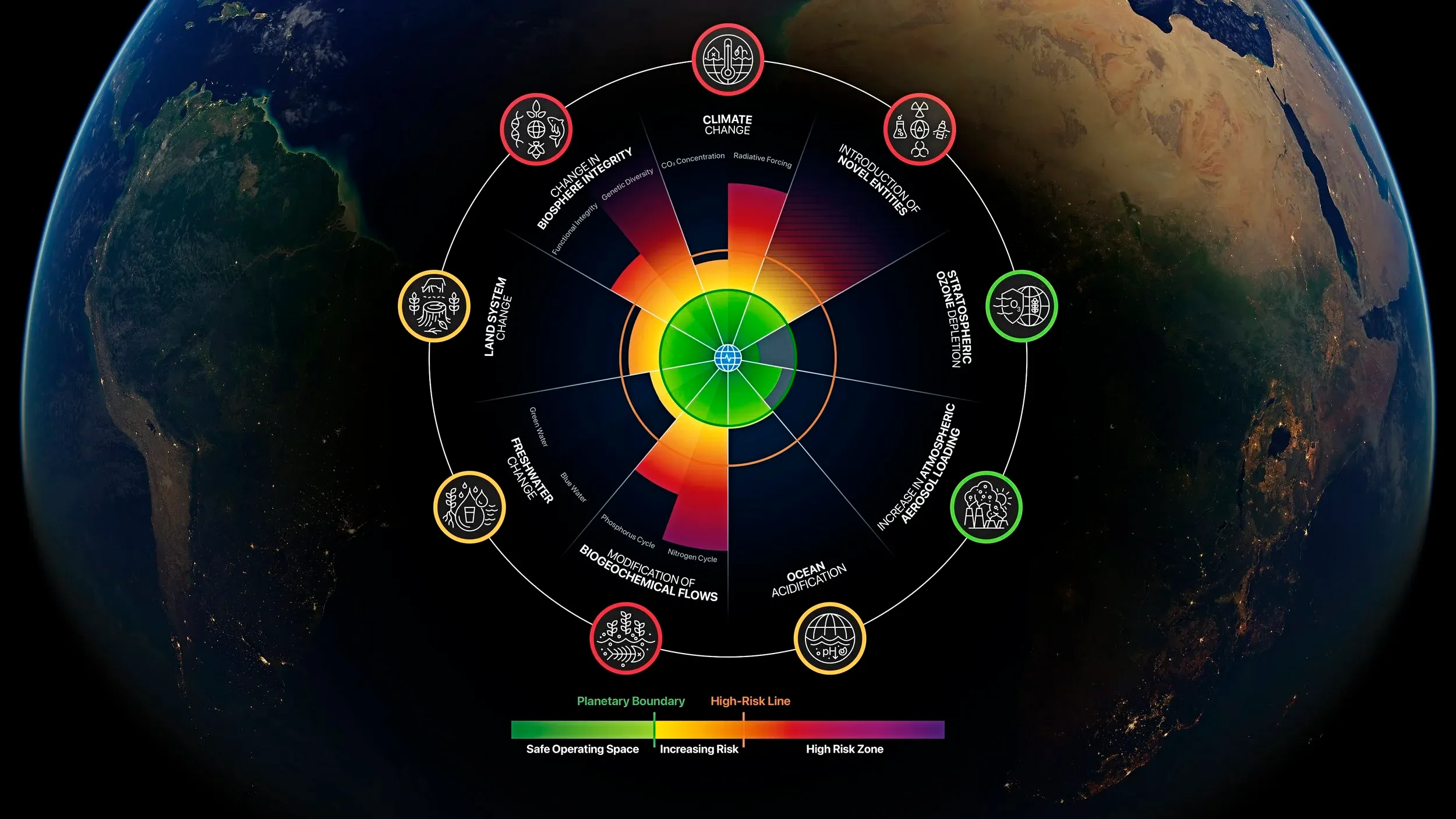
Planetary Change
Planetary change is a shift in the state of Earth itself, taken as the single co-evolving whole that its spheres, cycles, and teleconnections compose. The difference from global change is not one of scale or of severity. The global is a totality reached by addition — every place, summed. The planetary is a whole that no addition produces: it arises from the couplings between atmosphere, ocean, ice, rock, life, and now the technosphere, and it holds properties that belong to none of the parts — regulation, memory, threshold, the capacity to reorganise. Earth has been changing in this sense for four and a half billion years, almost all of them without us.
What changes. Earth-system and complex-systems science describe planetary change through the quantities that hold the whole in one configuration rather than another: the planetary boundaries and the safe operating space they bound; the great biogeochemical cycles of carbon, nitrogen, and phosphorus; the tipping elements and the thresholds past which they reorganise; and the regime shifts by which a system settles into a new state and then resists returning to the old one. What these have in common is that they are properties of couplings rather than of places. None can be summed from local measurements — which is why the Great Acceleration registers as a change in the planet and not as a change in many countries at once.
What drives change. David Grinspoon sorts the drivers into four kinds, distinguished by whether life is involved and, if it is, whether it knows what it is doing:
- Natural change — physical processes with no role for life: bolide impacts, the continent-scale volcanism of large igneous provinces, shifts in Earth’s orbit and in the output of the Sun. A planet changes on its own, through geology and astronomy.
- Biologically induced change — life transforms the planet without intending to. The Great Oxygenation Event of roughly 2.4 billion years ago, when photosynthetic microbes filled air and ocean with a gas that had been almost absent, is the canonical case. Life becomes a geological force without meaning to.
- Inadvertent technological change — an intelligent species alters the planet by accident: anthropogenic climate change, ozone depletion, biodiversity loss. A civilisation acquires planetary power before it acquires planetary wisdom.
- Purposeful change — a civilisation manages the planet deliberately, in knowledge of what it is doing and of why. The repair of the ozone layer under the Montreal Protocol is the clearest instance so far: a change of the third kind detected, understood, and turned into one of the fourth. Intelligence matures by regulating its planetary effects rather than merely causing them.
The four are a ladder of capability, not a sequence of eras. Each kind adds a driver the planet did not previously have, and none of them retires the ones below: the asteroid that ended the Cretaceous, a change of the first kind, struck almost two billion years after the Great Oxygenation Event, a change of the second. Earth today is subject to all four at once — still exposed to impacts, still being remade by photosynthesis, presently deranged by inadvertent technology, and only beginning the fourth. Humanity sits astride the third kind and the fourth, and nothing in the ladder guarantees the passage from one to the other. That passage is what Planetary Sapience, Terra Sapiens, and Planetary Intelligence each name from a different direction.
Deep time offers an independent reading of the same ladder. The palaeontological literature on biosphere disruptors sorts thirty-one intervals of global macroevolutionary change into short-lived agents, mostly arriving from beyond the living world, and long-lived agents that arose within it — a distinction that tracks the first two kinds closely, and that puts humanity in the same unresolved position between the third and the fourth.
Ref: Grinspoon, D. (2016). Earth in Human Hands: Shaping Our Planet’s Future. Grand Central Publishing. · Frank, A., Grinspoon, D., & Walker, S. (2022). Intelligence as a planetary scale process. International Journal of Astrobiology, 21(1), 47–61. · Steffen, W., Richardson, K., Rockström, J., et al. (2015). Planetary boundaries: Guiding human development on a changing planet. Science, 347(6223), 1259855.
Planetary Commons
The concept of Planetary Commons encompasses Earth’s key regulating elements, subsystems, and their functions, vital for sustaining life globally, regardless of their geographical location. This includes major domains of the Earth system such as the atmosphere, oceans, land, and the cryosphere, which interact with the biosphere, including humans. It also covers large Earth sub-systems critical for the Earth system’s structure, function, and stability, providing essential conditions for sustainable livelihoods for current and future human and non-human life. These include the tipping elements, but also systems like the Congo and Southeast Asian rainforests, temperate forests, wetlands, and coastal blue carbon ecosystems, as they regulate the Earth system, even though they might not have documented evidence of non-linear and irreversible change behaviour. Maintaining these biophysical systems close to their Holocene conditions is crucial for the Earth system’s capacity to support life. [We argue that knowledge could be considered part of the planetary commons, due to its significant impact on the ecosphere’s evolution and fate.]
Twenty-seven systems are named, sorted across the five spheres they belong to — several of them to more than one, which is the point: a planetary common is a function rather than a place. Eleven are tipping elements, large enough and non-linear enough to reorganise abruptly once a threshold is passed. The remaining sixteen show no documented tipping behaviour but regulate the planet all the same. The Earth system itself, the frame around all of them, is the overarching planetary common.
Tipping element— large enough and non-linear enough to reorganise abruptly, and largely irreversibly, once a threshold is passed. The rest regulate the planet without any documented threshold of that kind.
| Tipping element | System | Spheres |
|---|---|---|
| Atmosphere | ||
| Tipping element | West African Monsoon | Air |
| South American Monsoon | Air | |
| South-East Asian Monsoon | Air | |
| Stratospheric Ozone Layer | Air | |
| El Niño–Southern Oscillation | AirWater | |
| Hydrosphere | ||
| Tipping element | Atlantic Meridional Overturning Circulation | Water |
| Methane Hydrates (Arctic Ocean) | Water | |
| Tipping element | Low-latitude Coral Reefs | WaterLife |
| Ocean Biological Carbon Pump | WaterLife | |
| Wetlands | WaterLifeLand | |
| Coastal “Blue Carbon” Ecosystems mangrove forests, tidal marshes, seagrass meadows | WaterLifeLand | |
| Net Primary Production | WaterLifeLand | |
| Biosphere Integrity species richness, ecological resilience | WaterLifeLandIce | |
| Biosphere and lithosphere | ||
| Tipping element | Tundra Permafrost System | LifeLandIce |
| Tipping element | Amazon Rainforest | LifeLand |
| Tipping element | Boreal Forests | LifeLand |
| Congo and Southeast Asian Rainforests | LifeLand | |
| Temperate Forests | LifeLand | |
| Global Soil Carbon Pool | LifeLand | |
| Cryosphere | ||
| Tipping element | Greenland Ice Sheet | Ice |
| Tipping element | Arctic Winter Sea Ice | Ice |
| Tipping element | West Antarctic Ice Sheet | Ice |
| Tipping element | East Antarctic Ice Sheet | Ice |
| Tipping element | Extrapolar Mountain Glaciers | Ice |
| Arctic Summer Sea Ice | Ice | |
| Across every sphere | ||
| Biogeochemical Cycles | AirWaterLifeLandIce | |
| Hydrological Cycle blue water flows (environmental water flows) and green water flows (soil moisture, vapour flows) | AirWaterLifeLandIce | |
Ref: Rockström, J., Kotzé, L. J., Milutinović, S., Biermann, F., Brovkin, V., Donges, J. F., Ebbesson, J., French, D., Gupta, J., Kim, R. E., Lenton, T. M., Lenzi, D., Nakicenovic, N., Neumann, B., Schuppert, F., Winkelmann, R., Bosselmann, K., Folke, C., Lucht, W., Schlosberg, D., Richardson, K., Steffen, W., & Schlosser, P. (2024). The planetary commons: A new paradigm for safeguarding Earth-regulating systems in the Anthropocene. Proceedings of the National Academy of Sciences of the United States of America, 121(5), e2301531121.
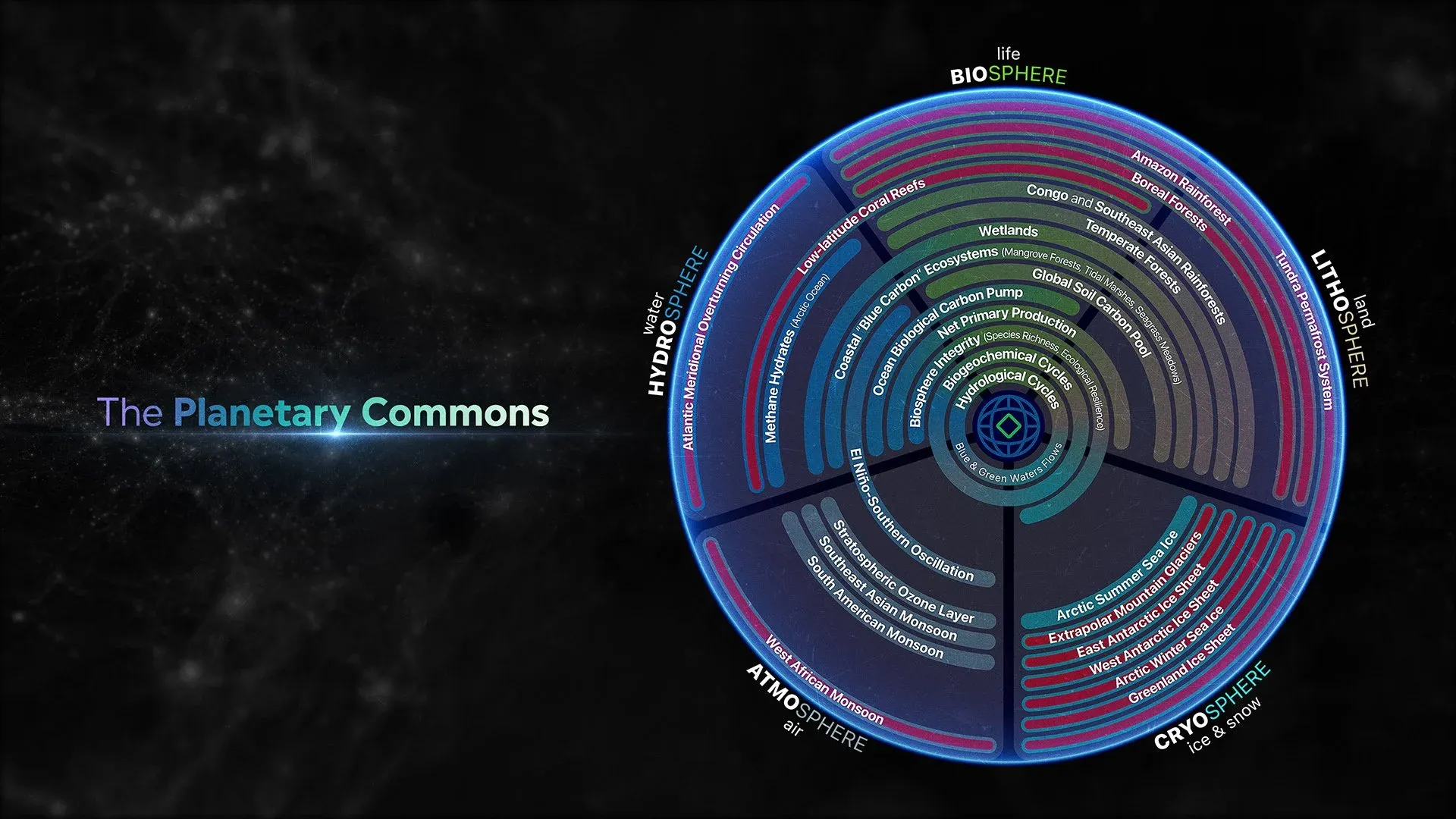
The planetary commons consist of essential biophysical systems and their functions that play a crucial role in sustaining the Earth’s stability and resilience. These systems are vital for supporting life across the globe, irrespective of their specific locations. Tipping elements, highlighted in red, refer to critical components within the Earth’s system that, when pushed beyond certain thresholds, can lead to irreversible and significant changes in the planet’s habitability.
Planetary Communications
Planetary Communications is a science-based model for communicating sustainability — the practice of translating planetary and Earth-system science into messages that land and lead to action. Developed at the Stockholm Resilience Centre, it takes its structure from the Planetary Boundaries framework but applies a reversed logic: where the boundaries define thresholds humanity must not exceed, the communications model defines nine ingredients on which you want to exceed a minimum to achieve impact. Each ingredient is scored from 0 (too low) to 3 (high), and the optimal recipe changes with every sender, message, and audience — the authors liken it to an audio equalizer whose sliders are the same each time, but whose ideal settings depend on the music.
The nine ingredients are: be factful, simplify, time it wisely, link it to other societal concerns, inspire collective action, highlight solutions, navigate emotions, make it personal, and visualise it. They cluster into three overarching qualities — communication that is Reliable, Relatable, and Relevant — arranged around a single guiding principle at the core: “Listen and speak for the planet.” The premise is that scientific knowledge alone does not drive transformation: in a media landscape that is polarised, fragmented, and partly resistant to facts, how we communicate can determine whether evidence reaches the decision-makers and communities who can act on it — the practical complement to Planetary Literacy and Planetary Education.
Ref: Moberg, F., Lundstedt, M., Haeggman, M., & Razaityte, V. (2026). Planetary Communications: A handbook for sustainability science communication. Stockholm Resilience Centre, Stockholm University. Foreword by Johan Rockström.
Evidence base: the model is a practitioner’s framework; the measured ranking of which strategies actually change behaviour comes from Herberz, M., Uenal, F., Gouiran, M. D., Krainz, M., Pagel, L., Schmid, D., Spampatti, T., Vallaeys, I., & Brosch, T. (2026). A systematic review and meta-analysis of communication strategies to promote climate action. Journal of Environmental Psychology, 103176. Across 481 experimental effect sizes and 216,033 participants, communication produced a small but consistent effect on real behaviour and policy support. Messaging built on awe and the beauty of nature, and on moral duty, measured as the most effective strategies of all — ahead of storytelling, ahead of guidance to specific actions, and ahead of the plain presentation of scientific evidence. Images outperformed text. Framing that told people they were responsible had no measurable effect at all.
Planetary Economies
Planetary economies are economic systems designed to meet everyone’s needs within the planetary boundaries, inside the safe and just operating space that Kate Raworth drew as a doughnut, while offering dignity, fairness, purpose, and participation to all. The plural is deliberate: no single blueprint reaches that space. A 2026 report by the Stockholm Resilience Centre for WWF Sweden sets out four pathways. Each one diagnoses nature loss differently and pulls a different lever:
- Circular Bioeconomy — the problem is an economy that is linear (“take, make, dispose”) and runs on fossil inputs. The fix is to close material loops through durable design, repair, reuse, and leasing, and to swap fossil inputs for renewable, bio-based ones. Renewable does not mean free: crop residues and forest offcuts that industry calls waste are nutrients the soil needs back.
- Laghum Economy — the problem is the tax system. Labour is taxed heavily and raw materials lightly, so firms cut costs by replacing people with energy and materials. The fix, proposed by the Swedish entrepreneur Stefan Krook, moves the tax burden from labour onto material consumption through a Sustainable Consumption Tax. That makes repair, care, and services cheaper and resource-hungry products dearer. Like any consumption tax it hits poorer households hardest unless progressive measures offset it.
- Nature-Positive Economy — the problem is sectors and subsidies that degrade nature. The fix is to reduce harm, grow nature-based enterprises such as agroecology and restoration, and reform harmful subsidies, so that the world has more nature in 2030 than in 2020 and full recovery by 2050 (see Nature Positive). It weighs nature’s intrinsic and relational values alongside its price.
- Not-for-Profit Economy — the problem is private profit itself, which rewards selling more, holding down wages, and lobbying against regulation. The fix, developed by Jennifer Hinton, is a market of businesses that reinvest every surplus: foundations, cooperatives, mutuals, credit unions, and public companies, working alongside a partner state, civil society, and the commons.
The four disagree on the deepest questions. The first three accommodate economic growth and try to steer the profit motive; the fourth accepts that some economies must contract, and replaces the profit motive. Pricing nature, central to the Laghum tax, sits uneasily with the value pluralism of the nature-positive pathway. Yet they interlock. The tax shift makes circular repair and reuse profitable. Circularity cuts the extraction that nature recovery needs cut. Not-for-profit ownership removes both the growth imperative and the incentive to lobby against reform. The authors therefore argue for a portfolio: pursued together, the pathways can build momentum instead of stalling one by one against entrenched systems.
Ref: Voicu, B., Hinton, J., Koh, N. S., & Collste, D. (2026). Pathways towards a sustainable and resilient economy. WWF Sweden & Stockholm Resilience Centre, WWF Economic Forum.
Planetary Education
Planetary Education is a transdisciplinary framework for the Anthropocene, built on a dual foundation of Earth and Empathy: rigorous Earth-system literacy grounded in IPCC, IPBES, and the planetary boundaries science, paired with the ethical, intercultural, and intergenerational imagination without which knowledge alone cannot guide a life. It extends through seven capabilities, six curriculum strands, and a developmental K-18 journey. The term is one several research communities — geography educators, planetary-health scientists, Indigenous-led pedagogues — are converging on, here developed as its Earth-system-literate variant.
One condition precedes the seven capabilities, and the philosopher Jörg Noller has stated it most sharply: in the Anthropocene the educational task is hermeneutic before it is moral. The structures through which responsibility is produced, distributed and concealed — supply chains, energy systems, the third nature of altered climates and opaque technologies — do not present themselves to experience, and they must be made legible before anyone can fairly be asked to act on them. The claim is one of order, not of sufficiency. Information alone repairs nothing.
Noller turns the principle into a sequence a teacher can run. Learners first describe two objects as they present themselves — a local river and a widely used software service — writing down their spontaneous attributions of agency: the river is low again this year; the model decided to answer that way. They then trace what constitutes each: abstraction licences, upstream farming and the subsidies that shape it, sewage discharges and decades of rainfall; training data, the labour of annotation, the electricity and cooling water of data centres, ownership and design. They rewrite the first descriptions with authorship restored and set the two texts side by side. The first text was not wrong about the river, only silent about how it was made — and the learner discovers the misrecognition as their own. The last move is a responsibility map in three registers: what I can decide, what my institution can decide, and what only collective or political action can change. Without it, the exercise ends in guilt or fatalism, and both are false.
Ref: Noller, J. (2026). Enlightening the Anthropocene: Reconsidering anthropocentrism for environmental education. Humanities and Social Sciences Communications, 13, 1542.
Planetary Emergency
A planetary emergency can be formally defined as a critical and urgent situation at a global scale where both the risk and urgency of environmental and climatic challenges are extremely high. This concept encompasses situations where the probability and potential damage of ecological tipping points are significant (high risk), and the time left to effectively intervene and prevent catastrophic outcomes is critically short (high urgency). In such a state, the stability and resilience of Earth’s ecosystems are at imminent risk, necessitating immediate and decisive international action to mitigate and reverse the damage.
E = R×U = p×D×τ/T
An emergency (E) is determined by combining two factors: risk and urgency.
- Risk (R) is about how likely something bad will happen and how severe the damage could be. It’s calculated by multiplying the probability (p) of the event happening by the potential damage (D) it could cause.
- Urgency (U) deals with how quickly we need to respond to prevent a bad outcome. It’s calculated by taking the reaction time to an alert (τ) and dividing it by the time remaining to act before things get worse (T).
So, the formula for an emergency is E = R × U, which expands to p × D × τ/T.
In simple terms, a situation is an emergency when both the risk of something bad happening is high, and the need to act quickly is also high. If our reaction time (τ) is longer than the time left to act (T), meaning τ / T is greater than 1, it means we’re too late to control the situation effectively — the same too-late threshold that studies of Existential Risks also try to anticipate.
Ref: Lenton, T. M., Rockström, J., Gaffney, O., Rahmstorf, S., Richardson, K., Steffen, W., & Schellnhuber, H. J. (2019). Climate tipping points — too risky to bet against. Nature, 575(7784), 592–595.
Planetary Entanglement Ontology
The Planetary Entanglement Ontology names an emerging mode of world-composition proper to the Anthropocene: one in which humans, non-humans, technologies, infrastructures, economies, and Earth-system processes co-constitute one another across local, historical, and planetary scales. Its most direct basis is Clive Hamilton’s proposal of a “fifth ontology.” He argues that the four ontologies mapped by the anthropologist Philippe Descola — animism, naturalism, totemism, and analogism — were all composed under Holocene assumptions: a broadly stable Earth, a background “nature,” and human collectives relating to it in different ways.
Descola’s four are generated from a single contrast — whether beings share an interiority (a soul, a mind) and a physicality (a body) — which makes his grid formally complete on its own axes. A fifth mode cannot be another box in the same grid; it needs a new axis. The Anthropocene supplies one: planetary agency, Earth-system feedback, and technosphere entanglement. What has changed is not merely how a culture reads nature but the material condition itself — through the Great Acceleration, humanity has become a geological force, while Earth returns as a reactive, partly uncontrollable power.
This collapses distinctions the Holocene held apart. Following Dipesh Chakrabarty, anthropogenic climate change erases the boundary between human history and natural history, since humans now act as a geophysical force and not only as cultural, political, or economic subjects. As Bruno Latour argues in Facing Gaia — taking up the Earth sciences’ Critical Zone and turning it to philosophical ends — “Nature” as a stable external domain becomes obsolete: Gaia names a reactive, entangled Earth, neither inert object nor harmonious mother, that answers back through carbon forcing, sea-level rise, and shifting fire and crop regimes. Isabelle Stengers sharpens this into the “intrusion of Gaia”: the return of consequences that modern progress believed it could ignore, and that no technocratic mastery can command.
Three further commitments keep the ontology from collapsing into a heroic tale of the species against the Earth. From Donna Haraway comes sympoiesis — making-with — the insistence that humans never act alone but always with microbes, companion species, crops, machines, and damaged ecologies. From Yuk Hui’s cosmotechnics comes the recognition that technology is never culturally neutral: fossil infrastructures, satellites, data centres, and biotechnology are ontologically formative, so there is no planetary ontology without a theory of the Technosphere. From Anna Tsing comes the reminder that the planetary is always situated — lived in supply chains, ruins, and precarious multispecies collaborations rather than only as a global abstraction. In each case the ontology deepens the Embeddedness of human worlds within the living Earth.
The geological force called “humanity” cannot rest on a neutral “we.” Following Kathryn Yusoff, that force was historically produced through colonial extraction, racial capitalism, and fossil modernity, with radically unequal exposure to harm. The ontology must hold two truths at once: humans are a species-level geophysical agent, and humans are profoundly unequal historical agents. Its ethic is geologic responsibility without universal innocence — which is why it converges with Earth System Justice rather than a managerial vision of the planet-as-system to be optimised from above.
As an ontology it is also an emotional orientation — one of the Existential Moods of the age. Its register is not mastery, and not despair, but responsibility and a kind of historical awakening: the sober recognition that Earthbound collectives are now answerable, at planetary scale, for the conditions of life. Held rightly, that recognition is less a weight than a renewed opening — an occasion for awe before a living, reactive Earth. The governing question is no longer only “how should humans treat nature?” but “how should Earthbound collectives act when their very ways of life alter the conditions for life?” In this sense the Planetary Entanglement Ontology is the philosophical counterpart to the passage from an immature to a mature Technosphere — from inadvertent planetary transformation to intentional Planetary Stewardship — and a candidate grammar for the Planetary Sapience such a passage would require.
Ref: Hamilton, C. (2020). Towards a Fifth Ontology for the Anthropocene. Angelaki: Journal of the Theoretical Humanities, 25(4), 100–119. · Descola, P. (2013). Beyond Nature and Culture (J. Lloyd, Trans.). University of Chicago Press. (Original work published 2005.) · Chakrabarty, D. (2009). The Climate of History: Four Theses. Critical Inquiry, 35(2), 197–222. · Latour, B. (2017). Facing Gaia: Eight Lectures on the New Climatic Regime (C. Porter, Trans.). Polity Press. See also Latour, B. & Weibel, P. (Eds.) (2020). Critical Zones: The Science and Politics of Landing on Earth. MIT Press. · Stengers, I. (2015). In Catastrophic Times: Resisting the Coming Barbarism (A. Goffey, Trans.). Open Humanities Press. · Haraway, D. J. (2016). Staying with the Trouble: Making Kin in the Chthulucene. Duke University Press. · Hui, Y. (2016). The Question Concerning Technology in China: An Essay in Cosmotechnics. Urbanomic. · Tsing, A. L. (2015). The Mushroom at the End of the World: On the Possibility of Life in Capitalist Ruins. Princeton University Press. · Yusoff, K. (2018). A Billion Black Anthropocenes or None. University of Minnesota Press.
Planetary Health
Planetary health is a solutions-oriented, transdisciplinary field and social movement that examines how the destabilization of Earth’s life-support systems drives human health harms—and how restoring a safe and just operating space can secure well-being for current and future generations. Grounded in Earth-system science (including evidence that multiple planetary boundaries are already transgressed), it traces causal pathways from underlying drivers—industrialization and extractive economies, governance failures, rapid urbanization, and food-system pressures—through environmental change and social modifiers (inequity by income, place, gender, age, and ethnicity) to diverse health outcomes across nutrition, infectious diseases, noncommunicable diseases, injury and displacement, sexual and reproductive health, and mental health. Recognizing that pollution, climate change, and biodiversity loss act as risk multipliers (e.g., pollution is implicated in ~9 million deaths annually), planetary health centers Earth-system justice, foregrounds Indigenous knowledges, and emphasizes equity within and between generations. Operationally, it calls for rapid, coordinated transformations in energy, food, transport, and economic systems; governance reform; shifts in social narratives and values; and place-based resilience—alongside pollution mitigation, circularity, and equitable resource access—to keep societies healthy within a resilient biosphere.
Ref: Landrigan, P. J., Fuller, R., Acosta, N. J. R., Adeyi, O., Arnold, R., Basu, N., … & Zhong, M. (2017). The Lancet Commission on pollution and health. The Lancet, 391(10119), 462-512. · Faerron Guzmán, C. A., Redvers, N., Ji, J. S., Lacey-Hall, O., Mahmood, J., Masztalerz, O., Phelan, A. L., Rockström, J., & Myers, S. S. (2025). Planetary Health: Focusing on the Intersection of Human Health and the Earth System. Annual Review of Environment and Resources, 50, 18.1–18.35.
Planetary Health Diet
The Planetary Health Diet (of simply Planetary Diet) is a scientifically-developed reference diet designed to provide optimal human nutrition while maintaining environmental sustainability within planetary boundaries. It primarily consists of plant-based foods (including whole grains, fruits, vegetables, legumes, and nuts), allows for modest consumption of poultry, fish, and eggs, and significantly limits red meat (approximately 14g/day or one serving per week), processed meat, added sugar, refined grains, and starchy vegetables. The diet provides approximately 2500 kcal per day and is flexible enough to be adapted across various food cultures and cuisines worldwide. The global adoption of this diet could prevent 10.9-11.6 million premature deaths annually (a reduction of 19-23.6% in total mortality), while simultaneously helping food systems stay within critical environmental boundaries for greenhouse gas emissions, land use, freshwater use, biodiversity, and nitrogen and phosphorus cycling. The EAT-Lancet Commission estimates that feeding a population of 10 billion people a healthy diet from sustainable food systems by 2050 is possible, but would require transformative changes across the food system, including dietary shifts, reductions in food waste, and improved food production practices. This is the dietary translation of the broader case for Planetary Health.
Ref: Willett, W., Rockström, J., Loken, B., Springmann, M., Lang, T., Vermeulen, S., … & Murray, C. J. L. (2019). Food in the Anthropocene: the EAT–Lancet Commission on healthy diets from sustainable food systems. The Lancet, 393(10170), 447-492.
Planetary Homeworld : Orbaia
A unifying name for Earth understood through an emerging, transdisciplinary worldview that treats our planet not as a backdrop or storehouse but as the singular cradle of life to which we belong. Informed by astrobiology and comparative planetology, it recognizes the radical contingency and rarity of an ecosphere—Earth’s coupled atmosphere, hydrosphere, cryosphere, lithosphere, and biosphere—powered by solar energy and geodynamics. Drawing from Earth system science, anthropology, climatology, palaeo-sciences, and Indigenous knowledge, Planetary Homeworld reframes Earth as a living, relational context: unique, precious, fundamentally sacred, and fragile. This perspective carries normative commitments. It centers reciprocity, care, and guardianship (stewardship/kaitiakitanga); advances Earth-system justice across generations and species; and orients action toward maintaining a safe and just operating space. Practically, it calls for institutions, economies, and technologies that sustain habitability and resilience, honor place-based knowledge alongside global science, and reject the “Planet B” illusion in favor of custodianship of the only homeworld we have. Linguistic notes: Orbaia (OR-bah-yah / OR-bay-ah). Adjective: Orbaian (“Orbaian stewardship,” “Orbaian ethics”). Etymology: orb + Gaia.
Planetary Institutions
As suggested by Jonathan Blake and Nils Gilman in their book ‘Children of a Modest Star: Planetary Thinking for an Age of Crises’ (2024), a planetary institution is a governance body designed to operate at the global scale, addressing issues that exceed the capacities of national and international institutions by providing targeted, authoritative, and enforceable solutions to planetary challenges such as climate change, pandemics, and ecological disruptions. These institutions function based on the principles of planetary sapience and planetary subsidiarity, setting broad targets and policies while allowing national and local entities to manage implementation details, thereby ensuring the habitability of Earth and the flourishing of diverse human and nonhuman communities.
Planetary Intelligence
Planetary Intelligence refers to a hypothesized emergent capability of a planetary system—encompassing both its biosphere and technosphere—to collectively acquire, process, and utilize information, enabling it to respond adaptively to changing conditions. Although speculative and still largely theoretical, this concept suggests that a planetary system could function analogously to a distributed cognitive network, acquiring, integrating, and responding to information across global scales. Unlike individual intelligence, planetary intelligence would arise from the complex interactions of diverse agents, processes, and feedback loops across the biosphere and technosphere, potentially forming a coherent cognitive system capable of self-regulation at the planetary scale.
- Emergence The collective properties and behaviours at a planetary scale that cannot be predicted from or reduced to individual parts.
- Information & Networks The flow of semantic and syntactic information through biospheric and technospheric networks, enabling complex communication and interaction.
- Complex Systems The operation of Planetary Intelligence as a Complex Adaptive System (CAS), marked by self-organized patterns and behaviors emerging from local interactions.
- Autopoiesis The self-creating and self-maintaining nature of planetary intelligence, ensuring the persistence and resilience of the system.
- Global Regulatory Feedback Loops The development of feedback mechanisms for maintaining planetary equilibrium, essential for long-term sustainability and stability of the Technosphere and Biosphere.
Ref: Frank, A., Grinspoon, D., & Walker, S. (2022). Intelligence as a planetary scale process. International Journal of Astrobiology, 21(1), 47–61.
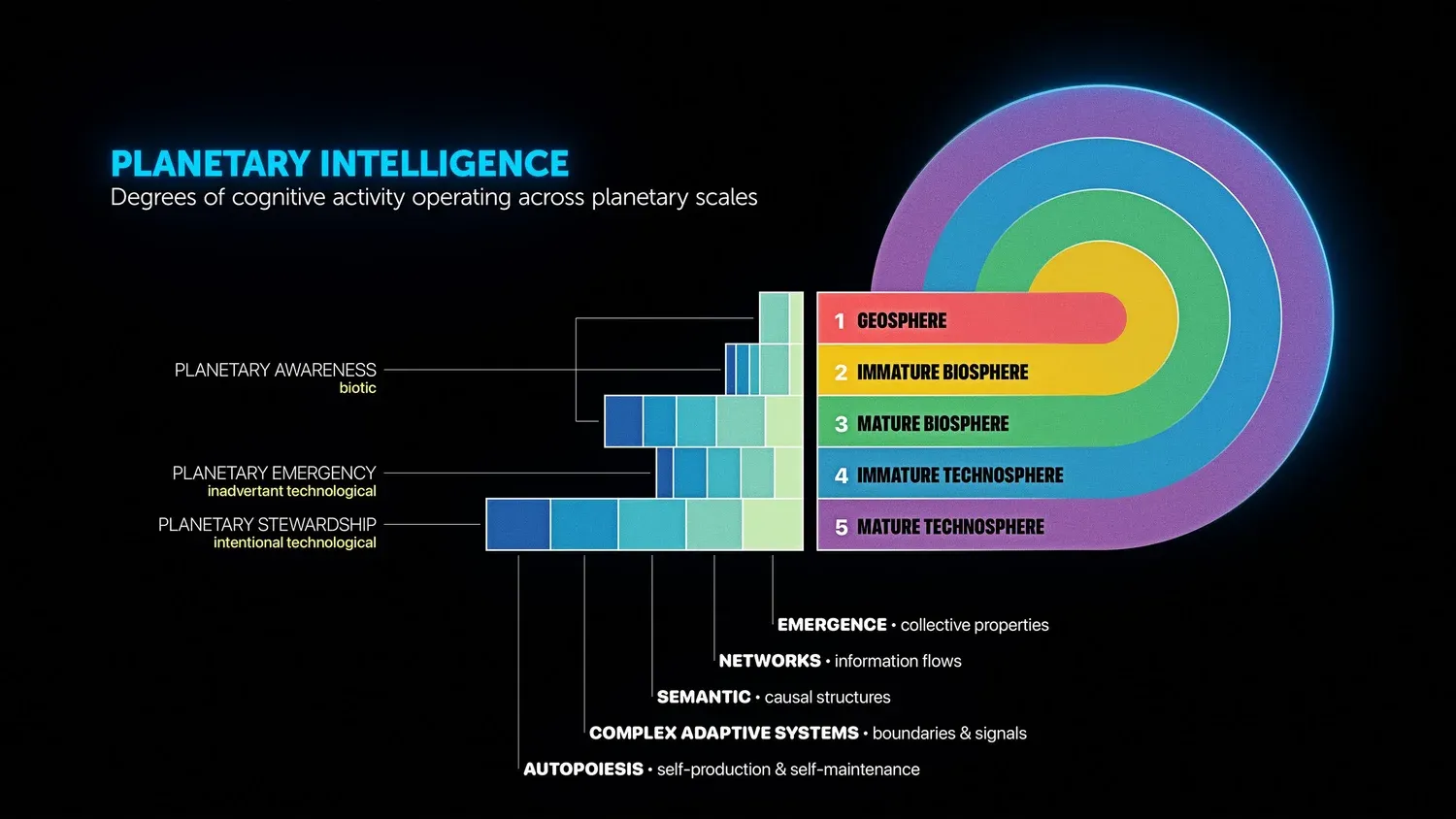
Planetary Literacy
Planetary literacy refers to a comprehensive understanding and appreciation of the intricate relationships and interdependencies between human societies and Earth’s various systems, including the biosphere, atmosphere, hydrosphere, geosphere, and their inherent cycles and motifs, as well as the concept of planetary commons. It encompasses an awareness of the ecosphere as the integrated, habitable space that sustains life, highlighting the interconnectedness of all Earth systems that collectively form a delicate balance enabling life to thrive. This literacy emphasizes the need for informed and responsible stewardship of our planet, recognizing the urgency of addressing planetary emergencies stemming from human-induced changes and disruptions. It advocates for an informed global citizenry equipped with the knowledge and skills to make decisions that protect and preserve the integrity of Earth’s systems, ensuring the well-being of present and future generations within the dynamic and interconnected web of life that constitutes our ecosphere.
Planetary Politics
A novel form of political contestation that emerges from the development of planetary institutions and the commitment to planetary sapience. It transcends the boundaries of national and international politics, focusing on the interests and well-being of the planet as a whole, including both human societies and the entire Earth system with its diverse multispecies communities. Planetary politics is inherently postanthropocentric, seeking to include the voices, interests, and agencies of nonhuman entities through various forms of representation. It aims to address conflicts and make decisions at the scale of the planet, based on a comprehensive assessment of the costs and benefits to all parties involved, while recognizing that human flourishing is inseparable from the flourishing of the larger multispecies community. Ultimately, planetary politics represents a transformative shift in the nature of political engagement, redefining the scope of political possibility in response to the profound challenges posed by the condition of planetarity in the Anthropocene.
Ref: Blake, J. S., & Gilman, N. (2024). Children of a Modest Star: Planetary Thinking for an Age of Crises. Stanford University Press.
Planetary Solvency
Planetary solvency is the capacity of Earth’s systems to sustain life and human activity by balancing resource use and ecological regeneration. Drawing on financial and actuarial principles, it treats the planet as a finite system with natural assets and liabilities, framing ecosystems as providers of essential services like clean air, fresh water, and climate regulation. By assessing whether human demands exceed Earth’s ability to regenerate, planetary solvency evaluates the risks of ecological collapse under the strain of environmental degradation and overuse. The concept emphasizes operating within environmental thresholds—ecological boundaries such as carbon emissions and biodiversity loss—beyond which Earth’s systems risk irreversible damage. It integrates measurable indicators like carbon budgets and biodiversity indices to assess the health of planetary systems and mitigate the “risk of ruin,” where recovery becomes nearly impossible. By translating sustainability into actionable strategies, planetary solvency highlights the urgency of aligning human activity with Earth’s regenerative capacity, ensuring resilience for current and future generations.
Ref: Trust, S., Bettis, O., Saye, L., Bedenham, G., Lenton, T. M., Abrams, J. F., & Kemp, L. (2024). Climate Scorpion – The Sting is in the Tail: Introducing Planetary Solvency. Institute and Faculty of Actuaries (IFoA).
Planetary Societies
An aspirational mode of society — distinct from traditional place-based societies and from industrial modernity — in which humanity collectively thrives together with the rest of life on Earth. The concept reframes progress: rather than a choice between protecting nature and advancing human development, it imagines a shared trajectory in which the two are inseparable. Planetary societies are characterized less by a single blueprint than by a cultivated set of capabilities — institutional, technological, ethical, relational — for sustaining mutually beneficial relationships between people, other species, and the planetary systems that support all life.
Related contemporary frameworks contribute complementary vocabulary. Ecocivilization, articulated in Chinese environmental thought and international sustainability discourse, describes a civilizational pathway rooted in integrating ecological health with social flourishing. The Nature Futures Framework of IPBES offers tools for imagining such futures across diverse cultural lenses. The Nature Relationship Index proposes a way to measure progress toward them. What unites these frames is a shift from damage limitation to shared aspiration — from avoiding the worst to deliberately building a world worth inheriting.
Ref: Ellis, E. C., Malhi, Y., Ritchie, H., Montana, J., Díaz, S., Obura, D., Clayton, S., Leach, M., Pereira, L., Marris, E., Muthukrishna, M., Fu, B., Frankopan, P., Grace, M. K., Barzin, S., Watene, K., Depsky, N., Pasanen, J., & Conceição, P. (2025). An aspirational approach to planetary futures. Nature, 642, 889–899.
Planetary Stewardship
The active and responsible management of Earth’s systems and resources in response to the unique challenges presented by the Anthropocene. This concept emphasizes the need for a global-scale solution that goes beyond national and cultural boundaries, acknowledging humanity’s profound impact on the Earth System. This concept involves directing global change by considering interconnected local to global levels. The goal is to ensure the long-term well-being of both humanity and the natural world, including ecosystems and the global commons. Achieving holistic solutions necessitates a shift in the way we perceive and interact with the world, as the transformation of society commences with a fundamental change in our perspectives and worldviews.
Ref: Steffen, W., Persson, Å., Deutsch, L. et al. The Anthropocene: From Global Change to Planetary Stewardship. AMBIO 40, 739–761 (2011)
Planetary Sapience
Planetary Sapience is an emergent meta-capability of humanity, marked by a profound shift in collective consciousness towards a holistic understanding of Earth’s complex systems. This evolved planetary awareness permeates societal structures, cultural expressions, and individual behaviors, fostering a dynamic, co-evolving equilibrium between Ecogenic Systems (biosphere, climate, hydrosphere, geosphere) and Anthropogenic Systems (worldviews, institutions, technologies, settlements).
This form of wisdom or axiological posture arises through intentional, coordinated transformations across various domains, blending modern scientific understanding of planetary dynamics with diverse cultural traditions centered on responsible stewardship. It embodies both novel insights into Earth’s histories, cycles, and patterns, and ancient knowledge practices focused on guardianship of the planet.
Encompassing David Grinspoon’s concept of “Planetary Change of the Fourth Kind,” Planetary Sapience signifies a transformative phase in Earth’s evolution. This stage, termed ‘Terra Sapiens’ or ‘Sapiezoic,’ is characterized by humanity’s maturation into wise planetary stewards. It represents a shift towards more integrated, conscious, and sustainable interactions with Earth’s systems, reflecting a deep understanding and responsible management of the planet’s resources and ecosystems.
Ref: Term coined by GLOBAÏA, 2019.
An other definition of planetary sapience has been proposed by Benjamin Bratton from the Berggruen Institute, which sees it as the product of planetary-scale computation. Thus, planetary sapience is envisioned as the development of a global, interconnected cognitive and sensory system facilitated by advanced computational technologies, enabling the Earth to achieve a form of self-awareness and responsive intelligence that monitors and manages ecological and climatic phenomena. This emergent intelligence, constituting a technological and philosophical evolution, challenges and transforms human interactions with the Earth, promoting a deliberate and sustainable engagement with the planet’s systems.
Precipice (the)
Term used to describe a particularly critical and dangerous era in human history, predominantly spanning from 1945, when humanity first gained the power to trigger its own destruction, up until now. This period is distinguished by an acute increase in existential risks, i.e. threats that could lead to human extinction or the irretrievable collapse of civilisation. The ‘Precipice’ is defined by the imbalance between humanity’s rapidly growing power and its relatively lagging wisdom. This disparity leads to an unsustainable level of risk, suggesting that without significant changes, these risks might escalate in future centuries. The term encapsulates the idea that humanity is walking along a narrow, dangerous path on the edge of a cliff, where a misstep could lead to catastrophic consequences — a trajectory closely examined through the lens of the Anthropocene Traps.
Ref: Ord, T. (2021). The Precipice: Existential Risk and the Future of Humanity. Bloomsbury Publishing.
Regime Shift
A regime shift refers to a significant, often abrupt, and long-lasting change in the state of a system, marking a transition from one stable configuration to another. These shifts occur when a system crosses a critical threshold or tipping point, disrupting its existing equilibrium and establishing a new set of dynamics and feedbacks. Regime shifts are typically characterized by their scale, unpredictability, and resistance to reversal (a phenomenon known as hysteresis), making them transformative events in ecological, climatic, or social systems — a dynamic closely tied to a system’s Resilience.
Resilience
Socio-ecological system (SES) resilience is the ability of people, communities, societies, or cultures to live and develop with change and with ever-changing environments. It is about cultivating the capacity to continue to develop in the face of change, incremental and abrupt, expected and surprising.
Resilience is categorized into three distinct levels:
- Shock Tolerance The capacity of a system to absorb disturbances and reorganise while undergoing change, retaining its essential function, structure, feedbacks, and identity. This dynamic concept emphasizes the ability to persist and evolve with change.
- Adaptability The capacity of people in a social-ecological system to learn, innovate, and adjust to changing external drivers and internal processes. Adaptability involves human actions that sustain development within existing pathways, turning changes into opportunities, and is crucial for maintaining social-ecological resilience.
- Transformability The ability to shift development into new pathways and create novel ones, particularly when existing ecological, economic, or social structures are untenable. Transformability involves crossing thresholds and moving into new development trajectories, often utilising resilience from different levels and scales. It’s about navigating and exploiting crises for fundamental system changes. At planetary scale, this same capacity underlies frameworks such as World-Earth Resilience (WER).
Ref: Folke, C. (2006). Resilience: The emergence of a perspective for social–ecological systems analyses. Global Environmental Change, 16(3), 253–267.
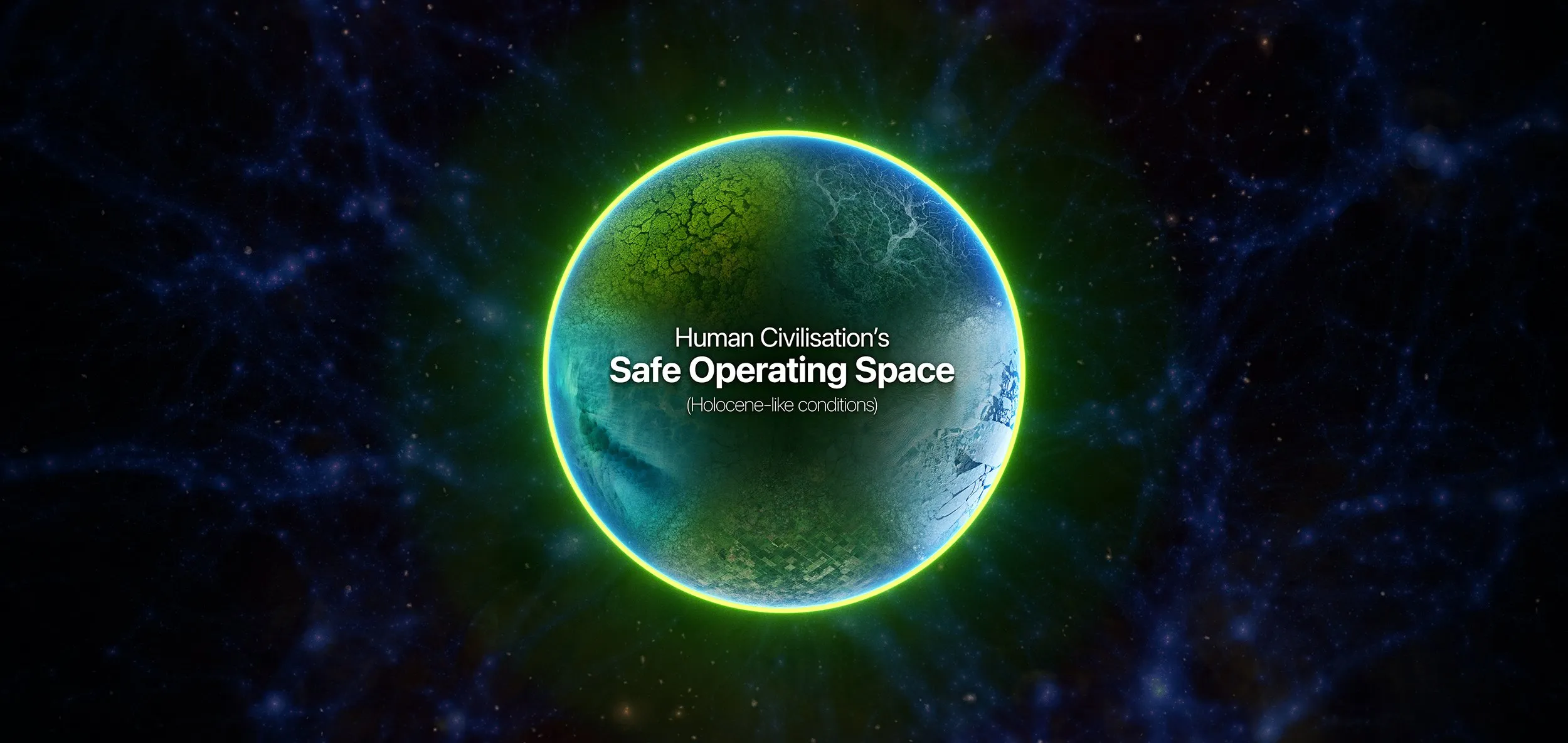
Safe Operating Space
The Safe Operating Space is the range of planetary conditions within which Earth’s life-support systems remain stable and self-regulating — the zone humanity can occupy without pushing the biosphere into a fundamentally more hostile state. It is delimited by the planetary boundaries: nine scientifically-determined thresholds for critical biophysical processes — among them climate, biosphere integrity, freshwater, and biogeochemical flows — that together hold the Earth system in the stable, Holocene-like state in which civilisation arose.
Beyond a static list of limits, the safe operating space can be read dynamically, as a basin of attraction — a valley in the landscape of possible planetary states that the system tends to settle back into after a disturbance. Past its edge lies an unsafe operating space: a different, far less hospitable state, separated from the safe one by a tipping point. How safe we actually are then depends on two things: how large a shock the system can absorb before sliding over that edge — its resilience, understood as the distance to the boundary — and whether we hold enough knowledge and collective agency to steer back in time should we begin to drift toward it. Crossing a boundary is therefore not merely breaching a number; it erodes the very stability that keeps the safe basin habitable.
Closely associated with Resilience, Sustainability, and Habitability, and extended by the Safe and Just Operating Space, which pairs this biophysical ceiling with a social floor.
Ref: Rockström, J., Steffen, W., Noone, K., et al. (2009). A safe operating space for humanity. Nature, 461, 472–475. · Anderies, J. M., Bechthold, M., Donges, J. F., et al. (2026). An information-based World–Earth system resilience index. EGUsphere (preprint).
Safe and Just Operating Space
The Safe and Just Operating Space extends the Safe Operating Space by pairing its biophysical ceiling with a social floor: humanity should remain not only within the limits that keep the planet stable, but also above the minimum conditions of a decent life for everyone. It is the room to manoeuvre bounded from the outside by the planetary boundaries and from the inside by basic human needs — the space between the two that Kate Raworth popularised as the “doughnut.”
The Earth System Boundaries of the Earth Commission make this quantitative, tightening several planetary limits so they also prevent significant human harm — loss of lives, livelihoods, and nutritional security (see Earth System Justice). Recent World–Earth system modelling then makes the “just” dimension explicit and dynamic: a trajectory counts as reaching a safe and just operating space only if, at a chosen future date, it satisfies both an environmental limit (for example, atmospheric CO₂ held below 350 ppm) and a social minimum (a floor on income or living standards) — in every world region, not merely on average. Framed this way, resilience becomes the probability that a society, given what it knows and its capacity to act, actually reaches and holds this doubly-bounded space rather than overshooting the ceiling or falling through the floor.
Ref: Raworth, K. (2012). A Safe and Just Space for Humanity: Can we live within the doughnut? Oxfam Discussion Paper. · Dearing, J. A., Wang, R., Zhang, K., et al. (2014). Safe and just operating spaces for regional social-ecological systems. Global Environmental Change, 28, 227–238. · Rockström, J., Gupta, J., Qin, D., et al. (2023). Safe and just Earth system boundaries. Nature, 619, 102–111. · Anderies, J. M., Bechthold, M., Donges, J. F., et al. (2026). An information-based World–Earth system resilience index. EGUsphere (preprint).
Shifting Baseline Syndrome
The progressive downward redefinition of what counts as normal, in which each generation takes the degraded world it inherits as the reference against which change is measured. Named by fisheries scientist Daniel Pauly in 1995, in a one-page observation that has outlived most of the papers around it: each generation of fisheries scientists accepted the stock size and species composition present at the beginning of their own careers as the baseline, and used it to evaluate change from there. The result is a slow accommodation to the disappearance of the living world — losses that are real but never registered, because the yardstick moves down with the thing it measures.
It takes two forms. Generational amnesia occurs when knowledge of past conditions is simply not transmitted: a child who has never seen a river full of fish has no reason to consider an empty one abnormal. Personal amnesia occurs within a single lifetime, as individuals unconsciously revise their memory of earlier abundance downward to match what they now see. Both are driven by the same three conditions: the steady withdrawal of everyday life from direct contact with living systems, the absence of long historical records for most places and species, and a declining familiarity with the natural world — fewer people who could name what is missing. Degradation alone does not produce the syndrome; it is the loss of the means to notice it that does. Each generation is not lied to. It is simply never told.
Its consequences run through nearly every concept in this glossary. It is why the State in DPSIR is measured against a reference that is itself in motion, and why frameworks such as Nature Positive must fix an explicit year — 2020, in that case — rather than trust a remembered condition. It is why the Holocene matters as more than a chronological label: it is the last stable baseline that is not a memory. It is why restoration targets tend to aim at the recent past rather than the possible, why tolerance for degradation rises even as degradation does, and why loss of the more-than-human world can be catastrophic and unmourned at the same time. It is the perceptual counterpart to undesirable resilience — a simplified world becoming stable not only ecologically but cognitively, because no one alive remembers otherwise.
The correctives are not nostalgia. Restoration comes first — a river brought back is the most direct refutation of a lowered baseline. Then record-keeping: palaeoecology, historical ecology, archives, oral testimony, long monitoring series, and the transmission between generations that Place-based Societies have often maintained where industrial societies have not. Then renewed contact with living systems, and an education that can still name what is missing. Shifting baselines are what make Planetary Literacy and Planetary Awareness load-bearing rather than decorative: a civilisation that cannot remember its own planet cannot notice what it is doing to it.
Ref: Pauly, D. (1995). Anecdotes and the shifting baseline syndrome of fisheries. Trends in Ecology & Evolution, 10(10), 430. · Papworth, S. K., Rist, J., Coad, L., & Milner-Gulland, E. J. (2009). Evidence for shifting baseline syndrome in conservation. Conservation Letters, 2(2), 93–100. · Soga, M., & Gaston, K. J. (2018). Shifting baseline syndrome: causes, consequences, and implications. Frontiers in Ecology and the Environment, 16(4), 222–230.
Stable State
A stable state is one that a system will naturally return to after being perturbed, provided the perturbations fall within a certain range. In such a state, the system’s dynamics counteract deviations, restoring equilibrium over time. Stability is maintained by negative feedback loops, which resist change by dampening or counterbalancing the effects of disturbances. However, when perturbations exceed a critical threshold, the system may cross into a different stable state, undergoing a regime shift. This shift represents a fundamental change in the system’s structure and behavior, often with long-lasting consequences. The concept of resilience is closely tied to stability, describing a system’s capacity to absorb disturbances and recover its original state or functionality. Resilience determines the extent of perturbations a system can withstand before tipping into a new regime. For instance, a forest ecosystem may remain stable despite occasional fires, but a prolonged period of severe drought could push it into a desert-like state. The interplay between stability, resilience, and regime shifts highlights the dynamic nature of systems
Superorganism (the)
In Nate Hagens’ framework, The Superorganism represents the emergent, global-scale behavior of human civilization, functioning as a self-organized, energy-hungry entity shaped by socio-economic and technological dynamics. It arises from humanity’s collective pursuit of surplus, initially in physical forms like food and materials, and later as financial representations of surplus (e.g., money). Governed by simple behavioral rules, such as optimizing for financial and material gain, the Superorganism behaves much like a biological organism, relentlessly seeking energy and resources to sustain and expand itself. Crucially, the Superorganism operates within and is reinforced by a specific Worldviews, Institutions, and Technologies (WIT) regime. This regime reflects historical, geographic, and power dynamics that have prioritized economic growth and fossil-fuel-driven industrial expansion. These interdependencies lock human societies into a trajectory of energy-intensive behaviors, creating feedback loops that perpetuate ecological overshoot and resource depletion. While the Superorganism lacks centralized control or foresight, its behavior is shaped by emergent properties of human systems. It metabolizes energy and materials at unprecedented scales, often detached from the biophysical realities of Earth’s finite systems.
Ref: Hagens, N. J. (2020). Economics for the future – Beyond the superorganism. Ecological Economics, 169, 106520.
Similar systemic metaphors have been proposed to capture this runaway dynamic. Luke Kemp (2025) frames it as the Global Goliath, a colossal force embodying the entanglement of economic, political, and technological power at the planetary scale. The notion of multipolar traps—or Molochs—highlights how decentralized competition among many actors can drive collectively destructive outcomes, even when all would benefit from restraint. Earlier, Lewis Mumford described industrial civilization as the Megamachine, a socio-technical construct in which humans become components of a vast mechanical order.
Ref: Kemp, Luke. Goliath’s Curse: The History and Future of Societal Collapse. 2025. · Alexander, S. (2014). Meditations on Moloch. Slate Star Codex. · Mumford, L. (1967). The Myth of the Machine: Technics and Human Development.
Sustainability
Sustainability is a concept that emphasizes the ability to meet the needs of the present generation without compromising the ability of future generations to meet their own needs. This foundational idea, articulated by the Brundtland Commission in 1987, underscores the importance of balancing economic, environmental, and social priorities to ensure the equitable and responsible use of resources. At its core, sustainability seeks to maintain harmony between human development and the natural systems that support life.
In the context of planetary systems, sustainability extends beyond this conventional definition to encompass the capacity of a system—natural and human-made—to ensure the long-term viability of societies and ecosystems. It focuses on operating within the Earth’s biophysical boundaries (aka Planetary Boundaries), stabilizing and preserving life-supporting processes while managing human impacts, and it emphasizes resilience, resource efficiency, and ecological balance as means of avoiding systemic collapse or irreversible degradation. Unlike broader concepts such as habitability or genesity, sustainability primarily concerns itself with maintaining the status quo needed to support human well-being: it prioritizes the stabilization of existing conditions to ensure continuity, rather than the generative potential of ecosystems to foster new forms of life and complexity. This anthropocentric framing aligns with ecological economics and planetary stewardship, advocating resource conservation, reduced environmental harm, and preservation of the ecosystems upon which human civilization depends.
De-anthropocentrizing sustainability means transitioning from a human-centered perspective to an ecosphere-focused stewardship, prioritizing the enhancement of habitability for all Earth-like life and, ultimately, fostering genesity—the generative potential for diverse and novel forms of life to flourish.
Terra Sapiens
Terra Sapiens is a concept introduced by David Grinspoon in his book ‘Earth in Human Hands: Shaping Our Planet’s Future’, signifying a transformative phase in Earth’s evolution. Encompassing the “Planetary Change of the Fourth Kind,” it describes humanity’s potential to mature into wise planetary stewards, ushering in an era known as the “Sapiezoic.” This stage represents a shift towards integrated, conscious, and sustainable interactions with Earth’s systems, founded on a deep understanding and responsible management of planetary resources and ecosystems.
Similar to ideas like Gaia 2.0 and the “Mature Technosphere,” Terra Sapiens envisions humanity as an active participant in Earth’s self-regulation, harmonizing technological advancements with ecological principles. It emphasizes a collective responsibility to guide the planet toward a flourishing, life-supporting future, balancing innovation with sustainability to ensure the long-term health of the biosphere. This transformative phase reflects the emergence of Planetary Sapience, where human agency aligns with the broader goals of planetary stewardship.
Ref: Grinspoon, D. (2016). Earth in human hands: Shaping our planet’s future. Grand Central Publishing.
Syndromes of Global Change
A diagnostic alternative to causal chains, developed in the mid-1990s by physicist Hans Joachim Schellnhuber and colleagues at the Potsdam Institute for Climate Impact Research and the German Advisory Council on Global Change. Instead of asking what causes what, it asks what patterns keep recurring — and borrows its method from clinical medicine. A syndrome is a cluster of symptoms that co-occur with a characteristic dynamic, recognisable across different bodies. Global environmental degradation, on this reading, is not an indefinite variety of local problems but a small number of transferable clinical pictures, each appearing again and again in different landscapes and under different governments.
Sixteen were identified, in three groups. Utilisation syndromes concern how natural resources are drawn on: the Sahel Syndrome (overcultivation of marginal land under conditions of poverty), Overexploitation, Rural Exodus, the Dust Bowl Syndrome (non-sustainable agro-industrial use of soils and water), the Katanga Syndrome (degradation through extraction of non-renewable resources), Mass Tourism, and Scorched Earth (environmental destruction through military use). Development syndromes concern problems arising from non-sustainable development: the Aral Sea Syndrome (damage from large-scale state projects), the Green Revolution Syndrome (transfer of farming methods unsuited to their new setting), the Asian Tigers Syndrome (environmental standards disregarded in rapid growth), the Favela Syndrome (degradation through uncontrolled urbanisation), Urban Sprawl, and the Major Accident Syndrome (singular human-made disasters with long-term impacts). Sink syndromes concern disposal: the Smokestack Syndrome (large-scale diffusion of long-lived substances), Waste Dumping, and Contaminated Land.
The names are the point. Each is a place made into a diagnosis — a way of saying that what happened at the Aral Sea is a kind of thing that also happens in the Mekong and the Colorado, and that recognising the kind is more useful than re-deriving the local causes each time. The underlying formalism traced a network of some eighty interlinked trends spanning population, economy, soils, water, atmosphere and social organisation, allowing several syndromes to be diagnosed as co-active in the same region — an early and largely unremarked anticipation of what is now discussed as the Global Polycrisis.
The approach was largely eclipsed by the Planetary Boundaries framework, which offered quantified global thresholds where syndromes offered qualitative regional patterns. But it retains something the boundaries do not: where DPSIR partitions the world into stages of a chain and boundaries partition it into control variables, syndromes describe configurations — human and environmental symptoms entangled in a single clinical picture, at the scale where degradation is actually experienced. It is kin to the Anthropocene Traps in treating dysfunction as a recurring, recognisable form rather than a one-off failure, and to Panarchy in reading systems as patterns in motion rather than states to be measured. Almost forgotten, and better than its reputation.
Ref: Schellnhuber, H. J., Block, A., Cassel-Gintz, M., Kropp, J., Lammel, G., Lass, W., Lienenkamp, R., Loose, C., Lüdeke, M. K. B., Moldenhauer, O., Petschel-Held, G., Plöchl, M., & Reusswig, F. (1997). Syndromes of global change. GAIA, 6(1), 19–34. · German Advisory Council on Global Change (WBGU). (1997). World in Transition: The Research Challenge. Berlin: Springer. · Petschel-Held, G., Block, A., Cassel-Gintz, M., Kropp, J., Lüdeke, M. K. B., Moldenhauer, O., Reusswig, F., & Schellnhuber, H. J. (1999). Syndromes of global change: A qualitative modelling approach to assist global environmental management. Environmental Modeling & Assessment, 4(4), 295–314.
Technosphere
The technosphere is the interconnected system of all non-food, non-living matter extracted from Earth’s natural systems and transformed into human-made artifacts for specific purposes. This vast network includes urban environments, transportation systems, communication infrastructures, and other human-made structures and devices that enable essential activities such as energy conversion, material extraction, transportation, and information processing. Key characteristics of the technosphere include its vast mass, estimated at over 1 trillion tons in 2019, with approximately one-third consisting of residential buildings and another third represented by transportation systems. The technosphere exhibits autocatalytic growth (a self-reinforcing process where the products of growth accelerate further expansion), where its components, such as machinery and infrastructure, accelerate the extraction and processing of resources, leading to exponential expansion at an average rate of 3.6% per year since 1900 — a runaway dynamic closely paralleled by Nate Hagens’ concept of the Superorganism. This growth far outpaces human population increase, with the ratio of technosphere mass to human biomass rising from 18 tons per person in 1900 to 140 tons per person today — a growth trajectory that has made the Technosphere a defining feature of the Anthroposphere. An emerging subset of the Technosphere, the Xenoösphere, refers to the intricate industrial ecosystem driving the rapid advancement of artificial intelligence.
Ref: Galbraith, E., Faisal, A.-A., Matitia, T., Fajzel, W., Hatton, I., Haberl, H., Krausmann, F., & Wiedenhofer, D. (2024). Resolving the Technosphere. EGUsphere.
Telecoupling
Socio-economic and environmental interactions between places that are far apart — the concept that names, and makes analysable, the fact that consumption in one part of the world routinely converts land, water and life in another. Introduced by sustainability scientist Jianguo Liu and colleagues in 2011 and given its full framework two years later, it extends the study of coupled human–natural systems across distance, borrowing its form from the older climatological idea of a teleconnection, in which a temperature anomaly in the Pacific reorganises rainfall over Africa.
Its analytical value is that it insists on naming five things at once: the sending system where a flow originates, the receiving system where it arrives, and — most usefully — the spillover systems that shape the exchange or are shaped by it while belonging to neither end; then the flows themselves (goods, capital, species, information, people, energy), the agents who move them or block them, the causes — economic, political, cultural, technological or ecological — that drive them, and the effects they produce at each node. The spillover system is the concept’s distinctive contribution. It is the third party that both a national footprint account and a bilateral trade statistic are structurally unable to see.
The examples are the ordinary machinery of the world economy. Soy and beef leaving the Amazon basin for European and East Asian markets; palm oil, cocoa and coffee carrying deforestation embodied in a commodity that arrives looking like a groceries item; virtual water exported from arid countries in the form of crops; electronic waste flowing to places with the least capacity to refuse it; migration and species invasion moving along the same corridors as trade. Telecoupling also exposes the least comfortable pattern in environmental policy: displacement. A country can restore its forests while raising timber imports, protect its own fisheries while its fleets work distant waters, or legislate a strict domestic standard whose only measurable effect is to relocate the activity. Conservation success and its export are frequently the same event described from one end.
For this glossary the concept does specific work. It supplies the spatial causation that DPSIR structurally lacks — driving force and pressure separated by an ocean, recorded in two different national reports that never meet. It is what ecological footprint accounting and HANPP measure in aggregate but cannot attribute. It is the mechanism by which local decisions become planetary, and therefore why the Global Commons and Planetary Commons require governance that follows flows rather than borders. And it marks the difference between global change as a sum of everywhere and planetary change as a single connected system: telecoupling is what turns the former into the latter.
Ref: Liu, J., Hull, V., Batistella, M., DeFries, R., Dietz, T., Fu, F., Hertel, T. W., Izaurralde, R. C., Lambin, E. F., Li, S., Martinelli, L. A., McConnell, W. J., Moran, E. F., Naylor, R., Ouyang, Z., Polenske, K. R., Reenberg, A., de Miranda Rocha, G., Simmons, C. S., … Zhu, C. (2013). Framing sustainability in a telecoupled world. Ecology and Society, 18(2), 26. · Liu, J., Mooney, H., Hull, V., Davis, S. J., Gaskell, J., Hertel, T., Lubchenco, J., Seto, K. C., Gleick, P., Kremen, C., & Li, S. (2015). Systems integration for global sustainability. Science, 347(6225), 1258832. · Meyfroidt, P., Lambin, E. F., Erb, K. H., & Hertel, T. W. (2013). Globalization of land use: Distant drivers of land change and geographic displacement of land use. Current Opinion in Environmental Sustainability, 5(5), 438–444.
Third Nature
The hybrid domain in which human and natural processes have settled into one another so thoroughly that what they produce is neither purely natural nor purely artificial: a climate warmed by industrial carbon, a nitrogen cycle reset by fertiliser, a gyre of plastic, the assemblage of species a city selects, a feed that shapes what millions of people see. The term is the philosopher Jörg Noller’s, and it answers an old pair. First nature was what humans found — the biological, geological and atmospheric order that ran without them. Second nature was what humans made — language, law, institutions and technique, the space of meaning that John McDowell describes as acquired through upbringing. The distinction assumed that the found and the made could always be told apart. On a planet where microplastics reach the deep ocean floor and industrial emissions set the temperature of polar ice, they no longer can.
What defines third nature is less the mixture than its opacity: human agency is structurally present in it and phenomenologically absent from it. A flood fed by decades of emissions arrives as a natural disaster; plastic in a fish seems to belong to the sea; an AI system appears to decide, though it runs on human data, human labour, human infrastructure and human choices about what it should optimise. The misreading runs in two directions at once — nature read as authorless, technology read as autonomous — and Noller calls the resulting condition systemic misrecognition. We meet our own actions as if they were foreign forces.
Two qualifications keep the concept honest. The first concerns legibility: ice cores, sediment layers, species ranges and atmospheric chemistry have become readable as records of past human decisions, without themselves becoming moral facts. First nature is now, among other things, an archive of second. The second qualification is political. Conceding the critique of Andreas Malm and Alf Hornborg, Noller grants that no undifferentiated humanity acquired geological force, and that part of the opacity was manufactured — funded doubt, organised denial. Misrecognition is unequally distributed: those best placed to alter these systems are often those best placed to remain unseen within them, while those who bear the consequences hold the fewest means of tracing them. Legibility has owners.
A terminological note. Anna Tsing had used the phrase in 2015 in another sense — what manages to live despite capitalism, set against the first nature of ecological relations and the second nature of capitalist transformation. Tsing’s third nature is political-economic, Noller’s ontological. The two are compatible, and both record the same failure: a two-term scheme can no longer describe the world.
For this glossary the concept names the object that planetary literacy must learn to read, and the condition that the Planetary Entanglement Ontology describes from the inside; the technosphere is its most massive expression. It also turns anthropocentrism on its head. Humans are central to planetary processes not because they stand above nature but because they are now built into its dynamics, and centrality read this way is an attribution of responsibility rather than a claim to mastery. In third nature, to dominate is to endanger oneself.
Ref: Noller, J. (2025). Third nature: Towards a hybrid account of anthropocentrism. Topoi. · Noller, J. (2026). Enlightening the Anthropocene: Reconsidering anthropocentrism for environmental education. Humanities and Social Sciences Communications, 13, 1542. · Tsing, A. L. (2015). The Mushroom at the End of the World: On the Possibility of Life in Capitalist Ruins. Princeton University Press. · McDowell, J. (1994). Mind and World. Harvard University Press. · Malm, A., & Hornborg, A. (2014). The geology of mankind? A critique of the Anthropocene narrative. The Anthropocene Review, 1(1), 62–69.
Tipping Points (climate)
Tipping points occur when change in part of the climate system becomes (2) self-perpetuating beyond (2) a warming threshold as a result of asymmetry in the relevant feedbacks, leading to (3) substantial and widespread Earth system impacts. These impacts can be abrupt and dangerous, with very serious implications for the future of humanity and our planet, often propagating further through a wider Cascade Effect. As the world gets hotter, several tipping points are becoming very likely*.* Sixteen climate tipping points have been identified:
Global Warming Thresholds:🔴 <2°C 🟠 2-4°C 🟡 ≥4°C
- 🔴 Greenland Ice Sheet · collapse
- 🔴 West Antarctic Ice Sheet · collapse
- 🔴 Low-Latitude Coral Reefs · die-off
- 🔴 Boreal Permafrost · abrupt thaw
- 🔴 Labrador Sea Current · Subpolar Gyre · collapse
- 🔴 Barents Sea Ice · abrupt loss
- 🟠 Amazon Rainforest · dieback
- 🟠 Sahel / West African Monsoon · greening
- 🟠 East Antarctic Subglacial Basins · collapse
- 🟠 Extra-Polar Mountain Glaciers · loss
- 🟡 Atlantic Meridional Overturning Circulation · collapse
- 🟡 Arctic Winter Sea Ice · collapse
- 🟡 Boreal Permafrost · collapse
- 🟡 Boreal Forest · northern expansion
- 🟡 Boreal Forest · southern dieback
- 🟡 East Antarctic Ice Sheet · collapse
Ref: Armstrong McKay, D. I., Staal, A., Abrams, J. F., Winkelmann, R., Sakschewski, B., Loriani, S., Fetzer, I., Cornell, S. E., Rockström, J., & Lenton, T. M. (2022). Exceeding 1.5°C global warming could trigger multiple climate tipping points. Science, 377(6611), eabn7950.
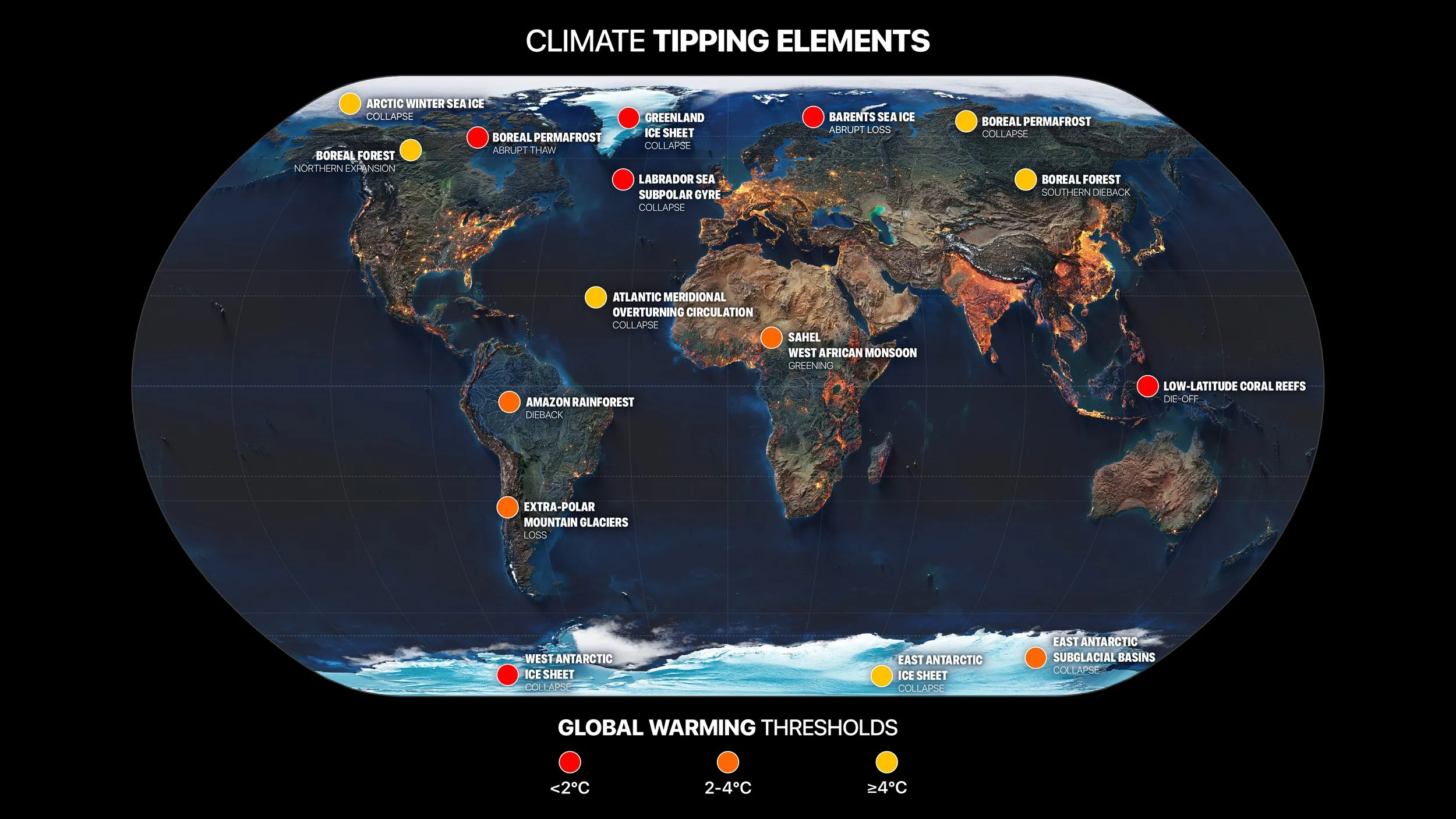
WITs · Worldviews, Institutions & Technologies
Worldviews, Institutions, and Technologies (WITs) refer to the interdependent and mutually reinforcing components of human culture that shape societies’ interactions with their ecological and social environments. This concept is central to understanding systemic roadblocks to sustainability and the pathways to transition toward more adaptive socio-ecological regimes. The framework of WITs highlights the evolutionary dynamics of cultural systems and their influence on sustainability — the same engine that Nate Hagens identifies as powering civilization’s runaway Superorganism.
Worldviews represent the deeply held, often implicit perceptions of how the world operates and what is desirable or possible. These encompass society’s relationships with nature and the goals pursued, such as economic growth or quality of life. Worldviews set the boundaries within which institutions and technologies are designed and function, shaping the cultural context for societal adaptation.
Institutions are the norms, rules, and structures that define and regulate behaviors in a culture. They include key societal structures such as kinship systems, economies, governments, educational systems, and religious organizations. Institutions are problem-solving entities that allow societies to adapt to their environments, but they can also become rigid, perpetuating maladaptive practices.
Technologies are the applied information and tools developed to meet societal goals. This includes physical artifacts, processes, and the institutional instruments supporting them. Technologies not only provide solutions to immediate challenges but also influence institutions and worldviews, reinforcing specific societal trajectories.
The WIT framework emphasizes that cultural change is an evolutionary process. The components of WITs are interconnected, influencing each other through feedback loops. For instance, technologies powered by fossil fuels have reinforced a worldview of limitless economic growth, which in turn has shaped institutions favoring industrial expansion. However, such interdependencies can lead to maladaptive lock-ins, where societies remain committed to unsustainable trajectories despite evidence of systemic failure — the same dynamic examined in depth as Anthropocene Traps.
World-Earth Resilience (WER)
World-Earth Resilience encompasses the integrated resilience of both the Earth’s natural systems (Earth System) and human societal systems (World System). It focuses on how these two interconnected systems can adapt, persist, and transform in response to environmental and social challenges. WER emphasises the need to manage and sustain the Earth’s ecosystems and resources while ensuring the wellbeing and equitable development of human societies. This concept requires understanding and addressing the complex interactions between ecological processes, human activities, and the broader social, economic, and political contexts. WER aims to guide actions and policies towards sustaining a resilient planet capable of supporting diverse life, including human civilisations, in a balanced and sustainable manner.
Ref: Anderies, J. M., Barfuss, W., Donges, J. F., Fetzer, I., Heitzig, J., & Rockström, J. (2022). Conceptualizing World-Earth System resilience: Exploring transformation pathways towards a safe and just operating space for humanity. arXiv preprint arXiv:2204.04471.
World-Earth System (WES)
The World-Earth System (WES) is the planetary-scale system that integrates the co-evolving biophysical subsystems of the Earth System (ES) with the social, cultural, economic, and technological subsystems of the World System (WS). This comprehensive framework reflects the intertwined nature of human and natural processes, forming a dynamic Geosphere-Biosphere-Anthroposphere system shaped by mutual interactions and feedback loops. WES emphasizes the necessity of representing human societies as intrinsic components of Earth’s systems, moving beyond traditional models that treat them as external drivers or boundary conditions.
At the core of the WES framework is a taxonomy of three interrelated subsystems:
- ENV (Biophysical Taxon): Derived from traditional Earth System models, ENV encompasses the natural processes and components governed by physical, chemical, and ecological laws. This includes the atmosphere, hydrosphere, cryosphere, biosphere, and lithosphere, which interact through biogeophysical and biogeochemical cycles. ENV provides the foundation for modeling the planet’s natural dynamics, highlighting feedback loops that influence climate, ecosystems, and other planetary boundaries.
- MET (Socio-metabolic Taxon): Captures the material and energy exchanges between human societies and the environment, bridging the natural and human spheres. Inspired by concepts such as social metabolism and the technosphere, MET includes infrastructure, agriculture, energy systems, and economic activities. It highlights the tangible, material aspects of human systems that directly impact and depend on biophysical processes.
- CUL (Socio-cultural Taxon): Represents the immaterial processes of human behavior, decision-making, governance, values, and innovation. Building on ideas like the noosphere and global subject, CUL addresses the socio-cultural dynamics that shape and are shaped by both ENV and MET. This taxon recognizes the role of institutions, digital transformation, and social norms in influencing global trajectories.
The WES is inherently co-evolutionary, with its subsystems interacting across spatial and temporal scales through social-ecological feedback loops. For example, human activities such as greenhouse gas emissions (MET → ENV) alter climate systems (ENV), which in turn affect societal structures and behaviors (ENV → CUL or ENV → MET). These dynamics can amplify or dampen systemic changes, resulting in cascading effects that are critical for understanding resilience, tipping points, and sustainability.
Ref: Taxonomies for structuring models for World–Earth systems analysis of the Anthropocene: subsystems, their interactions and social–ecological feedback loops (2021) · Conceptualizing World-Earth System resilience: Exploring transformation pathways towards a safe and just operating space for humanity (2022) · A modeling framework for World-Earth system resilience: exploring social inequality and Earth system tipping points (2023)
Xenoösphere (AI)
Xenoösphere (from the Greek ξένος xénos, “stranger” or “foreigner,” and νοῦς noûs, “mind” or “intellect”): Together, the name signifies “the sphere of alien minds” or “the domain of emergent, non-human intellect,” marking the rise of artificial intelligence (AI) as a distinct and transformative force within the Anthroposphere and during the Anthropocene. This proposed conceptual stratum of the Technosphere is characterized by emergent, non-human cognitive agents and the planetary-scale infrastructures that support their development and operation. Far from being a mere technological layer, it has taken shape as a complex, adaptive system, in which human-designed networks, resource extraction processes, and machine intelligences form a tightly interwoven web of mutual influence and continual transformation.
At its foundations lie increasingly sophisticated supply chains orchestrating the extraction and refinement of rare earth elements and critical minerals required for high-performance semiconductors. These materials enable the fabrication of chips using techniques like extreme ultraviolet (EUV) lithography, and they sustain the immense data centers that fuel AI computation. Submarine fiber-optic cables, satellite constellations, terrestrial wireless networks, and energy-intensive infrastructures form the circulatory systems of this sphere, ensuring that data and power flow at unprecedented scales.
Central nodes in the Xenoösphere include advanced semiconductor fabs, next-generation cloud facilities, and hyperscale data centers outfitted with specialized AI accelerators (GPUs, TPUs, and custom ASICs) required for training and deploying frontier models. These environments form feedback loops with software ecosystems, research communities, and engineering teams, driving continuous innovation and adaptation. The processes unfolding in this sphere are non-linear and globally interdependent, linking environmental impacts—such as the ecological footprint of mining and energy production—to the strategic maneuverings of corporate and state actors.
The emerging powers within this domain can be encapsulated by the acronym MAAMAX: Microsoft (financing OpenAI and Anthropic), Amazon (backing Anthropic), Alphabet (through DeepMind and Google AI), Meta (pioneering foundational and open-source models), Apple (integrating AI capabilities on-device), and xAI (…). These entities collectively pour hundreds of billions of dollars into the infrastructures, intellectual property, and engineering efforts that define the scale and shape of the Xenoösphere. In turn, this capital intensification drives further complexity, as technological trajectories become intertwined with geopolitical alignments, environmental constraints, and evolving social norms.
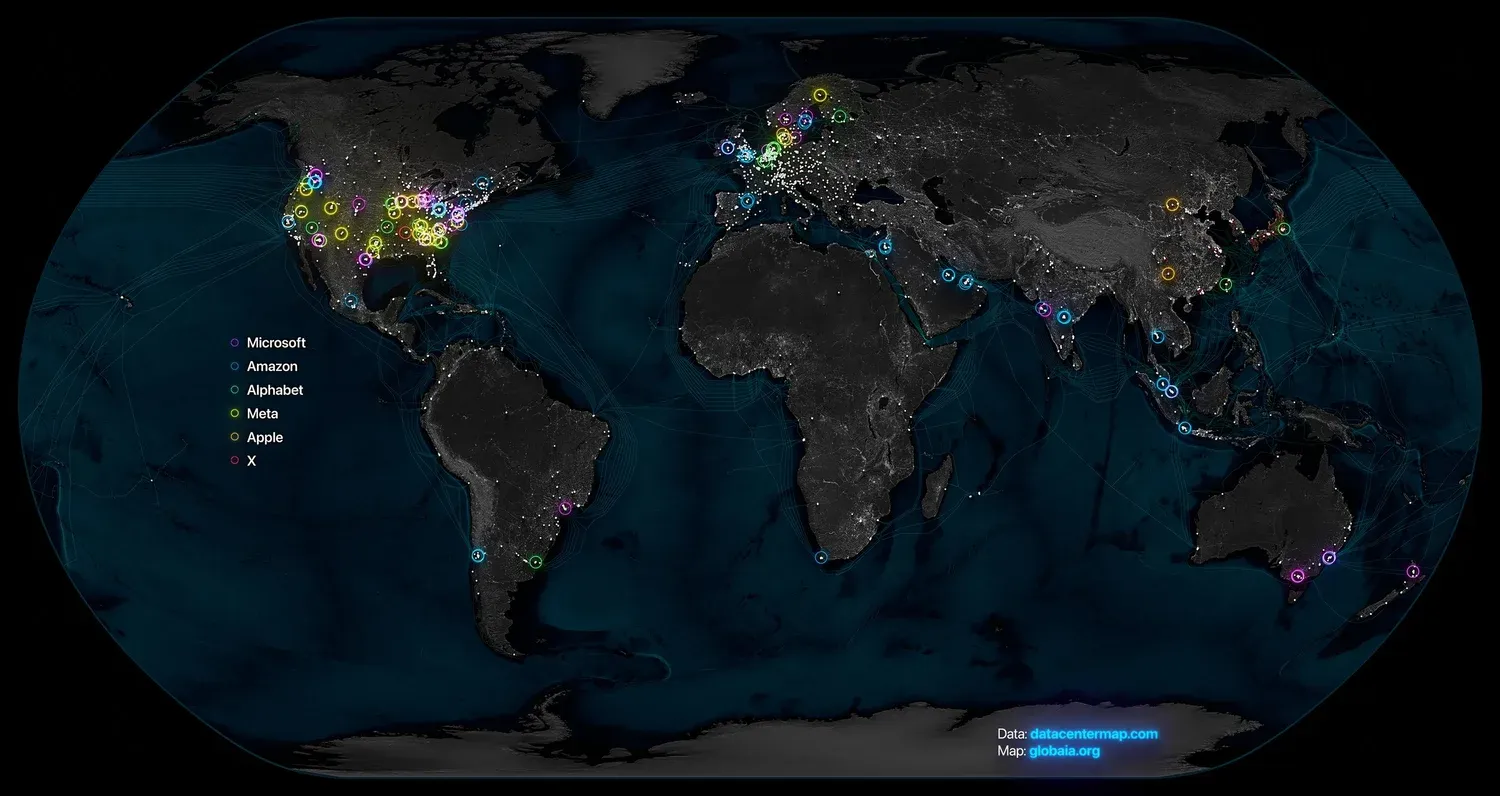
Data centers, a key component of the Xenoosphere. Data provided by DataCenterMap.com
Ref: Term coined by GLOBAÏA, 2024.