
Interactive Dashboard
Planetary Boundaries
Nine processes that regulate the stability and resilience of the Earth system
Last updated: February 13, 2026

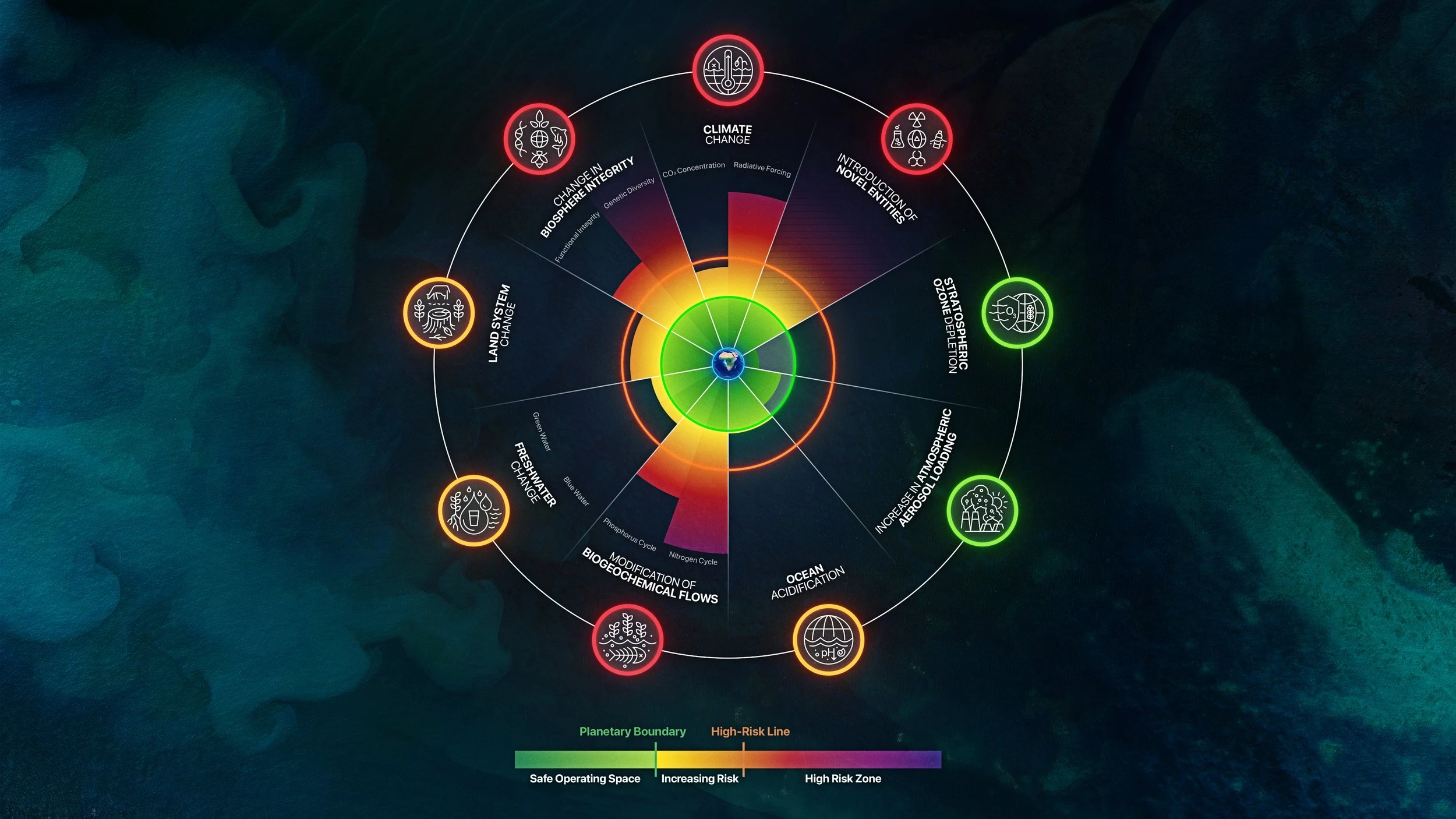
Explore the state of our planet through nine planetary processes. Each visualization is driven by peer-reviewed data and updated research.
Planetary boundaries define nine critical Earth system processes that regulate the stability and resilience of the planet. Proposed by Johan Rockström et al. (2009) and updated by the Stockholm Resilience Centre, they identify a safe operating space for humanity. Crossing these boundaries increases the risk of generating large-scale, abrupt, or irreversible environmental changes. As of the Planetary Health Check 2025, seven of nine boundaries have been transgressed.
Planetary Boundaries Science (PBScience). 2025. Planetary Health Check 2025. Potsdam Institute for Climate Impact Research (PIK), Potsdam, Germany. planetaryhealthcheck.org
Planetary Boundaries Over Time
Watch how Earth's boundaries have evolved from 1950 to 2025
Post-2009 values are based on published planetary boundary assessments (Rockström 2009, Steffen 2015, Richardson 2023, Planetary Health Check 2024, Planetary Health Check 2025). Earlier values are estimated from expert judgment and interpolation from Holocene baseline conditions. All boundary quantifications carry uncertainty and may be revised as science evolves. This visualization is intended to reveal broad temporal patterns, not precise annual estimates.
About the Planetary Boundaries Interactive
Explore the nine critical Earth system processes that define humanity's safe operating space. Proposed by Johan Rockström et al. in 2009 and continuously updated by the Stockholm Resilience Centre, the planetary boundaries framework identifies thresholds beyond which irreversible environmental damage becomes increasingly likely.
This interactive features an animated time machine that lets you travel from 1950 to the present, watching each boundary's status evolve over decades. A donut chart provides an at-a-glance view of the current state of all nine boundaries, color-coded by transgression status. Expand any boundary for a detailed breakdown of its control variables, current measurements, and the distance to the safe threshold.
Data is sourced from the 2025 Planetary Health Check by the Potsdam Institute for Climate Impact Research (PIK), the most comprehensive assessment to date. As of the 2025 Planetary Health Check, seven of nine boundaries have been transgressed: climate change, biosphere integrity, land-system change, biogeochemical flows (nitrogen and phosphorus), freshwater change, novel entities, and ocean acidification. Only stratospheric ozone depletion and atmospheric aerosol loading remain within safe limits.