Navigating Universal Representation
The Minimum Information Representation Algorithm (MIRA) is a principle stating that the visual representation of universal concepts inevitably results in a loss of information and introduction of bias. As the universality of a concept increases, the difficulty of creating an inclusive and comprehensive visual representation increases proportionally, leading to unavoidable exclusions or misrepresentations of certain perspectives or groups.
We acknowledge the inherent challenges in visually representing broad, universal concepts as described by the Minimum Information Representation Algorithm (MIRA). In our work, we strive to include diverse perspectives and are acutely aware of the sensitivities surrounding visual representation. We engage in thoughtful consideration of the potential impacts and repercussions of our visual choices.
However, we recognize that compressing general ideas into specific visual elements has inherent limitations. The MIRA principle underscores that even with the utmost care and intention, some degree of exclusion or bias may be unavoidable when visually depicting universal concepts. We present our visual work with this understanding, inviting dialogue and continual improvement in our quest for more inclusive and representative visual communication.
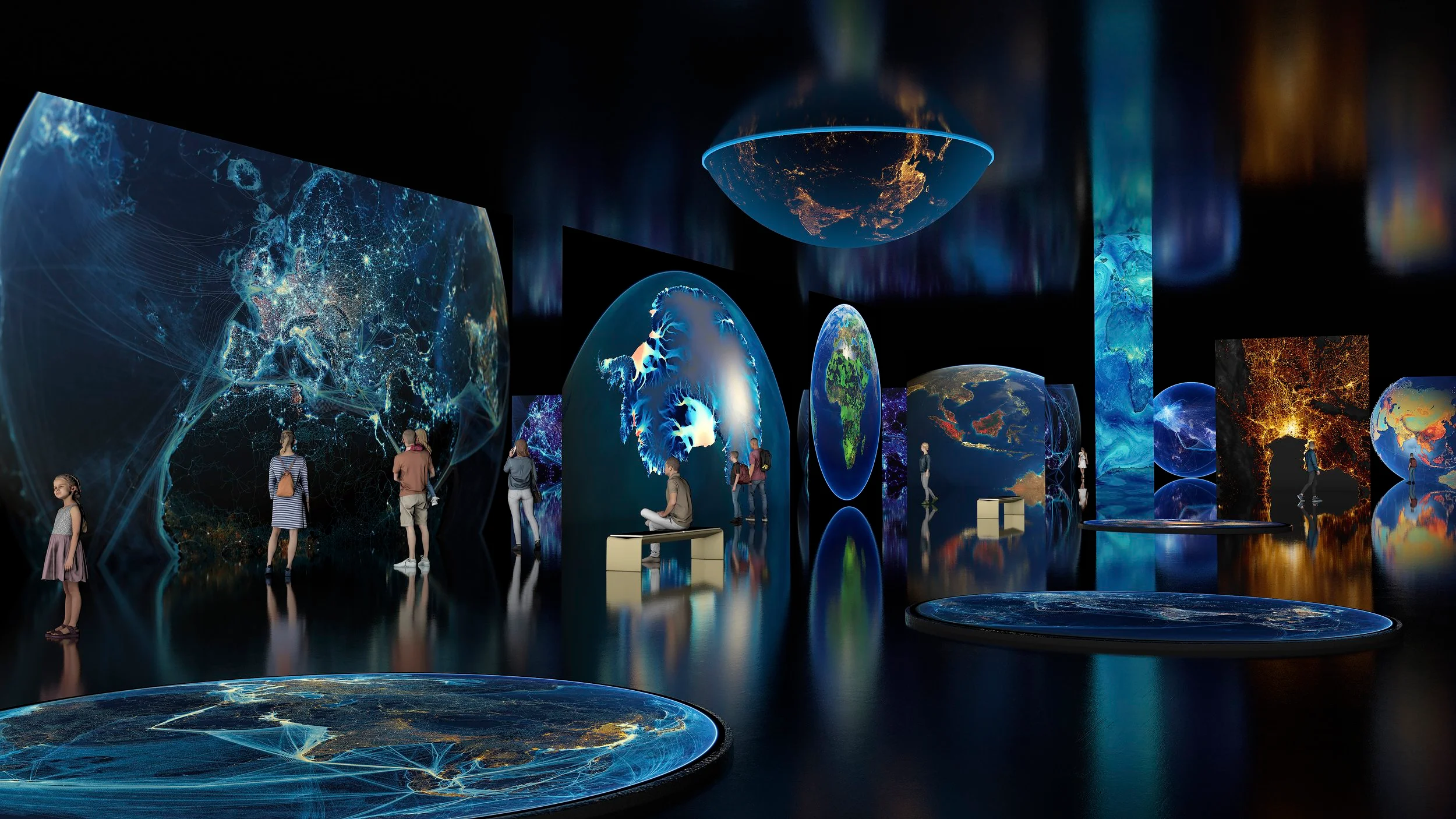
Reimagining Earth
We acknowledge the Eurocentric biases in standard cartographic conventions, such as Greenwich-centered projections and North-up orientations. These norms subtly influence global power perceptions and distort geographical relationships. Our work explores alternative representations, including South-up maps and centering traditionally marginalized regions like New Zealand. By challenging cartographic assumptions, we aim to foster a more inclusive and nuanced understanding of global geography, encouraging viewers to reconsider their perceptions of Earth’s spatial relationships and geopolitical dynamics.
AI-Assisted Writing
In keeping with our commitment to transparency, we note that some texts on this website were drafted with the assistance of generative AI tools. All content has been reviewed, edited, and validated by our team to ensure scientific accuracy, clarity, and alignment with GLOBAÏA’s mission. The ideas, creative direction, and editorial voice are entirely our own.
Privacy & Data
GLOBAÏA is committed to respecting your privacy. This website does not use cookies, does not run third-party ad trackers, and does not build visitor profiles.
Analytics — We use Vercel Web Analytics and Speed Insights to understand aggregate site traffic (page views, countries, device types). These tools are cookieless and collect no personal identifiers. Visitor data is derived from an anonymized hash discarded within 24 hours.
Contact form — When you submit the contact form, your name, email address, and message are sent to our team via Resend. We use this information solely to respond to your inquiry. We do not add you to any mailing list.
Store — Product purchases are processed by Shopify. Shopify may set its own cookies during checkout. We do not access or store your payment information.
Local storage — We use your browser’s local storage for minor interface preferences (e.g., dismissing announcements, remembering access-gate status). No personal data is stored this way.
Your rights — If you have questions or wish to request deletion of any data you have shared with us, contact info@globaia.org.