On December 7, 1972, the crew of Apollo 17 took a photograph that would reshape the human imagination. On April 3, 2026, the crew of Artemis II did it again. These two images — The Blue Marble and Hello, World — bookend half a century of planetary awareness. What follows is a reflection on what they show, what has changed between them, and what they ask of us now. It was first published on GLOBAÏA’s identity page.
The Blue Marble was taken in 1972, the year of the first United Nations Conference on the Human Environment in Stockholm, the birth of the modern environmental movement. Hello, World arrives fifty-three years later, in an age of heightened geopolitical tensions, accelerating ecological crisis (global heating, biodiversity erosion, multiple transgressed planetary boundaries) and rapid, ungoverned technological advances, from artificial intelligence to synthetic biology. An age, in short, of polycrisis and existential stakes.
And yet — consider the sheer improbability of the world these photographs depict. A planet where liquid water has persisted for four billion years1. Oceans vast enough to regulate the climate of entire continents. Tropical rainforests so dense with life that a single hectare can harbour more tree species than all of northern Europe. Coral reefs, mangrove coasts, alpine meadows, abyssal plains — each an experiment in survival, each irreplaceable. Roughly eight million species2 sharing a thin, luminous shell of atmosphere, locked in a web of reciprocity so intricate that the pollination of a flower and the migration of a whale are part of the same planetary metabolism. And within this living world, tens of thousands of human cultures, languages, cosmologies, musical traditions, ways of grieving, ways of celebrating, ways of making sense of the astonishing fact of being here at all. That any of this exists — that matter organised itself into birdsong, into ocean currents, into a species capable of photographing its own home from the void — is not a backdrop to the crisis. It is the reason the crisis matters.
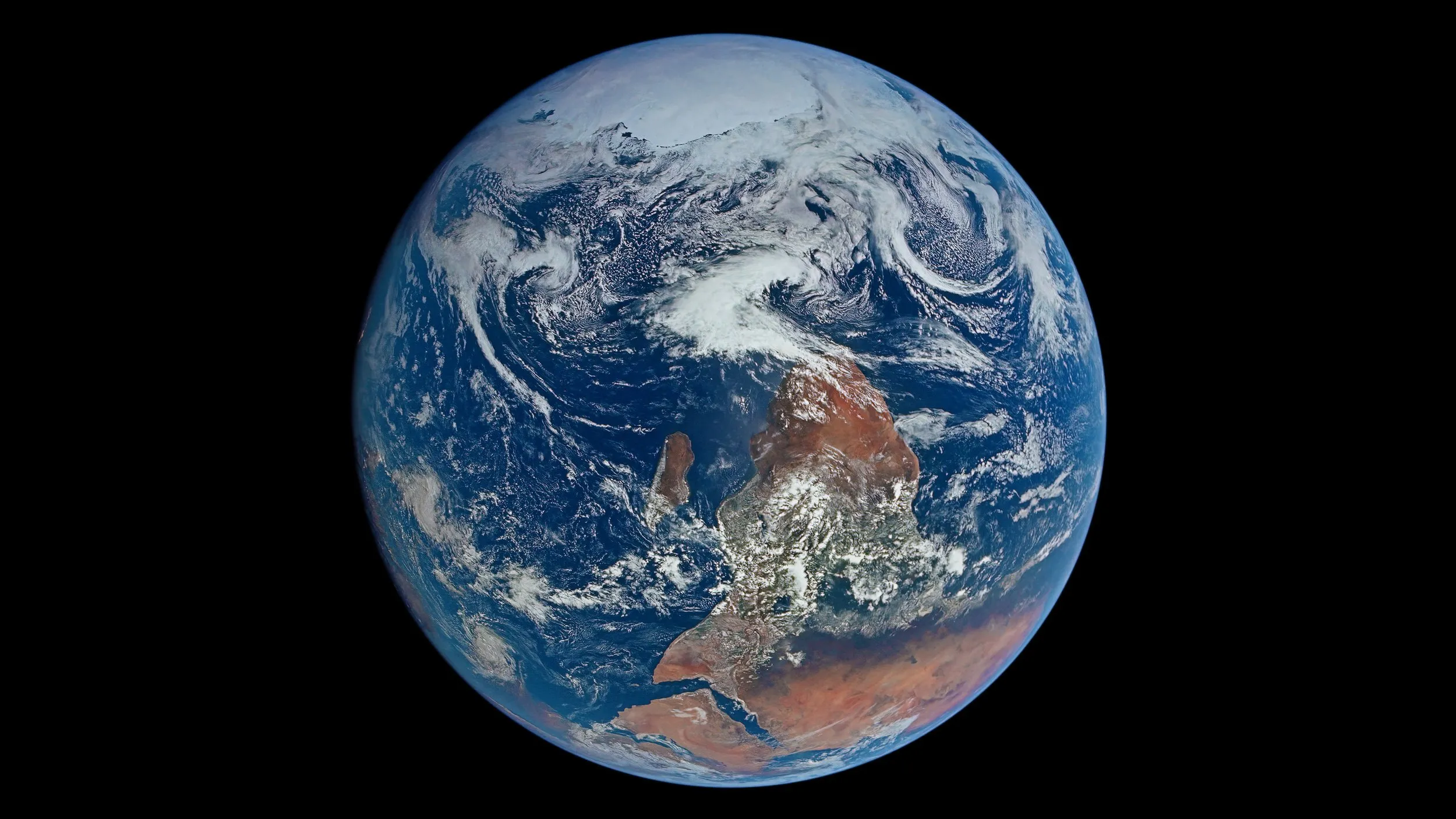
The two photographs are separated by more than time. The Blue Marble shows the day side: oceans, clouds, continents in sunlight, a world of geology and weather with no visible trace of the species that sent the camera. Hello, World shows the night side, and with it something new. City lights are visible across the darkened surface, making human presence legible from space for the first time in an Apollo-lineage photograph. Where the 1972 image depicted a planet, the 2026 image depicts a civilization on a planet, and all the contradictions that follow.
The photograph repays close reading. The Iberian Peninsula is visible beneath the clouds, a landmass that was, for tens of thousands of years, the last refuge of the Neanderthals3, our closest evolutionary cousins, whom Homo sapiens drove to extinction through competition, displacement, and the inability of a sister species to adapt fast enough to a changing world in the late Pleistocene4. Below it, the Sahara, the largest hot desert on Earth, a region where mean annual temperatures are projected to exceed 29°C by the end of this century, rendering it virtually uninhabitable5. The Atlantic occupies much of the frame, its waters carrying the Atlantic Meridional Overturning Circulation, a planetary heat conveyor already showing signs of weakening6, with consequences for every continent. Beyond it, the Amazon basin, another tipping system under mounting thermal stress, part of an emerging cascade linking tropical forests, ocean circulation, and Antarctic ice sheets.
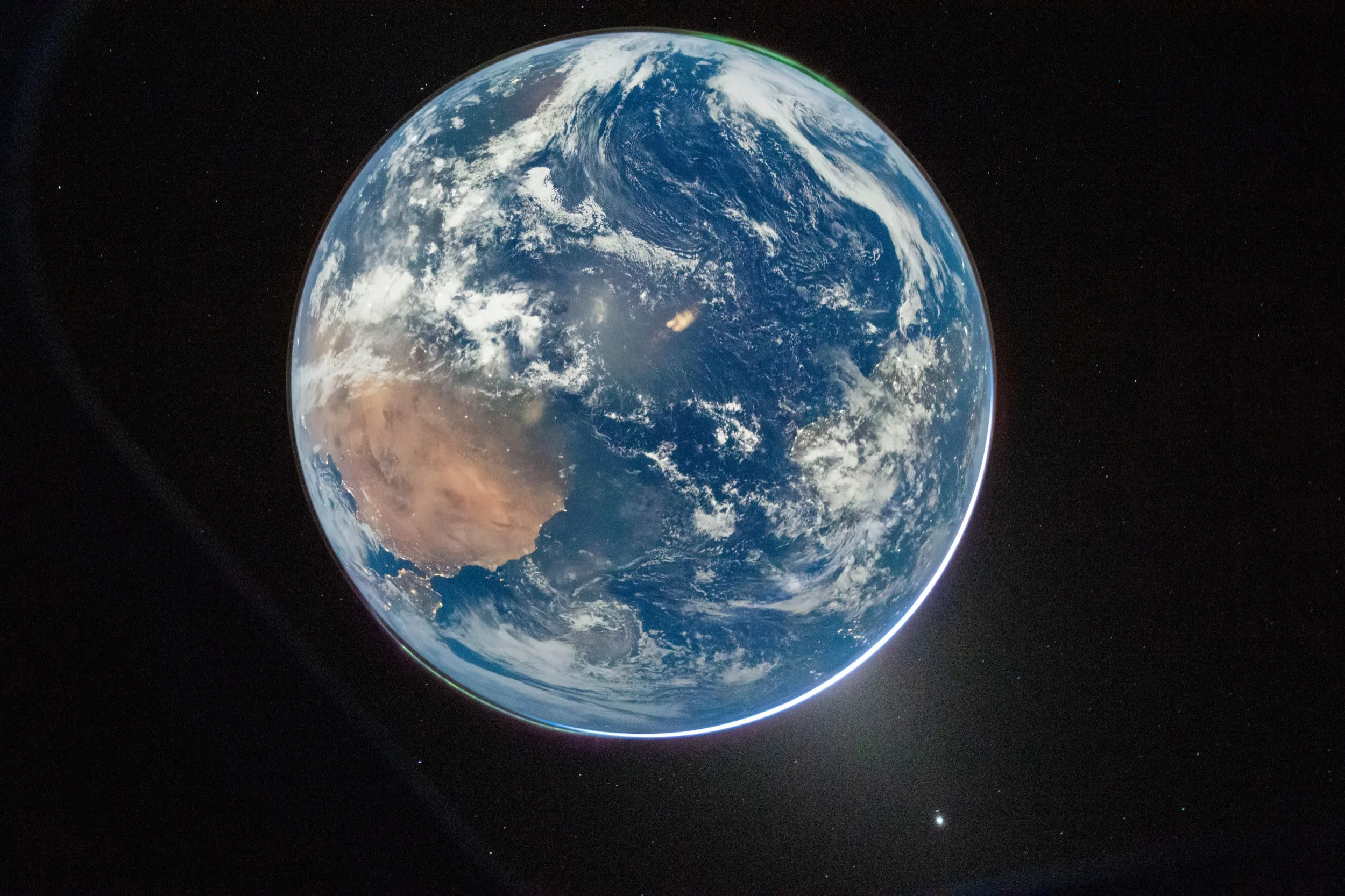
At the planet’s edges, twin aurorae mark the poles, produced when the solar wind interacts with Earth’s magnetosphere and excites atmospheric gases. They are a visible trace of the magnetic shield that deflects high-energy particles from the sun. Surrounding the entire globe, the thin band of airglow traces the outermost limit of the atmosphere, the last shared frontier between habitability and vacuum. On the horizon, the brightening rim of dawn announces a new day. And in the zodiacal light, Venus is visible, a world that may once have harboured oceans but was consumed by a runaway greenhouse effect, its surface now hot enough to melt lead. It sits in the same frame as a planet that is, at present, moving along a similar thermodynamic trajectory.
The image is oriented with the south up, subverting the cartographic convention that places the Northern Hemisphere at the top. In space, as the Apollo 17 crew already knew, there is no up or down. To see the world this way is to begin to see it without the filter of convention.
There is an irony in the fact that seeing our planet whole requires leaving it, escaping the ecosphere aboard machines whose exhaust scars the very atmosphere they photograph. Yet these views, captured from a place hostile to all life, remain the most direct expression of the choice that Einstein, Oppenheimer, Bohr and others laid before humanity in their 1946 book One World or None: either we learn to see Earth as a single, shared home and govern it accordingly, or we don’t. “Civilization is presented with a challenge more serious perhaps than ever before,” Bohr wrote in his foreword, “and the fate of humanity will depend on its ability to unite in averting common dangers.” Einstein, for his part, questioned whether our species could “prove [itself] worthy, at least to some extent, of the self-chosen name of homo sapiens.” Their book closed with five words that remain unanswered: “Time is short. And survival is at stake.” In 1946, the threat was singular — the atom bomb. Eight decades later, the threats have multiplied and compounded into what we now call polycrisis, but the underlying question has not changed: can we learn to coordinate across borders, worldviews, and generations at the speed the emergency demands? There is no second option.
May these images, old and new, continue to unsettle our parochialism and invite us to reconsider our place in the cosmos and our trajectory on planet Earth — and to remember that what we stand to lose is not an abstraction but the most extraordinary thing we know of in the universe: a living world, and the wonder of being alive within it. What remains to be seen is whether we can learn to inhabit it as though what we know had become what we see and feel.
References
- Wilde, S.A., Valley, J.W., Peck, W.H., & Graham, C.M. (2001). Evidence from detrital zircons for the existence of continental crust and oceans on the Earth 4.4 Gyr ago. Nature, 409, 175-178. DOI: 10.1038/35051550
- Mora, C., Tittensor, D.P., Adl, S., Simpson, A.G.B., & Worm, B. (2011). How Many Species Are There on Earth and in the Ocean? PLOS Biology, 9(8), e1001127. DOI: 10.1371/journal.pbio.1001127
- Lenton, T.M., Xu, C., Abrams, J.F., et al. (2023). Quantifying the human cost of global warming. Nature Sustainability, 6, 1237-1247. DOI: 10.1038/s41893-023-01132-6
- Caesar, L., McCarthy, G.D., Thornalley, D.J.R., Cahill, N., & Rahmstorf, S. (2021). Current Atlantic Meridional Overturning Circulation weakest in last millennium. Nature Geoscience, 14, 118-120. DOI: 10.1038/s41561-021-00699-z
- Ditlevsen, P. & Ditlevsen, S. (2023). Warning of a forthcoming collapse of the Atlantic meridional overturning circulation. Nature Communications, 14, 4254. DOI: 10.1038/s41467-023-39810-w
- Finlayson, C., Pacheco, F.G., Rodriguez-Vidal, J., et al. (2006). Late survival of Neanderthals at the southernmost extreme of Europe. Nature, 443, 850-853. DOI: 10.1038/nature05195
- Higham, T., Douka, K., Wood, R., et al. (2014). The timing and spatiotemporal patterning of Neanderthal disappearance. Nature, 512, 306-309. DOI: 10.1038/nature13621
- Banks, W.E., d’Errico, F., Peterson, A.T., et al. (2008). Neanderthal extinction by competitive exclusion. PLOS ONE, 3(12), e3972. DOI: 10.1371/journal.pone.0003972
- Federation of American Scientists. (1946). One World or None: A Report to the Public on the Full Meaning of the Atomic Bomb. New York: McGraw-Hill. Digital archive
Footnotes
-
The oldest evidence for liquid water on Earth comes from zircon crystals in the Jack Hills of Western Australia, dated to 4.4 billion years ago. See Wilde, S.A. et al. (2001). ↩
-
The estimate of approximately 8.7 million eukaryotic species comes from Mora, C. et al. (2011), who used higher taxonomic patterns to predict total species richness. Of these, roughly 86% of land species and 91% of marine species remain undescribed. ↩
-
The Iberian Peninsula harboured the last known Neanderthal populations, surviving until approximately 40,000-37,000 years ago. Finlayson, C. et al. (2006) documented late Neanderthal occupation at Gorham’s Cave, Gibraltar. ↩
-
The causes of Neanderthal extinction remain debated, but competitive exclusion by Homo sapiens — through advantages in social networks, technology, and dietary flexibility — is the leading hypothesis. See Higham, T. et al. (2014) for revised chronology and Banks, W.E. et al. (2008) for ecological modelling of the replacement. ↩
-
Lenton, T.M. et al. (2023) estimate that by 2070, areas currently home to over a billion people could be exposed to mean annual temperatures exceeding 29°C, well outside the human climate niche. ↩
-
Evidence from the RAPID-AMOC array and proxy reconstructions suggests the AMOC is at its weakest in at least a millennium. See Caesar, L. et al. (2021) and Ditlevsen, P. & Ditlevsen, S. (2023) for statistical early-warning signals. ↩