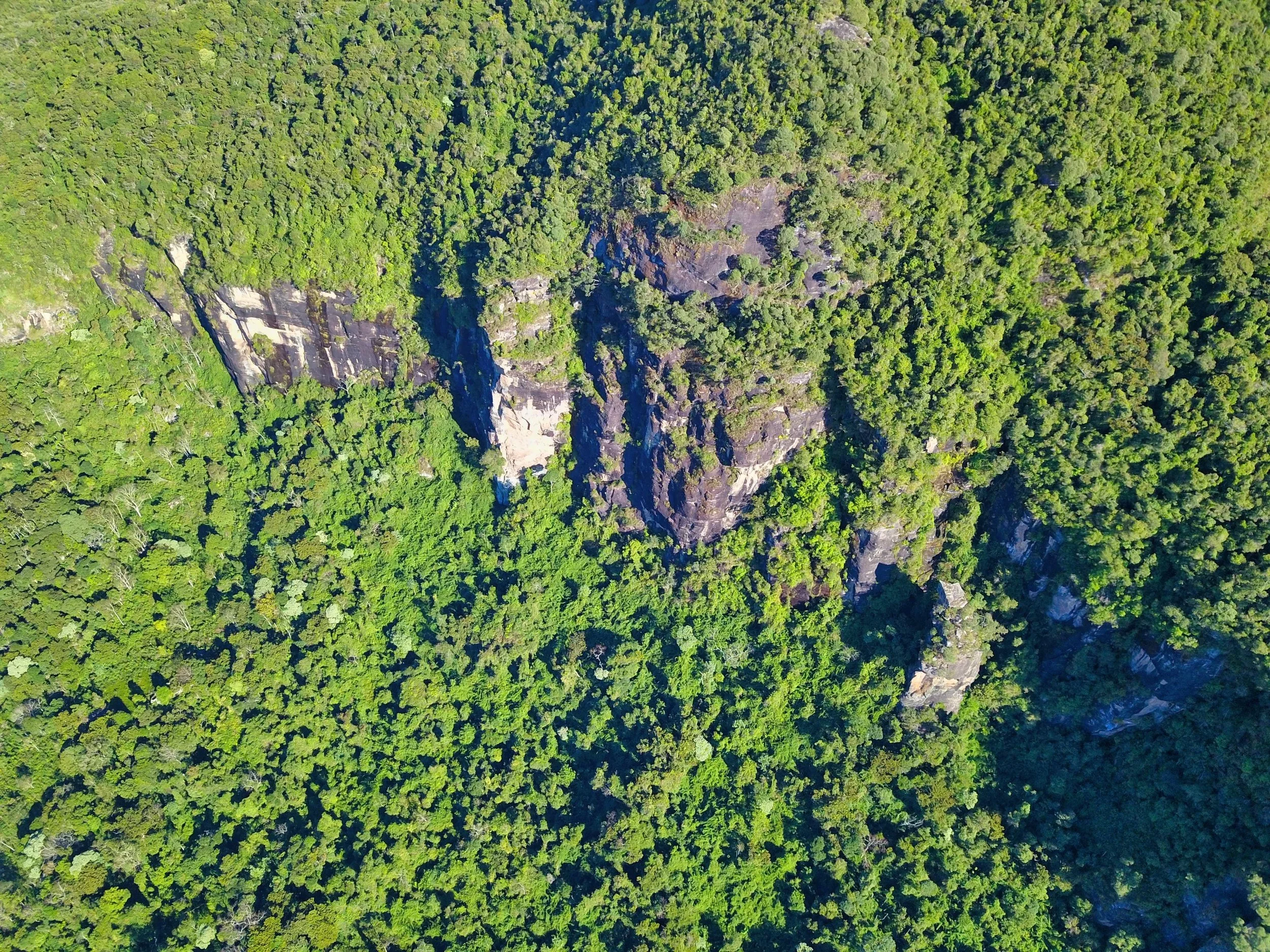
Aerial view of the Atlantic Forest canopy in the Serra da Mantiqueira, Vale do Matutu, Brazil — ancient trees and exposed rock faces in one of the most biodiverse regions on Earth

GLOBAÏA at the local scale

locaïa

Where the planetary meets the living ground

The planetary is composed of the local.
The local is shaped by the planetary.

GLOBAÏA makes Earth's systems visible at the scale of the whole — its deep history, its boundaries, its tipping points, its living fabric. But planetary understanding, alone, is abstraction. It needs roots. It needs ground truth. It needs the smell of soil after rain, the memory of a river's seasonal rhythm, the knowledge held by a community that has tended its land for generations.

Locaïa is GLOBAÏA at the scale of the living ground — the scale of watersheds, forests, communities, and the relationships between people and place. Each Locaïa initiative translates planetary awareness into territorial practice: education rooted in local ecosystems, stewardship shaped by both scientific data and ancestral knowledge, resilience built from the ground up.

For more than fifty years, one intuition has circulated through environmental thought: think globally, act locally. But it was always half a sentence. GLOBAÏA has spent two decades building the first half — making the planetary visible, intelligible, urgent. Locaïa is the second half made concrete: not a slogan, but a practice. Not an injunction to act, but a structure through which planetary knowledge and local stewardship actually meet, challenge each other, and co-evolve.

Two Scales in Conversation

Earth Systems

Living Ground

From the planetary to the local

Earth system science, data, and visualizations flow to communities — giving local actors the planetary context to understand why their watershed matters, what thresholds are being crossed, and how their territory fits into the living whole.

From the local to the planetary

Ground truth, ecological memory, and the knowledge held by people who have tended their land for generations flow back into the planetary picture — correcting, enriching, and grounding what satellite data and global models alone cannot see.

Neither scale is complete without the other.
Each continually informs and renews the other.

Three Lenses, Three Practices

Three lenses thread through GLOBAÏA's work: awareness, emergency, stewardship. Locaïa carries each one into the territory beneath our feet — translating planetary intelligence into the education, civic action, and ecological practice that communities can wield at the scale where change actually begins.

The theory of change is simple and radical: planetary transformation is an emergent property of local transformation. When enough communities see clearly, act decisively, and steward wisely, the cumulative effect crosses a social tipping point — and what seemed impossible becomes inevitable.

Planetary Awareness

Place as Teacher

Earth as an interconnected whole — its deep history, its boundaries, its fragile equilibria — gains its full meaning only when it reaches the people who live on the ground it describes. Locaïa carries that understanding into classrooms, community halls, and the daily experience of inhabited places: school curricula shaped by local watersheds and planetary science, pedagogical tools that connect children to the soil beneath their feet and the carbon cycle above their heads, citizen science observatories, an ecological literacy that makes the abstract tangible. A child who has mapped the species in her river will understand biodiversity loss in a way no graph can teach.

Planetary Emergency

Civic Mobilization

An emergency mapped is not an emergency answered. The science of tipping points crossed, boundaries breached, and cascades accelerating only becomes change when it walks into council chambers and citizen assemblies. Locaïa turns that science into civic muscle — informed lobbying grounded in planetary data, local governance pressure that pulls Earth system science into municipal decisions, community organising around social tipping points where a critical mass shifts the trajectory of a town, a region, a policy. Not protest alone, but the persistent, strategic work of democratic pressure applied where it has the shortest feedback loop: the local.

Planetary Stewardship

Hands in the Earth

Stewardship at planetary scale is enacted, in the end, on a thousand hectares at once. Locaïa works at that scale: ecological restoration that reconnects fragmented habitats through biological corridors, community-led efforts to de-transgress planetary boundaries — reducing nitrogen loads in local watersheds, rebuilding soil carbon, protecting biosphere integrity one hectare at a time. Resilience here is not the abstract goal of a policy document but the daily practice of communities who understand what the science demands and choose to answer it with their hands in the earth.

Every social tipping point began in a place.
Every planetary boundary is crossed — or defended — in a territory.

Principles

  1. I

    Integrity of the Living Earth

    The biosphere is the enduring foundation upon which all human endeavour depends. The health of human societies and the health of Earth's living systems are one and the same concern.

  2. II

    Scientific Rigour and Epistemic Honesty

    Every claim, visualisation, and tool is grounded in peer-reviewed science. Where knowledge is uncertain, uncertainty is stated. Where science evolves, we evolve with it.

  3. III

    Plurality of Knowledge

    The ecological knowledge, cosmologies, and stewardship practices of Indigenous peoples and diverse cultural traditions are valid and essential ways of understanding Earth — always through partnership and dialogue, never through extraction.

  4. IV

    Intergenerational Continuity

    This work serves not only those alive today but those — human and beyond human — who will inherit the consequences of present choices. Future generations possess a claim on the present.

  5. V

    Reciprocity of Scales

    Global understanding without local engagement is abstraction. Local action without planetary awareness is incomplete. Locaïa sustains the continuous exchange between these scales: planetary science informs community resilience; local and traditional wisdom grounds and enriches planetary understanding.

  6. VI

    Open Access and Common Heritage

    Knowledge of the Earth is part of the common heritage of humanity and is held in trust for all. Core works — visualisations, educational resources, and public tools — are made freely available.

Inaugural Initiative

Matutu Foundation

Serra da Mantiqueira, Minas Gerais, Brazil

Founded in 1995 in the Vale do Matutu, the Matutu Foundation is an independent organisation whose work embodies everything Locaïa stands for. GLOBAÏA proudly supports it as an exemplary project — a living demonstration that planetary stewardship begins in the relationship between a community and its land.

For three decades, the Foundation has worked at the intersection of conservation, education, and community resilience in one of Brazil's most biodiverse and culturally significant regions. Its approach is rooted in the conviction that enduring stewardship emerges not from imported models, but from the accumulated wisdom of people who have lived with — and within — their ecosystems for generations.

Conservation

Protecting water resources and remaining Atlantic Forest — the Reserva Matutu and the Ribeirão da Água Preta micro-basin — through participatory management and integrated fire stewardship.

Education

Environmental education rooted in place — connecting scientific understanding with local ecological knowledge, building the capacity of communities to understand and steward the systems they inhabit.

Resilience

Strengthening community capacity through participatory governance, integrated fire management, and the intergenerational transmission of knowledge — including the Brigada Matutu, a volunteer wildfire brigade active for over three decades.

More than proposing ready-made models, the Matutu Foundation experiments with dynamic solutions — and shares results as a way to face environmental transformations.

Led by Manno Andrade França, the Matutu Foundation embodies the conviction that the knowledge held by communities who have sustained their landscapes over generations is not an object of study — it is a living knowledge system essential to the stewardship of the whole.

Every Place Is a Planet

Matutu is the first. It will not be the last. Every bioregion, every watershed, every community that sustains a living relationship with its land carries knowledge the planet needs. Locaïa exists to find these places, to listen, to connect them to the planetary whole — and to let the planetary whole be transformed by what they know.

If you are a community, an organisation, or a knowledge holder working at the intersection of local stewardship and planetary awareness — we want to hear from you.

Get in touch